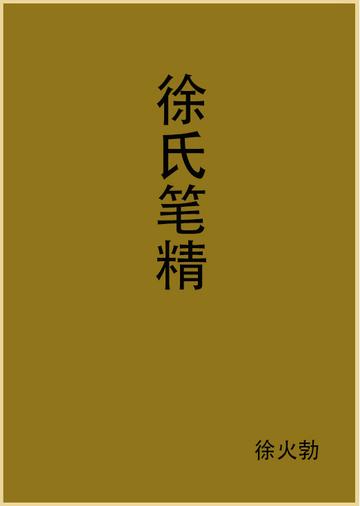
Notes from the Ming Dynasty. 8 Volumes. Written by Xu Huobo. Today there is a printed edition from the Chongzhen period of the Ming Dynasty, preceded by prefaces by Shao Jiechun and Huang Juzhong. The whole book is divided into 38 categories. There is also a copy of Sikuquanshu, titled "Bi Jing", with no order at the beginning and the whole book is divided into five categories. The arrangement of the two versions is different, and the "Sikuquanshu" is probably based on the manuscript. The "Bilinlangguan Series" and "Taoyuan Series" were both reproduced from the Chongzhen version. Huang Juzhong's preface explains the content and characteristics of the notes: "You must recognize any strange information and search for secret notes. When you understand the meaning, or have a unique picture of your mind, you often write down the notes in your hand, and they will be collected and accumulated over time." "It compiles scriptures into history, and it is only detailed in poetry. The poems have come to my mind since the 300th chapter, but they are not followed by titles." In the section about poetry, the Chongzhen version is divided into seven categories: "original poetry", "poem exegesis", "poetry edition", "poem Bianstone", "poetry criticism", "poetry talk" and "poetry". Among them, the discussion about Ming poetry, such as the comments on the poems of Wang Xing, Lan Zhi, Shen Yu, He Qiyu, Tang Yin, Shen Zhou, etc., Is very helpful to the study of Ming Dynasty poetry. In addition, this note dares to express its own opinions. The "General Catalog of Sikuquanshu" accuses it of "preferring to be a heterodox theory, and to support Confucianism and incorporate Mohism." The "Xing Qi Ting" in the Gen hexagram refers to the "Huang Ting" of Taoism, and the "Wandering Soul as Bian" in "Xici" is used as Shi's "Four Lives and Six Paths", etc. Although not entirely appropriate, they all show the relatively free style of study in the late Ming Dynasty.
Reader comments
This book is very rich in content, especially the comments on poetry that inspired me very much. The author is knowledgeable and original in his analysis. Just like I work hard to make money for my dreams, he is also creating with his heart. I particularly like his discussion of Ming poetry, which is very helpful for studying Ming poetry. However, there are some views in the book that I don't agree with, but this is where the fun of reading lies, as it allows me to think more. Overall, this is a good book worth reading.
This book is very rich in content, especially the comments on poetry that inspired me very much. The author is knowledgeable and original in his analysis. Just like I work hard to make money for my dreams, he is also creating with his heart. I particularly like his discussion of Ming poetry, which is very helpful for studying Ming poetry. However, there are some views in the book that I don't agree with, but this is where the fun of reading lies, as it allows me to think more. Overall, this is a good book worth reading.