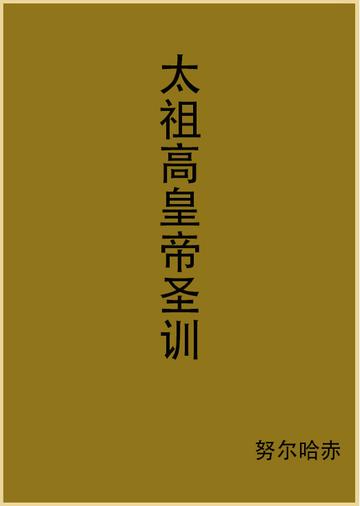
The full title is "The Holy Instructions of the Emperor Taizu of the Qing Dynasty, Chengtian Guangyun's Holy Virtue and Divine Deeds, and the Initiation of the Rules of Benevolence, Filial Piety, Rui Wuduanyi, Qin'an, Hongda, Dingye, and Gao". 4 Volumes. It was compiled by imperial decree in the twenty-fifth year of Kangxi's reign (1686). This is a collection of various remarks by Nurhaci on governing the country and ensuring peace of the country, and then arranged in chronological order under the categories. There are 92 items in the book, which are divided into 26 categories, including respecting heaven, holy filial piety, divine martial arts, wisdom and strategy, benevolence, discussing governance, training kings, training ministers, governing the country, appointing ministers, employing people, seeking outspokenness, promoting culture and governance, advocating education, diligence and economy, frugality, caution in punishment, compassion for subordinates, understanding people's hearts, understanding people's feelings, clarifying laws, appreciating the past, appreciating merit, showing trustworthiness, admonishing leisure and pleasure, being careful about hobbies, etc. It is a valuable historical material for studying Nurhaci's life and thoughts. In the fourth year of Qianlong's reign (1739), Emperor Qianlong hid it in the inner palace and could not see it among the ministers. It could not serve as an instruction, so he ordered the inner palace to engrave and print it so that it could be circulated. By the end of the Qing Dynasty, a variety of reprints appeared.
Reader comments
This book is very interesting! It records various remarks of Nurhachi. I feel like he is like an old man full of wisdom, imparting life experience to me. I especially like his views on using people to govern the country. It is really insightful. And I think these ideas are equally applicable in today's life and work. However, some classical Chinese passages in the book are still a bit difficult to understand and require me to ponder them slowly. Overall, this is a book worth reading!
This book is very interesting! It records various remarks of Nurhachi. I feel like he is like an old man full of wisdom, imparting life experience to me. I especially like his views on using people to govern the country. It is really insightful. And I think these ideas are equally applicable in today's life and work. However, some classical Chinese passages in the book are still a bit difficult to understand and require me to ponder them slowly. Overall, this is a book worth reading!