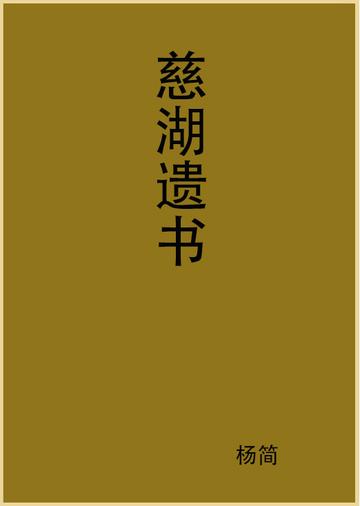
A collection of poems and essays. Written by Yang Jian of the Song Dynasty (known as Mr. Cihu in the world). The current edition contains eighteen volumes. The first five volumes contain more than 90 chapters such as prefaces and postscripts; Volume six contains six poems and more than one hundred poems; Volumes seven to one six are "Family Records"; Volume 17 is "Ji Xian Xun"; Volume 18 contains lines of conduct, etc. "Sequel" has two volumes: Volume 1 contains more than 70 essays; Volume 2 is "Explanation of Confucius' Leisurely Life". According to the original biography of "History of the Song Dynasty", Jian wrote many collections such as "Jia Manu" and "Jia Ji". Chen Zhensun's "Explanation of Zhizhai Shulu" also contains one volume of "Lectures on Confucius' Leisurely Residence", three volumes of "Cihu Posthumous Notes", and 20 volumes of "Cihu A Manuscript". Therefore, the current version is neither the original "Cihu Posthumous Book" nor the original "Cihu Manuscript"; it was compiled by Zhou Guang in the Ming Dynasty, who synthesized the lost books and reorganized them. There are engravings and Ming manuscripts from the fourth year of Jiajing reign of Ming Dynasty (1525) handed down to the world. Ding Bing of the Qing Dynasty wrote in his "Postscript to Cihu's Posthumous Notes": "The notes contain dozens of articles, and their contents are also different." There is also a version of Sikuquanshu, the content of which is the same as the Ming Dynasty edition, but the arrangement is slightly different, that is, Volume 18 is the essays in the first volume of the "Sequel"; while the first volume of the "Sequel" is "Explanation of Confucius's Leisurely Residence"; the last volume is the behavior. There is also Zhang Shouyong's version of "Siming Series", which is also recorded in the engraving version. It is appended with one volume of "Supplement" compiled by Feng Keyong of the Qing Dynasty, which contains more than ten poems and essays; one volume of Zhang's "Appendix" contains more than ten prefaces and postscripts from various schools, three volumes of "Chronology", and one volume of "Zhushu Kao"; the content is more complete than the "Sikuquanshu" version.
Reader comments
This book is very interesting! Most of Yang Jian's articles expounded his teacher's teachings, but some of the views he put forward in his treatment were quite insightful. Although some of his ideas are rather idealistic, such as restoring the well-field system, it can also be seen that he has his own thoughts on current affairs. Moreover, when he was an official, he was able to handle things according to the actual situation, which was quite pragmatic. Overall, this book gave me a deeper understanding of Yang Jian and allowed me to see his thoughts and personality.
This book is very interesting! Most of Yang Jian's articles expounded his teacher's teachings, but some of the views he put forward in his treatment were quite insightful. Although some of his ideas are rather idealistic, such as restoring the well-field system, it can also be seen that he has his own thoughts on current affairs. Moreover, when he was an official, he was able to handle things according to the actual situation, which was quite pragmatic. Overall, this book gave me a deeper understanding of Yang Jian and allowed me to see his thoughts and personality.