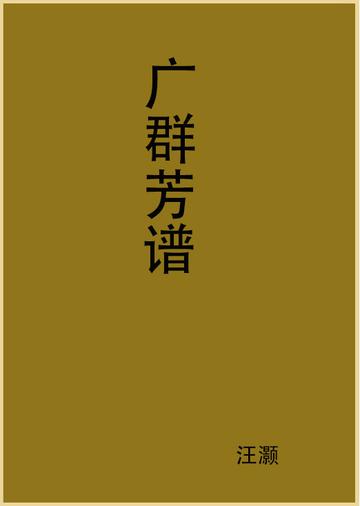
The original name is "Yu Ding Pei Wenzhai Guang Qun Fang Pu". Class book. Qing Wang Hao et al. One hundred volumes. There are six volumes of Tianshi Pu, four volumes of Grain Pu, two volumes of Mulberry Pu, five volumes of Vegetable Pu, four volumes of Tea, thirty-two volumes of Flowers, fourteen volumes of Fruit, fourteen volumes of Wood, five volumes of Bamboo, six volumes of Hui, and eight volumes of Medicine. The preface of the Holy Ancestor of the Qing Dynasty states that because he saw that King Xiang Jin of the Ming Dynasty "collected and compiled all the strong points, and the meanings are acceptable", he ordered the court officials to "collect the collection, delete the redundant parts, and fill in the missing parts. The Six Classics of Shangyuan, based on the history of Zi, the words of the officials and Yecheng, the songs of the talented men, and the narrations of Tian Fu, are all written in the chapter." Although the "General Catalog of Sikuquanshu" is recorded in the Zibu Category, it is actually a book with the nature of a plant encyclopedia. The style is based on Wang Pu, with defining words first, followed by "Huikao" and allusions, followed by "Collections", followed by poems (full text or prose), and then "Bie Lu", describing the method of preparation and use. The original text of Wang Pu comes first, and the supplementary text comes last. It is rich in information and has great reference value for literary research. The book was published in the forty-seventh year of Kangxi (1708) and submitted to the public. There are the original editions of Wuyingdian, the Sikuquanshu, and the typesetting edition of the Basic Chinese Studies Series of the Commercial Press in the 24th year of the Republic of China (1935). Recently, there was a photocopy of the "Basic Series of Chinese Studies" in a Shanghai bookstore in 1985. The original genealogy of Wang Xiangjin is available in 28 volumes published by Erru Pavilion in Ming Dynasty and in 29 volumes published in Shacun Caotang published in Ming Dynasty.
Reader comments
The content is rich and diverse, especially the introduction to various plants, which opened my eyes. The author's writing style is concise and clear, and his writing style is smooth and comfortable to read. I especially like the "Collection of Algae" section in the book, which collects a lot of poems and poems with very artistic conception. This book is not only a plant encyclopedia, but also a wonderful reading experience for me.


The content is rich and diverse, especially the introduction to various plants, which opened my eyes. The author's writing style is concise and clear, and his writing style is smooth and comfortable to read. I especially like the "Collection of Algae" section in the book, which collects a lot of poems and poems with very artistic conception. This book is not only a plant encyclopedia, but also a wonderful reading experience for me.