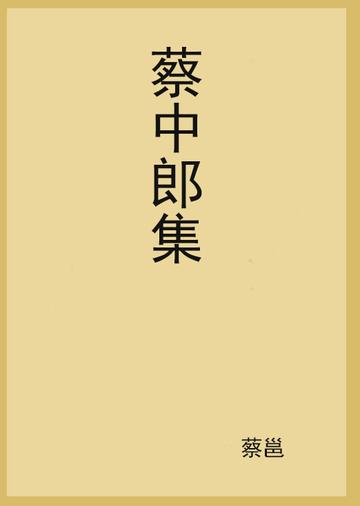
Collection of poetry. Written by Cai Yong (132-192) of the Eastern Han Dynasty. The original collection has been lost. The current versions are all compiled by later generations. 6 Volumes, written by Cai Yong of Han Dynasty. This collection can be found in the Sikuquanshu. "Sui Zhi" contains 12 volumes of the collection, and notes that Liang has 20 volumes. It seems that the collection was not complete by the Sui Dynasty. "Old Tang Chronicles" still contains 20 volumes. When an official document was lost but the folk biography was not lost, it was revived. "Song Zhi" contains only 10 volumes, so it has been scattered and lost, so it is not the original version. Bojie, whose name is Yong, was born in Chenliuyu (now Qixian County, Henan Province). Young and erudite, he likes poetry, mathematics, and is proficient in music and rhythm. During the reign of Emperor Ling, he was called to be a doctor, and his books were edited in Dongguan, and he was moved to Yilang. Later, he was exiled to Shuofang because he wrote a letter discussing the government affairs. When he was pardoned, he lived on the run for more than ten years. Dong Zhuo had exclusive power and was appointed as the censor. Zhuo was executed, Wang Yun came to power, and Yong was imprisoned and died. This compilation is compiled by Zhang Pu of the Ming Dynasty, and contains one hundred and thirty-one poems including fuss, essays, tables, books, treatises, discussions, dialogues, essays, continuos, odes, praises, maxims, inscriptions, tablets, spiritual tables, eulogies, sacred promises, laments, congratulations, condolences, and poems. This biography follows. Fu may be played on the piano, chess, pen and fan, or written about marriage and love. "Shu Xing Fu" is the most famous, describing what Chen Liu saw on his way to Luoyang, describing the past and the present, criticizing the decadent politics of the late Han Dynasty, and showing concern for the suffering of the people, with extremely sad words. His writing is clear and elegant, mostly using parallel sentences. The "Chen Taiqiu Stele" and the "Guo Youdao Lin Zong Stele" commemorate famous figures in the late Han Dynasty. They are simple and natural and are the authentic expressions of the tombs. The poem "Drinking Horses in the Great Wall Grottoes" has the highest achievement, but the "Selected Works" is titled Yuefu Ancient Ci, and later generations often hold this view. The poem "Kingfisher" is also an excellent five-character work in the late Han Dynasty. "Zhuan Shi" and "Li Shi" discuss calligraphy, and they are like countless treasures, with sonorous tones. "Shiji" inherits the tradition of rhetoric, expressing worry and confusion, and expressing anger directly. There is a printed version of the letter written in 1879, the fifth year of the reign of Emperor Guangxu of the Qing Dynasty.
Reader comments
This "Collection of Cai Zhonglang" contains many poems by Cai Yong. He has high literary attainments, especially his "Shu Xing Fu", which uses sincere words and makes people feel his concern for the sufferings of the people. His "Drinking Horse in the Great Wall Grottoes" is also very good, allowing people to feel the charm of five-character poetry. These works not only showcase his talent, but also allow us to better understand that era. However, there are many different versions of his collections in history, and each version has some differences, which also makes people think more about his works.
This "Collection of Cai Zhonglang" contains many poems by Cai Yong. He has high literary attainments, especially his "Shu Xing Fu", which uses sincere words and makes people feel his concern for the sufferings of the people. His "Drinking Horse in the Great Wall Grottoes" is also very good, allowing people to feel the charm of five-character poetry. These works not only showcase his talent, but also allow us to better understand that era. However, there are many different versions of his collections in history, and each version has some differences, which also makes people think more about his works.