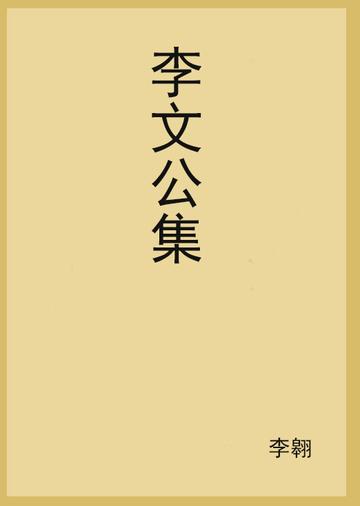
Eighteen volumes. Written by Li Ao (772-841) of Tang Dynasty. Li Ao's posthumous title was Wen, and later generations were called "Li Wengong". For details of his life, see "The Analects of Confucius" (Dictionary). There are many editions of this book. According to "New Book of Tang·Yiwenzhi" and "Zhizhai Shulu Jieti", both have ten volumes, while Chen Zhensun's "Shulu Jieti" states that there is "Shu version, divided into twenty volumes." However, both are scattered and lost. This collection consists of eighteen volumes. Everything recorded is text, no poetry. There is a preface by He Yizhi, the chief envoy of Guangxi. Volume 1 is a poem, Volume 215 is a text, Volume 618 is a book, Volume 9 is a summary, Volume 10 is a memorial, Volume 11 is a record of deeds, Volume 12 is a stele biography, Volume 13 is a stele narrative, Volume 1415 is an epitaph, Volume 16 is a memorial text, and Volume 1718 is a miscellaneous work. Although Li Ao's talents and learning were inferior to those of Han Yu, he could not cast hundreds of scholars as his own, but he still had a solid foundation. Most of them are kind-hearted and peaceful, with a moderate attitude of proclivity. They are not as reserved as Li Guan, Liu Shang and others. Su Shunqin rated it as "his lyrics are not as good as Han's, but his reasoning is better than Liu's." In addition, in the early Guangxu period, Feng Zhangguang engraved the "Collection of Three Tang Dynasties" series of books, which is "Li Wengong Collection" in eighteen volumes, with one supplement and one appendix. The first part is an abstract, followed by a preface by He Yi and a preface by Huang Jingkui. The appendix includes a historical account and an article by Ouyang Xiu reading Li Wen. At the end of the volume, there are postscripts by Xing Rang, Zhao Yan, Mao Jin, Quan Zuwang, Wu Dating, Feng Zhangguang and others. There are also copies of "Sikuquanshu", "Sibu Series" and "Collected Works of Three Tang Dynasties". Both are in eighteen volumes.
Reader comments
This "Collection of Li Wengong" contains many works of Li Ao, which can give us a certain understanding of his literary style. Li Ao's articles are gentle and peaceful, and have their own foundation. He has a high self-esteem, but he does have some strength. The people who compiled it were very careful and rigorous. However, I don't really like the arrogant title of "Records of the Imperial Ancestor". Overall, this book is still worth reading.
This "Collection of Li Wengong" contains many works of Li Ao, which can give us a certain understanding of his literary style. Li Ao's articles are gentle and peaceful, and have their own foundation. He has a high self-esteem, but he does have some strength. The people who compiled it were very careful and rigorous. However, I don't really like the arrogant title of "Records of the Imperial Ancestor". Overall, this book is still worth reading.