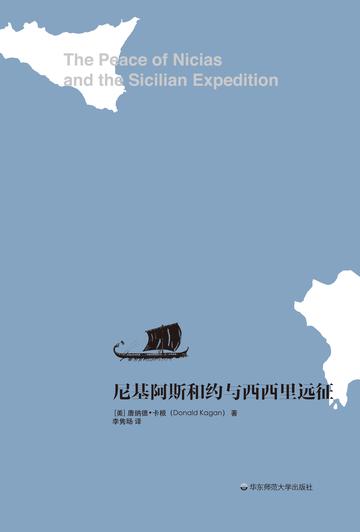
Donald Kagan provides new insights into the characters of Agis II and Prepus, Nicias and Alcibiades. These characters come to life in his writing like never before. ——"Classical Outlook" explains a period in Greek history that is very difficult to study. It is highly readable, consistent in discussion, and easy to understand. It is full of witty and polemical commentaries on Thucydides. ——The Historian: The Reappearance of War, a highly readable historical book for the general public. The smooth translation is a pleasure to read. From 431 BC to 404 BC, hundreds of city-states were involved in the unprecedented "Greek World War", which spread to almost the entire Mediterranean civilized world at that time. The two major military groups, the Peloponnesian League and the Athenian Empire, headed by Sparta, one dominated the land and the other dominated the sea. Both sides used their tactics to launch a long-term tug-of-war. Just when both sides were losing money and running out of money and troops, the covetous Persians took the opportunity to intervene, and finally helped the Spartans defeat the Athenians and destroy the then-prosperous Athenian maritime empire. This war had a huge impact and shock on the politics of the Greek states. It was tantamount to a catastrophe for the social economy. It had a major and far-reaching impact on the subsequent ideological culture of the Greeks and the international situation in the Mediterranean world. Volume 3 of "History of the Peloponnesian War" is the work of Professor Donald Kagan, a professor at Yale University and a famous historian, who has accumulated many years of experience. It will give you an all-round presentation of the turning stage of this protracted "ancient world war". Why did the Peace of Nicias fail to reconcile Athens and Sparta? Why did the Sicilian Expedition begin? Why did the Athenian expeditionary force collapse? Volume 3 of "History of the Peloponnesian War" is the work of Professor Donald Kagan, a professor at Yale University and a well-known historian. As the third volume of "History of the Peloponnesian War", this book focuses on the history from the Peace of Nicias (421 BC) to the failure of the Athenian expedition to Sicily (413 BC). The author mainly relies on the history of Thucydides and critically uses ancient historical materials such as Diodorus' "Historical Series" and Plutarch's works to conduct an in-depth analysis and study of military and political affairs during this period, especially the relationship between domestic politics and foreign policy. He points out that although this historical period consists of two independent events - the Peace of Nicias and the Sicilian Expedition - the nature of the two events is the same, that is, a peace that cannot satisfy all parties will eventually fail. About the author of the related best-selling book "The Fall of the Empire of Athens": Donald Kagan is Sterling Professor Emeritus at Yale University, winner of the National Humanities Medal, and former dean of Yale College. Professor Kagan is a leading figure in the study of Thucydides and the Peloponnesian War in Western classical circles. He is the author of four volumes of "History of the Peloponnesian War" ("The Peloponnesian War").
Reader comments
This book reminded me of a friend of mine who was also indecisive before getting married. Like Nikias in the book, she strives to find peace and happiness, but ultimately discovers that it is not easy. This book allows us to see the complexity and diversity of human behavior through in-depth analysis of historical events. It made me understand that no matter what era, people are constantly exploring and trying, hoping to find better solutions. I found this book very enlightening and worth reading.



This book reminded me of a friend of mine who was also indecisive before getting married. Like Nikias in the book, she strives to find peace and happiness, but ultimately discovers that it is not easy. This book allows us to see the complexity and diversity of human behavior through in-depth analysis of historical events. It made me understand that no matter what era, people are constantly exploring and trying, hoping to find better solutions. I found this book very enlightening and worth reading.