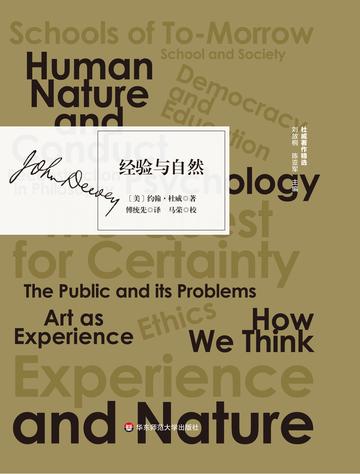
"Experience and Nature" is Dewey's masterpiece and one of the important works of the entire pragmatism school. In the book, Dewey proposed the basic views of his pragmatist philosophy and called it "empirical naturalism" or "naturalistic empiricism." This view opposes the complete separation of people and experience from nature, and advocates establishing the continuity between "experience and nature", thereby establishing a "unified whole of experience". About the author: The author John Dewey (1859-1952) is a famous American philosopher and educator, one of the founders of pragmatism philosophy, a pioneer of functional psychology, and a representative of the American progressive education movement. What was popular in the 19th century was the old education inherited from the colonial period. In addition, the Herbartian teaching methods introduced from Germany in the late 19th century gradually became stereotyped, making the schools at that time dull and lacking in vitality. The American pragmatist educator Dewey (1859--1952) was a reformer of traditional education at that time and a pioneer of new education. He advocated starting from children's nature and promoting children's personality development. Ma Rong, male, doctor of philosophy, graduated from the School of Philosophy, Fudan University, and currently teaches at the School of Marxism, Yancheng Institute of Technology. Academically, he focuses on research directions such as the basic theory of Marxism, American pragmatism and political philosophy. Recently, he has mainly studied the concepts of "material", "practice" and "cultural self-confidence" in Marxist philosophy. The main academic work is "Dewey's Pragmatist Theory of Truth".