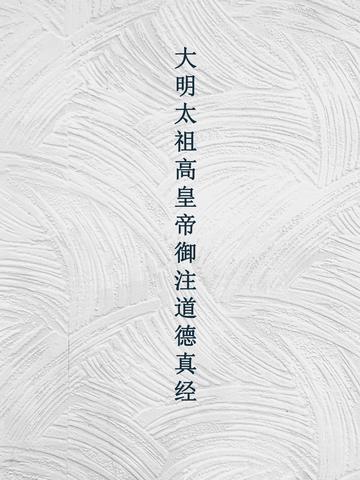
Name of the Sutra: The True Classic of Daode, written by emperor Taizu Gao of the Ming Dynasty. Annotated by Zhu Yuanzhang, Taizu of the Ming Dynasty, it was completed in the seventh year of Hongwu (1374). Note Volume 2, Chapter 67. "History of the Ming Dynasty·Yiwenzhi", "Wanjuantang Bibliography" and "Jiaqutang Bibliography" are all recorded. Zhu Yuanzhang said in his preface, "Since he came to the throne, he has not known the way of the previous philosopher kings. He has stayed at night and day, thinking about everything in the sky. In view of this, I asked everyone, everyone is my opinion, and they are not as good as the sages. One day, I was reading a group of books, and there was a volume of "Tao Te Ching" among them. I just looked at it and saw the number. Everything in the chapter is clear and simple, but the meaning is profound and difficult to understand. Ten days after I finished reading, I found another volume with different annotations. When I looked for and compared the annotations, people had different opinions. After pondering over them, I gained something. It is also said that the "Tao Te Ching" "is the ultimate root of all things, the supreme teacher of the king, and the most precious treasure of the subjects. It is not the magic of golden elixir." He claimed that after reading the "Tao Te Ching", he stopped the death penalty and eliminated prisoners. The "Summary of the Continuing Revision of Sikuquanshu" comments on this note: the book is "unreasonable in terms of literature and science, and the sentences are difficult to understand". It can be explained that it was written by Zhu Yuanzhang himself and was not ghostwritten by others.