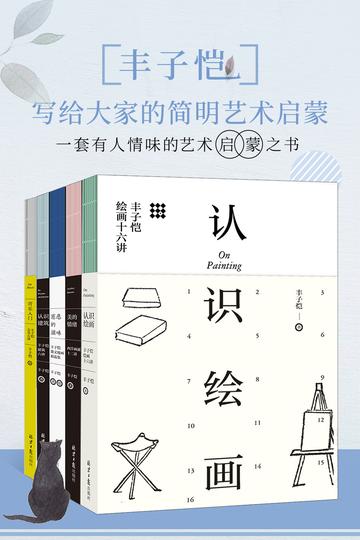
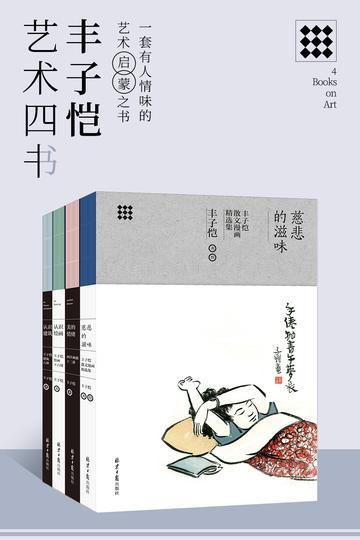
As Mr. Qian Zhongshu once wrote in Fortress Besieged: “A professor becomes a renowned professor in two stages: first, he treats his lecture notes as books; then, he treats his books as lecture notes.” Mr. Feng Zikai's teaching and creative career followed the same path. From 1919 to 1943, he taught at several institutions, including Shanghai Normal College and Zhejiang University. His lecture notes were published as art books, including A History of Western Art (Kaiming Bookstore, 1928), Talks on Western Architecture (Kaiming Bookstore, 1935), and Essays on Art (Shanghai Liangyou, 1935). These works provided an excellent introduction to art for young students of the time.
Understanding Painting is the first collection of Mr. Feng Zikai's writings on painting, and an advanced guide to artistic appreciation by a master. Why does learning to paint always begin with sketching? How can you tell whether a painting is good, and is a more realistic painting necessarily better? Why is Western art said to depend on hard work, while Chinese art relies entirely on talent? You'll find answers to these questions in the book.
In The Emotions of Beauty, Feng Zikai surveys nearly every major school of classical Western art. What seems like a bewildering tangle of influences to the uninitiated becomes clear and simple in his hands. Follow his explanations, and you'll learn to understand paintings, along with the emotions and spirit of beauty.
Understanding Architecture offers a comprehensive account of the development of architectural art. Why did the rulers of ancient Egypt devote such enormous effort to building massive, cumbersome pyramids? Why are the columns of Greek temples lined with grooves? Why were early Christian churches built underground? Behind these lighthearted and intriguing questions, Mr. Feng Zikai tells the deeper story of changes in the human spirit and in history.
The Taste of Compassion brings together 58 essays and 59 paintings, revealing the free-spirited yet compassionate outlook on life of a great artist through three perspectives: the human world, mountains and rivers, and the many faces of life. In Feng Zikai's hands, cats fighting, ants on the move, and a lazy springtime stretch can all become paintings. The everyday pleasures of ordinary people, children's sleep-talk, and the parasol tree outside a window can all become essays. As Zhu Guangqian said of him, “He is an artist from head to toe. His heart, his words and deeds, his smiles and expressions are all art, and all are the expression of profound love.”
An Introduction to Music: If art can be divided into spatial and temporal arts, then music is the foremost of the temporal arts.
What kinds of music are there? What are the three stages of learning music? How do we read musical notation and practice singing? How do we play common instruments such as the piano, violin, and harmonica? What path has Western music taken to reach the present day? In five introductory music lessons, Mr. Feng Zikai answers these questions one by one in clear, accessible language and vivid illustrations, opening a door for us to the world of music.
This book is great! I especially like Mr. Feng Zikai's explanation of art. He makes complex art concepts very simple and easy to understand. Just like he explained in "Understanding Painting" why learning to paint should start with sketching, which gave me a clearer understanding of children's art learning. And his interpretation of the emotion of beauty resonates with me. Just like those simple and beautiful moments in our lives, they can become inspiration for art. I think this book is not only suitable for children, but also for us parents. It can help us better understand and appreciate art.