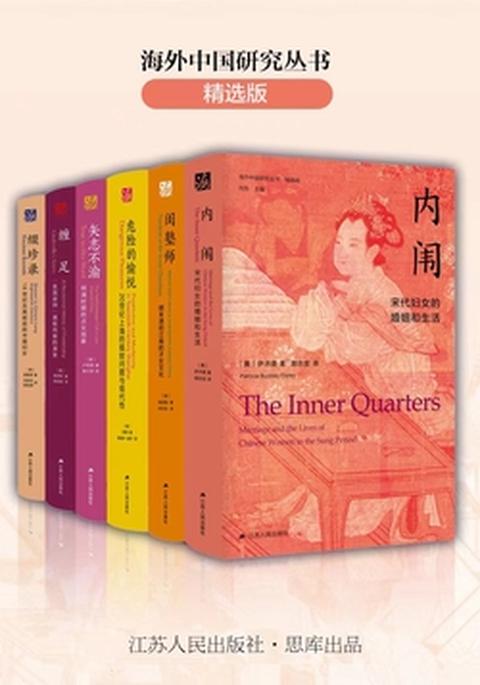
Overseas Chinese Studies Collection (Women’s Series, Five Volumes)
海外中国研究丛书合集(女性系列(五卷本))
by Yi Peixia (伊沛霞)
- Status
- Completed
- Length
- 1.7M Words
- Genre
- –
- Subgenre
- –
- Updated
- 2y ago
- English
- Request a translation

Synopsis
[Synopsis]
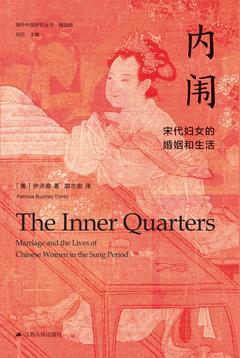
The Song dynasty examined in Within the Inner Quarters was a complex and changing era. On the one hand, foot binding began to grow popular, and scholars began to promote the belief that "starving to death is a small matter, losing one's chastity is a grave one." On the other hand, commerce flourished as never before, and women's marital and property rights received greater protection. In this pioneering work in the study of Chinese women's history outside China, the author presents us with an extraordinarily rich panorama. The lives of Song dynasty women come vividly into view: distinctions between inner and outer spheres, festivals and rituals, arranging marriages, serving in-laws, raising children, vying for favor within the inner quarters, remaining chaste after widowhood, remarrying... This shows that women's history is dynamic, filled with many possibilities. Readers can not only understand the many facets of Song dynasty women, but also grasp their choices and ingenuity amid social change at a historical turning point.
The Education of a Woman: The Culture of Talented Women in Late Ming and Early Qing Jiangnan
The profound social, economic, and cultural changes of the late Ming and early Qing dynasties fostered a flourishing culture of talented women. Key developments included the rise of commercial printing, the emergence of a broad reading public, renewed attention to emotion, support for women's education, increased opportunities for women to travel, and the redefinition of women's nature. This book seeks to rewrite the account of traditional women's history presented by the May Fourth historical perspective. It argues that the educated women of Jiangnan in the late Ming and early Qing were far from oppressed and voiceless. Within a Confucian system dominated by men, they created a rich and meaningful way of life. Through the interplay of idealized Confucian theory, lived experience, and women's perspectives, the author reconstructs these women's social, emotional, and intellectual worlds. Through the lives of women, the book proposes a new way of studying history, one that begins with a concrete understanding of how women lived.
Dangerous Pleasures: Prostitution and Modernity in Twentieth-Century Shanghai
Dangerous Pleasures is a history of prostitution in Shanghai, but it is a work of history written in the poststructuralist era, drawing on the wealth of theoretical inquiry, intellectual dialogue, and multiple perspectives developed in the second half of the twentieth century. The author was particularly influenced by Marxism, feminism and gender studies, poststructuralism, and the concept of "subaltern groups" in postcolonial studies. She sees both historical sources and the "history" she produces as part of an immensely vivid, complex, and open-ended process of dialogue, negotiation, memory, construction, and creation. Divided into five parts and fifteen chapters, Dangerous Pleasures examines how, over the hundred years from the late Qing to the early 1990s, the issue of prostitution became entangled at every level with national consciousness, political power relations, commercial and economic interests, nation-building policies, social reform, the national psyche, desire and fear, gender constructs, and a rich semantic field of other concerns. It became a powerful symbol at the heart of Chinese politics, economics, history, and spiritual culture.
Dangerous Pleasures received the Joan Kelly Memorial Prize for women's history from the American Historical Association, the first time the association awarded the prize to a writer on the history of women outside the United States.
Tags
Stats
More by this author
In booklists 1

Reader comments 1
Google Translate
As stated in *The Inner Chambers*, "The lives of women in the Song Dynasty often contradicted legal constraints," yet they still strived for freedom and participation. I particularly enjoyed the book's descriptions of how women navigated social changes, leveraging their choices and talents, which gave me a new understanding of history. It feels like these books are not only studying women but also exploring social and cultural transformation. Highly recommended!