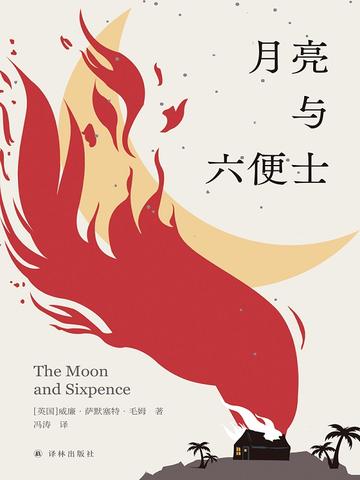
The Moon and Sixpence (Somerset Maugham Collection)
月亮与六便士(毛姆精选集)
- Status
- Completed
- Length
- 159k Words
- Updated
- 2y ago
- Source
- Fanqie
Stats
449Reads
9.4Score
151Shelves
63Chapters
93Listens
162.1kReads · all time
Tags
Synopsis
Reader comments
In booklists 6
I Am Looking for Books to Improve Myself, Whether It Is About Knowledge or How to Deal with People.
I want to read a book like "Rich People Think Differently from You".
5.6MViews561Books1dUpdated

Is There Any Book That Is a Classic Every Sentence?
3.8MViews524Books7dUpdated
Advanced Literary Works
Are there any novels that can be included in compositions or novels about famous people?
3.1MViews1.1kBooks2dUpdated

It Writes About Human Nature in a Very Dark Way
2.6MViews441Books3dUpdated
Pure Learning Book
I want to read a book similar to "A History of China that is addictive upon first reading (the first collection of works by the popular historical author "Wenhu", a common choice of 572,079 readers)". Books for pure learning
2.2MViews648Books7dUpdated
Is There Any Kind of Well-Written Prose or Poetry?
The kind that can make you wow, beautiful, very good, ah ah, I'm short of words, that's what I mean
336.9kViews330Books2dUpdated
Readers also read
 The Moon and Sixpence
 The Moon and Sixpence
 The Moon and Sixpence-Maugham
 The Moon and Sixpence
 The Moon and Sixpence
 The Moon and Sixpence (English Version)
 The Moon and Sixpence
 The Moon and Sixpence (English Original)
 The Moon and Sixpence: Illustrated Collector's Edition
 The Moon and Sixpence
 The Moon and Sixpence (Masterpieces of Foreign Literature Series)
 The Moon and Sixpence (2019 Single Book)
 The Moon and Sixpence
 The Moon and Sixpence (Collected Works of Maugham)
 Author's List: the Moon and Sixpence
 The Moon and Sixpence (Chinese Reading Recommended Series)
 The Moon and Sixpence (Famous Translation Series)
 Somerset Maugham's Classic Novel. the Moon and Sixpence. the Moon and Sixpence (Original English Version)
I have heard before: In a world full of sixpence, he was the only one who looked up and saw the moon. But I don't want to delve into the clichéd topic of ideals and reality. I don't know how women feel when reading this book, but when I read it, I couldn't stand Maugham's obvious misogyny. Behind Strickland's pursuit of art lies the trampling of women and the violence of patriarchy. The moon myth promoted by modern people is just a fig leaf for the privileged. A stockbroker can leave his mortgage and childcare responsibilities behind to become a painter, but do assembly line workers dare to quit their job and write poetry? Can a cleaning lady leave her sick parents to dance flamenco? The artist myth created by Maugham is essentially a fairy tale exclusively for bourgeois men. The moon made of sixpence can never shine on the real bottom. The most contradictory part of this novel is that the more it praises transcendent artistic pursuits, the more it exposes the eternal rift between art and morality. The artist's selfishness and coldness are transformed into spiritual purity that transcends the world, but he turns a blind eye to the messy fate of women on the ground. Strickland left everything behind to paint, but he could not avoid the worldly life. Fortunately, he exempted himself from the price of evil with his genius painting, but this just proved the powerlessness of art... When the brush cannot depict the abyss of human nature, no matter how beautiful the composition and coloring are, it is just an exquisite lie.
I have a lot to say but don't know how to say it. Everyone is Charles, everyone can be Charles, but no one is willing to truly become Charles.
When a middle-aged man had a happy family and a successful career, he suddenly abandoned it all and turned to art to become a painter. When he was in ragged clothes, hungry and cold, and about to die from typhoid fever, a sympathetic painter who was very optimistic about his painting talent took him home and took good care of him. This act of luring a wolf into the house caused the sympathetic painter to lose his wife. Then this man went through twists and turns again and came to a small island. He integrated here wholeheartedly. Under the introduction of a kind-hearted hotel proprietress, he married a wife who loved him very much and gave birth to two children for him. However, the good times did not last long. He died of illness within a few years. According to his attending doctor, he completed a shocking masterpiece during his lifetime - the Garden of Eden. This work was later burned by his wife at his request. After his death, his paintings began to be prized.
This book is very good! The protagonist in the book is willing to give up a stable life in order to pursue his ideals. This kind of courage is admirable. He experienced many bizarre things, and finally found inner peace on the island, which is quite legendary. I particularly dislike his wife, she is too selfish, only cares about her own social status, and has no understanding of the protagonist's pursuit. But this also reflects the portrayal of many people in reality. Overall, this book is worth reading and makes people think about the meaning of life.
Although I admire the male protagonist's pursuit of ideals and his purity, after reading the whole story, I still felt uncomfortable for his family. This may be due to a different perspective. Maybe in my opinion, there is nothing wrong with pursuing one's own ideals, but there is no need for him to break up like that and he can communicate appropriately.
He left a letter and walked away without any regrets. Everyone involved thought it was a common lover's elopement, and everyone who heard it believed it was a common lover's elopement. When "I" brought the news that Strickland was pursuing a dream rather than eloping, Colonel MacAndrew said that he "must have lost his mind and gone crazy"; Mrs. MacAndrew said that this matter was "of course just an excuse" and "unreasonable"; Mrs. Strickland was surprised... They couldn't believe it, thinking "this is unreasonable", thinking that such a thing would only happen because of elopement... This also reflects the vulgarity and short-sightedness of most people, and Strickland's giving up everything and being reborn in Nirvana reflects his otherworldliness. At the same time, their reactions to Chasing Dreams also hinted at the reason why Strickland had to leave - people would just think that he was messing around, and people in their forties shouldn't be like this. Even if Strickland didn't care what they thought, it was indeed a yoke given to him, and no wonder he wanted to break free of it. In his marriage to Atta, the surrounding environment was vivid and beautiful, people were kind and tolerant towards others, and Atta was supportive and hardly bothered Strickland (I think this is also an important reason why Atta and Strickland's marriage survived), which made him spend the good time willingly, which is in sharp contrast to the previous article. There is no doubt that many of the author's views are spot-on, but I disagree with some of the comments about women. I think women are indispensable in this world. Most of them are kind, soft, and thoughtful, like the second sun in the world.
It is a bit difficult for me to read. This can be said to be a different protagonist for me. He is like a rebel. Most people are picking up sixpence on the ground, but he looks up at the moon in the sky. When he decides to realize his dream, he does not want to be on the moral side. The author cannot use morality to persuade. In order to realize the dream that has been suppressed for a long time, he regards his wife as an obstacle and leaves her, regards the author as a friend, and regards Stroeve as a bad friend. People regard Blanche as a trouble, look down on Atta but admire her. In the second half of his life, his goal is to burn the last painting with fire for the unfinished dream in the first half of his life. His mission is completed, as if he is venting the unfinished anger in the first half of his life. In this, he may have thought about dying, but reality supports him and leaves after completing his masterpiece. In real life, how many people can give up their current life for a real dream? Strickland did it. [Thinking][Thinking][Thinking] In addition, I really want to slap this bad guy Stroeve. Although it can be seen that his respect for art exceeds impulse, what he did really feels like a dog-licking behavior, [face covering] [face covering] [face covering]
I was deeply moved after reading it. Judging from this era and my own environment, I strongly disagree with Strickland's view on marriage. For the sake of my own dream, I am irresponsible and have no responsibility for my family. I hate this approach very much. But the more I look at it, I feel a little relieved. He can be so cruel to people for his own dreams, so some of his actions make sense. Finally, it is a pity that geniuses are often discovered by people only after they leave. In fact, there are a few people in real life who can do as little as Strickland and not care about worldly views and not be confused by the world.
The raging fire brought by his ideals burned Strickland for the rest of his life. He is rude, mean, and uncaring. But his courage to abandon "all successful things" and the brilliance brought by the flame of this great ideal blurred his "evil". His courage to abandon everything and choose the moon amazed me.
The meaning of this book is very profound. The protagonist goes from numbness in the early stage, working at three points and one line, to awakening in the later stage. His feelings about society and his desire for freedom are reflected in the paintings he makes. Then to the narration of three love lines, from the marriage matched by parents, to the newly awakened marriage, to the different understandings of marriage after complete awakening, it depicts the changes in people's mentality in society at that time. Then when I looked at some of the protagonist's weird behaviors from my third-person perspective, I felt I had gone from not understanding to understanding. I will write about the incomprehension, confusion, and understanding of what the pioneers did when I was the majority in the society at that time.
Although I read the whole book with a lot of curses, I was still moved by the hero's belief, yearning and persistence for his ideals. In the last few chapters, when the author describes his paintings, the excitement in his heart will be aroused by the author's exquisite writing style, which makes people understand and slightly forgive the bastard behavior of the male protagonist.
This book seems to be the one that resonates most with my thoughts. I admire Strickland very much. He is truly detached from the world, determined in his heart, follows the guidance deep in his soul, and finally reaches the highest point in his heart. Speaking of which, he and I are quite similar. I don't know when, but there was a force pushing me deep in my heart. It made me think about right and wrong, love and beauty in this world again, and pursue my own beauty. At this moment, my soul is sitting on the sea in the wilderness, with the blue sky above my head and the bright stars. I am playing the guqin, with the literature I love in front of me, and bright and small light spots surrounding me. Life is as gorgeous as summer flowers, death is as quiet and beautiful as autumn leaves, prosperous but not chaotic, posture like smoke, individuals are hidden in the world, and thoughts are all over the garden. One day, I will plant the most beautiful flowers in the world and let this gorgeous garden bloom in this world!
If the moon is compared to ideals and freedom, and sixpence is the bondage of the world, the pursuit of ideals and freedom may harm secular people and cause trouble to others. The fearless pursuit of ideals and freedom does require courage. If you look carefully at the book, the protagonist does not seem to maliciously harm the rights and interests of others.
Some people like the moon to be hazy, while others like the bread to be solid. Different perceptions make it difficult to integrate. Instead of defending, respect. You don't have to be careful and live in other people's perceptions. You don't have to point fingers and judge other people's happiness.
I completely underestimated the philosophical wisdom of this book. What he always said when recommended by many people in the past made me feel that I was not interested in the story. But when I actually read it myself, I discovered another side from its delicate but precise language. It is not only telling you to pursue ideals, but also telling us how to face the self of the soul, a pure self...
After reading this book, my heart was shocked again. Some people may sympathize with Strickland's behavior described in it, while others may express doubts. In any case, the Strickland in it does not care about social comments. He lives in his own way. He is a person who truly lives for himself. He truly achieves the life he really wants. In a sense, Strickland is a successful person.
I disagree with some of the author's views, but at the end of the day, I feel that a good book may not only be reflected in its values. I am grateful to the great author and translator for allowing me, a layman, to feel and be touched by such words. I can't express my ideas with words, but I hope that everyone who is interested in literature can have in-depth exchanges and discussions. This book is of great value for reading and is highly recommended. The writing is deeply rooted in people's hearts, relaxed and concise.
This book not only feels the sadness of women, but also the author's pursuit of dreams, but his ideals carry the blood of others.
After reading this book, my soul couldn't help but be deeply and deeply shocked. Strickland was far away from the world. No difficulties or obstacles could knock him down from the courage to pursue his great dream. His life was like a wave in the wind, turbulent. , Although he died tragically in the end, he remained calm and peaceful at the last moment of his life, without a trace of fear. This is something that many people cannot achieve. It makes me respect him even more, although his life is not as tall and straight as a big tree, eye-catching. , He is a small grass on the stone cliff, standing firm in the cold wind, being ravaged by the violent storm and rain so much that people almost thought it would die... But this tenacious grass may have received a trace of God's favor, the violent storm stopped, and the warm sunshine The light once again shines on this frail and thin grass... It is still tenacious and persistent, and one day, it grows taller than all the grass! Although it is still thin, its life has reached an unprecedented height, and the world is shocked! Strickland lived out his truest self. His life was not bound by the world, he lived freely and wildly, and his soul was truly liberated! Salute! Wildness and freedom! Enthusiasm and perseverance! Strickland lives forever, let us carry all his precious qualities and bravely chase our dreams, let life be as bright as summer flowers, live up to our youth and our youth!
It feels more real. There is no halo of the protagonist, no weird situations, and no exaggerated plot. Flesh and blood. The only difference is that this man gave up the sixpence that almost everyone would bow his head to for the moon. This kind of life is so free and bold. This is the real "own" life, resisting and ignoring the worldly society, just like a moth seeing the light of fire. I used to think that everyone could chase their dreams, but now, I am a headless fly myself.
It's out of place for the times, but it's really thought-provoking
The choice seems difficult, but for some everything else is just a shackle
Girls must not take love as everything.
I just like the absurd contradiction between rationality and reality. The Moon and Sixpence is what it says. Maybe it can trigger people's thinking, so I think it is a good book. But I'm not used to foreign writing styles, so I can't stand it. I read it intermittently, but I should concentrate on thinking about it.
"The Moon and Sixpence" Strickland: All this is just a body, I am dealing with a disembodied soul. It is said that artists are madmen, and Strickland in Maugham's works is indeed such a character. It is precisely because of this that he created such a great artist. Under the conflict between ideal and reality, you can experience the philosophy of life balance.
The details are wonderfully written, and many are resonant. I was inspired by reading this book: The meaning of life is given by yourself, and life is short. Live according to your own way, live out of yourself, and live your life in vain.
What is the title of the book "The Moon and Sixpence"?
It's been a while since I read the book, but I didn't expect the content. If it's unquestionable in terms of storytelling, it is Maugham's book after all. If it's thought-provoking for readers, I think it's a bit difficult to comment. My thoughts after reading 1 Don't be love-minded, both men and women need to love your own life 2 Women must be independent and self-reliant, regardless of whether they lose love and marriage 3 Those who engage in art, especially those who are passionate about art, should be cautious in their interactions. They only have art in their eyes.
I feel like the second half is more engaging. From the initial disgust towards this character to the final understanding and envy of him, I gradually became able to feel the inadequacy of his pursuit of his ideals and the various hardships he encountered. After reading this work, I gained more knowledge and understanding of life.
Beautiful and very meaningful