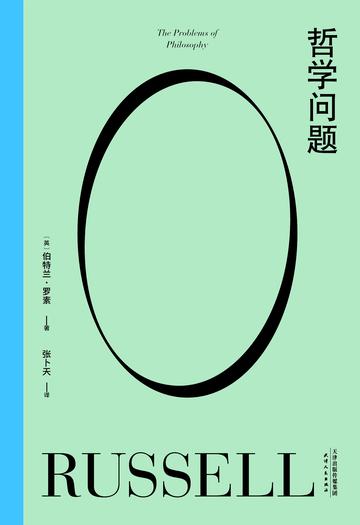
This small book of 100,000 words is an introductory reading of Russell's philosophy. Russell called it a "cheap thriller" because of its clarity and the introduction of new perspectives.
The book puts forward his own basic views on issues such as the foundation, scope, and meaning of philosophy, mainly in the field of philosophy, that is, epistemology. He believes that there are universals in this world that transcend the physical and spiritual worlds. It is also an entity and is the basis for people to understand the world in a universal sense. At the same time, the thoughts of philosophers such as Descartes, Hume, and Kant are analyzed.
Reader comments
In a clear, almost mathematical argumentation style, Russell explores the core question of the theory of knowledge: What can we really know? To what extent are our beliefs certain?
1. Deconstruction and doubt of certainty
· He inherited Descartes' method of systematic doubt and conducted a gentle review and deconstruction of the theories of Berkeley, Kant, Hegel and other predecessors.
· He challenges common sense and dogmatism, undermining our arrogance about certainties by revealing that even the most ordinary things contain unanswered questions.
2. The basis of knowledge: "personal knowledge" and "universality"
· Intimate knowledge: Russell believes that knowledge is based on "intimate knowledge". What we know directly are sensory data (such as colors and sounds), inner states (such as thoughts and desires), and memories.
· Universals: He particularly emphasized the importance of "universals" (such as relationships, properties, such as "similarity", "before"). He pointed out that we should not only pay attention to the universals of nouns (such as "白"), but also pay attention to the universal relationships contained in copulas (such as "是") and pronouns, which are the key to understanding the structure of the world.
3. The fundamental value of philosophy
Russell believed that the value of philosophy lay not in providing exact answers, but in the process itself:
· Emancipate the mind: Philosophy expands the realm of thought by liberating us from the shackles of habits and prejudices by showing "strange possibilities."
· The greatness of contemplation: Philosophy guides us to contemplate great and universal objects that transcend personal interests, thereby freeing us from the prison of our narrow self and instinctive desires.
· Shaping world citizens: Through contemplation of the non-self world, the narrow self can be expanded, ultimately making people become "world citizens" with a greater sense of justice and love. He explicitly rejected the "absolute solipsism" that enclosed the self.
Philosophy is a field where there are no final answers. Once a question has a clear answer, it becomes a science and no longer a philosophy. The true value of philosophy lies in this process of exploring uncertainty - it keeps us curious and gives us a greater and freer way of living.
I finished reading it in a daze, and probably understood less than 1%. It is better to accept that my brain lacks critical thinking. Its "existence" versus "reality" has not yet been able to establish a good "relationship" in philosophical contemplation. "Philosophy helps you understand life better", it makes people feel free! There is no right or wrong in the mind, but the mind creates beliefs, and beliefs have right or wrong biases. Through philosophical contemplation, we can better distinguish between knowledge, errors, and possible opinions!
A good companion for long distance trains
Solved some philosophical issues of the 20th century and before (Russell was a figure of the 20th century).








In a clear, almost mathematical argumentation style, Russell explores the core question of the theory of knowledge: What can we really know? To what extent are our beliefs certain? 1. Deconstruction and doubt of certainty · He inherited Descartes' method of systematic doubt and conducted a gentle review and deconstruction of the theories of Berkeley, Kant, Hegel and other predecessors. · He challenges common sense and dogmatism, undermining our arrogance about certainties by revealing that even the most ordinary things contain unanswered questions. 2. The basis of knowledge: "personal knowledge" and "universality" · Intimate knowledge: Russell believes that knowledge is based on "intimate knowledge". What we know directly are sensory data (such as colors and sounds), inner states (such as thoughts and desires), and memories. · Universals: He particularly emphasized the importance of "universals" (such as relationships, properties, such as "similarity", "before"). He pointed out that we should not only pay attention to the universals of nouns (such as "白"), but also pay attention to the universal relationships contained in copulas (such as "是") and pronouns, which are the key to understanding the structure of the world. 3. The fundamental value of philosophy Russell believed that the value of philosophy lay not in providing exact answers, but in the process itself: · Emancipate the mind: Philosophy expands the realm of thought by liberating us from the shackles of habits and prejudices by showing "strange possibilities." · The greatness of contemplation: Philosophy guides us to contemplate great and universal objects that transcend personal interests, thereby freeing us from the prison of our narrow self and instinctive desires. · Shaping world citizens: Through contemplation of the non-self world, the narrow self can be expanded, ultimately making people become "world citizens" with a greater sense of justice and love. He explicitly rejected the "absolute solipsism" that enclosed the self. Philosophy is a field where there are no final answers. Once a question has a clear answer, it becomes a science and no longer a philosophy. The true value of philosophy lies in this process of exploring uncertainty - it keeps us curious and gives us a greater and freer way of living.
I finished reading it in a daze, and probably understood less than 1%. It is better to accept that my brain lacks critical thinking. Its "existence" versus "reality" has not yet been able to establish a good "relationship" in philosophical contemplation. "Philosophy helps you understand life better", it makes people feel free! There is no right or wrong in the mind, but the mind creates beliefs, and beliefs have right or wrong biases. Through philosophical contemplation, we can better distinguish between knowledge, errors, and possible opinions!
A good companion for long distance trains
Solved some philosophical issues of the 20th century and before (Russell was a figure of the 20th century).
Very good, worth reading again and again
I don't know what to say, but it's really good