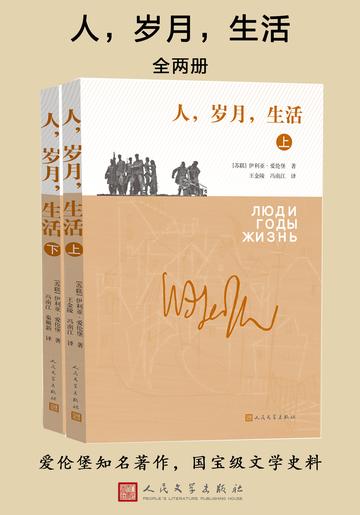
This is a long memoir by Soviet writer Eilenburg.
Published since 1960, it aroused strong repercussions and heated debates both inside and outside the Soviet Union.
In response to the instructions of the leaders of the Propaganda Department of the CPC Central Committee at that time, our publisher translated this world-famous work and published it as an internal book.
In 2008, due to various reasons, the book was published by Hainan Publishing House.
This year the club decided to purchase the copyright and bring it back to its hometown. Ellenburg was a literary master who was knowledgeable about both Russia and the West. He was a war correspondent during the First World War. After the October Revolution, he joined the Soviet government and spent more than ten years in Europe as a journalist.
During the Great Patriotic War, he worked as a reporter for the newspaper "Red Star".
Reader comments
The souls in Ellenburg's works who are misplaced with the times, but yet remain alive because of their misplacement, use personal memories to confront the grand narrative. He captures each specific person in the storm with slice-like glimpses.
The portraits of the characters in the book are particularly touching: when writing about Tsvetaeva, it is the "unruly and lost" eyes under the "arrogant appearance"; when writing about Pasternak, it is even more magical - "You can hear the beating of the heart and the growth of the grass, but you cannot hear the footsteps of the times." This misalignment with the wheel of history is the artist's most precious persistence and the deepest tragedy.
Ellenburg said that he "writes more about himself than the times", in the gap between "people want to live and people are dying". Those sad endings are no longer just past events, but become mirrors that reflect our own selves. The "screening memory" of survivors is itself historical evidence. To write about yourself is to write about the times - this may be the fate of all sincere memoirs, and it is also its eternal charm. This is a spiritual portrait of the century pieced together by a surviving witness using memory fragments.
This book is very real and the author has so many experiences! Especially his description of the war period made me feel the tension and difficulty of that era. The stories in the book seem to take me back in time, and I like this immersive feeling. Moreover, I think this book not only records history, but also makes us think about life and the meaning of life. The author's insights were profound and gave me a new perspective on many things. All in all, I think this is a book worth reading and I recommend it to you!

The souls in Ellenburg's works who are misplaced with the times, but yet remain alive because of their misplacement, use personal memories to confront the grand narrative. He captures each specific person in the storm with slice-like glimpses. The portraits of the characters in the book are particularly touching: when writing about Tsvetaeva, it is the "unruly and lost" eyes under the "arrogant appearance"; when writing about Pasternak, it is even more magical - "You can hear the beating of the heart and the growth of the grass, but you cannot hear the footsteps of the times." This misalignment with the wheel of history is the artist's most precious persistence and the deepest tragedy. Ellenburg said that he "writes more about himself than the times", in the gap between "people want to live and people are dying". Those sad endings are no longer just past events, but become mirrors that reflect our own selves. The "screening memory" of survivors is itself historical evidence. To write about yourself is to write about the times - this may be the fate of all sincere memoirs, and it is also its eternal charm. This is a spiritual portrait of the century pieced together by a surviving witness using memory fragments.
This book is very real and the author has so many experiences! Especially his description of the war period made me feel the tension and difficulty of that era. The stories in the book seem to take me back in time, and I like this immersive feeling. Moreover, I think this book not only records history, but also makes us think about life and the meaning of life. The author's insights were profound and gave me a new perspective on many things. All in all, I think this is a book worth reading and I recommend it to you!
Historical records have educational significance.