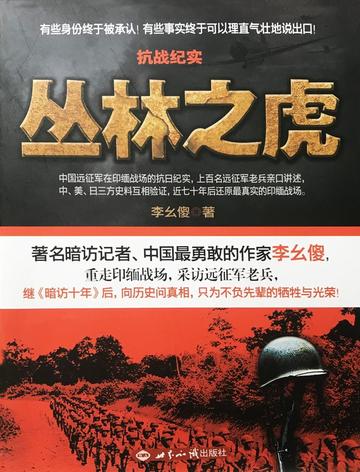
The New First Army, the main force of the Chinese Expeditionary Force stationed in India, was a very unusual army. It deeply admired the Eighth Route Army's guerrilla warfare, and the song its soldiers loved to sing most was "The Eighth Route Army March." In the jungles of northern Burma, this Chinese army relied on wide flanking maneuvers and sweeping encirclements. It paid little heed to gaining or losing individual cities and strongholds, instead focusing on wiping out enemy forces. Its art of war was remarkably similar to that of the Eighth Route Army. During the War of Resistance Against Japan, the strategies and tactics of two armies inflicted the heaviest losses on the Japanese and later became the talk of military historians: the Eighth Route Army's guerrilla tactics, and the New First Army's jungle warfare. The New First Army, which counterattacked in Burma, was dubbed the "Tiger of the Jungle" by Japanese Imperial General Headquarters.
After the Pacific War broke out, the Japanese 18th Division rapidly occupied the Malay Peninsula and Singapore, then advanced into Burma and fought the Chinese army in its first jungle engagement. The Chinese were defeated. Because of the 18th Division's outstanding military record, Japanese Southern Army Headquarters hailed it as the "Fox of the Jungle." After the Chinese New 38th Division and New 22nd Division retreated to India, they trained hard and launched a campaign of revenge in the spring of 1943. At the time, both the 18th Division, stationed in northern Burma, and the 56th Division, stationed in western Yunnan, belonged to the Japanese 15th Army. Its commander, Mutaguchi Renya, once told Division Commander Tanaka Shinichi, "Your 18th Division is known as the Fox of the Jungle, but this Chinese force stationed in India is extremely hard to deal with. They are the Tiger of the Jungle. You must never underestimate them." That is how the Chinese force stationed in India came to be called the "Tiger of the Jungle."
In fact, the Chinese Expeditionary Force routed the Japanese and won the Yunnan-Burma Campaign.
This book records that chapter of history.

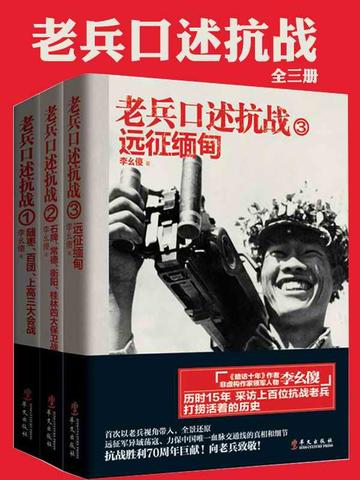

It's worth reading. I didn't expect that there would be this section during the Anti-Japanese War. Hiking on Savage Mountain, building railways and roads with bare hands, men fighting on the front lines, wives, children and parents building roads, 300,000 compatriots, more than 100,000 sacrifices, and Sun Liren, a hero of China, a soldier who was smart and able to fight. I am really grateful to them. This book made me know this history. Thank you to the author.
It is well written, and it truthfully describes the subjective and objective reasons for the failure of the first expeditionary force. Only 40,000 soldiers came back out of 100,000, and 60,000 soldiers left their young soldiers' lives in a foreign country. Many of them did not even leave their names. It is respectable, admirable, and lamentable. Second Expeditionary Force, (to be continued)
There may be issues with the review of the electronic manuscript, and a lot of data is missing. It is a very good war documentary book. Pay tribute to our mighty, brave, fearless, hard-working, bloodshed and sacrificed Chinese expedition heroes. Chinese soldiers are the best soldiers. They are worthy of the motherland and the people. With sufficient food and ammunition, and under the leadership of the correct commander, they achieved victory after victory. They are the good sons of China! There are indeed typos and omissions, but they are enough to let us understand the heroic deeds of the expeditionary force.
The content is authentic and the historical materials are detailed
Throughout World War II, the British army hardly performed well in the Eurasian battlefield and kept cheating its allies. There are plots to deceive the US military in the distant bridges
It truly writes the truth of history👍👍👍
Good book, it was really not easy for our ancestors
Good book, true and interesting to read