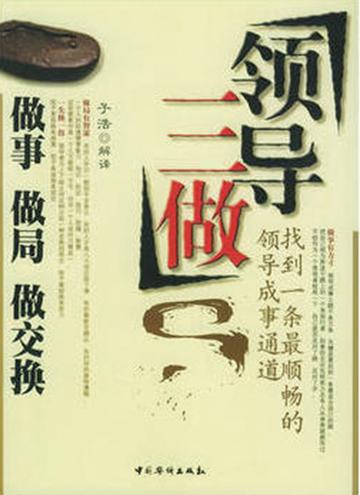
The so-called three things of leadership are to do things, to make situations, and to make exchanges. This book attempts to explore the leadership concepts and leadership arts of ancient Chinese leaders through the cases of leaders in different eras who have different paths to becoming officials, especially the rich ideological connotations and ingenious and practical leadership methods contained in them that can be used as reference for today's reality. "Leadership's Three Actions" is a summary of these connotations and methods. Doing things means that the leader must be a doer who can do practical things. It is not enough for a leader to just point his fingers and rely on the leadership power given to him by his position. He must also have the support of ability and morality, and he must be able to show his true ability to do things to convince the public. Making a situation means that leaders cannot deal with problems in a simplistic way, but should regard everything as part of the overall situation, and use superb leadership wisdom and skills to lay out, protect and end the situation. Exchange emphasizes that leaders and superiors should establish a concept of exchange: giving incentives in exchange for efforts, giving tolerance and abstraction in exchange for gratitude, and giving sincerity in exchange for trust. Historical experience tells us: "Three Dos" are the inevitable path for leaders to achieve success. It is undeniable that if leaders do not understand the art of leadership on the road to officialdom, they will eventually be eliminated by the times. Therefore, studying the science of leadership, studying and discussing the essence of the leadership art left by our predecessors, and understanding the spiritual essence of the "Three Dos of Leadership" is not only a matter for current leaders, nor is it just a patent for top leaders. It is also a lesson that those who are about to take leadership positions or are aspiring to become leaders need to review frequently.
Reader comments
This book is very good! By analyzing the cases of ancient leaders, it summarizes the three key elements of doing things, making decisions, and making exchanges. It also mentions the relationship between leaders and subordinates. However, I hate the kind of characters who only use their power to point fingers and have no real ability. This book is of great reference value for those who want to make a difference in leadership positions.



This book is very good! By analyzing the cases of ancient leaders, it summarizes the three key elements of doing things, making decisions, and making exchanges. It also mentions the relationship between leaders and subordinates. However, I hate the kind of characters who only use their power to point fingers and have no real ability. This book is of great reference value for those who want to make a difference in leadership positions.