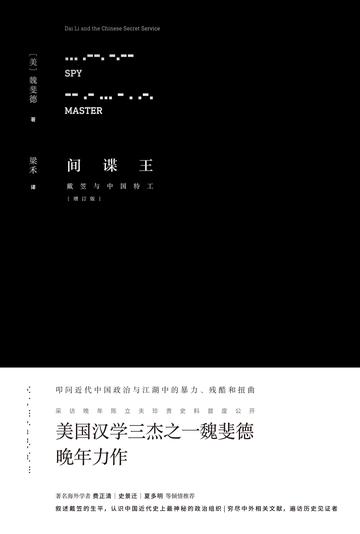
"The Spy King" takes the Kuomintang military reunification spies as the research object, and uses a large number of relevant memoirs and archival materials. It is the earliest representative academic work by overseas scholars to study the spy system of the Republic of China.
This book takes the overall life and political experience of "Spy King" Dai Li as a clue, and mainly studies the development of his huge and mysterious spy kingdom.
The author describes the intricate relationship between the Lanyi Society, Lixing Society and other organizations during the Whampoa Military Academy period, and the rapid expansion of the "military unification" after the outbreak of the Anti-Japanese War. At the same time, he restores the historical details of the training and actions of special agents through rich materials, exposing this dark and bloody history. Therefore, this book also details the development of the spy system of the Republic of China from the 1930s to the 1940s, which can greatly enrich and inspire our understanding of the history of the Republic of China during this period.
Reader comments
The author's research is very detailed, and by telling the life of Dai Li, it shows the life and work of the agents of that era. This reminds me of the competition and strategies in the entrepreneurial process, and sometimes some extraordinary means need to be used. However, we still have to stick to our moral bottom line. After all, honesty and integrity are the long-term solution. This book also reminded me to always stay vigilant and guard against potential risks.




The author's research is very detailed, and by telling the life of Dai Li, it shows the life and work of the agents of that era. This reminds me of the competition and strategies in the entrepreneurial process, and sometimes some extraordinary means need to be used. However, we still have to stick to our moral bottom line. After all, honesty and integrity are the long-term solution. This book also reminded me to always stay vigilant and guard against potential risks.