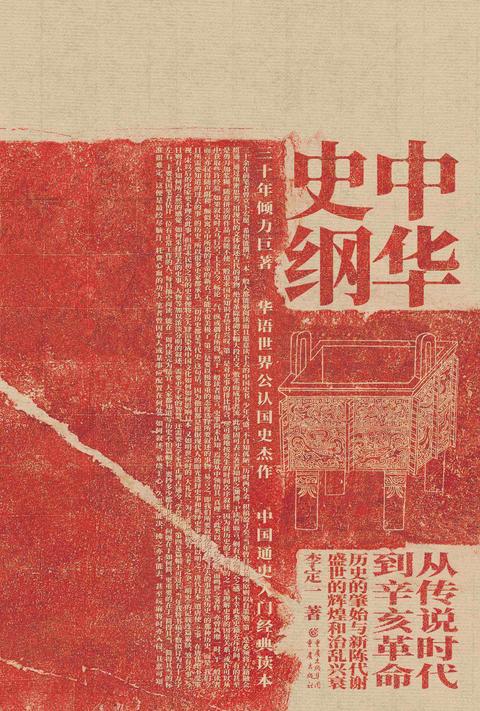
An Outline of Chinese History
中华史纲
by Li Dingyi (李定一)
- Status
- Completed
- Length
- 454k Words
- Genre
- Historical
- Updated
- 3y ago
- English
- Request a translation

Synopsis
At the 2019 spring knowledge launch for Dedao, Luo Zhenyu recommended Outline of Chinese History this way: "Reading this book felt a bit like the first time I took a photo with a drone a couple of years ago. The people were the same, but looking down from a new height, I realized how vast the sky and earth were, and saw things in a completely different light. Even if you know Chinese history well, this book will keep surprising you. For almost every point, Mr. Li Dingyi draws connections across time and compares East and West, helping you discover new meaning. That's right, this isn't a book of historical facts. It's a book that lets you rise up with a great guide, take in more reference points, and then return to the historical scene with a fresh perspective."
[Synopsis] Outline of Chinese History is a masterpiece of Chinese history by Li Dingyi, a renowned contemporary Taiwanese historian. It begins with the age of ancient legends and ends with the momentous Revolution of 1911, recounting the changes that shaped several thousand years of Chinese civilization. With striking originality, the author divides Chinese history into six periods: the formation of Chinese culture; its origins and development; renewal and transformation; consolidation; further development; and decline. In elegant, concise prose reminiscent of Sima Qian, he tells the story of thousands of years with a deft balance of detail and brevity. Though it is an outline, it is "concise in all the right ways." For many important historical figures and events, the author offers fresh insights from distinctive perspectives. He considers the importance of Yu the Great's flood control to Chinese civilization in the context of global civilization; explores the social conditions behind the divisions at the end of the Eastern Han through the outlook of its scholars, who recognized only family, friendship, and teacher-student ties; examines the upbringing of Emperor Xiaowen of Northern Wei to explain his vigorous promotion of "Sinicization"; and traces the causes of the Opium War to the breakdown of cultural exchange between China and the West at the end of the Ming and beginning of the Qing. He also revisits purportedly settled historical accounts, including Qin Shi Huang's "burning of books and burying of scholars," Wang Mang's usurpation of the Han, the invasions of the Five Barbarians, and the construction of the Grand Canal, using extensive historical sources to offer analyses and judgments that may better fit the historical context. These examples showcase his distinctive critical approach to history, broad historical vision, and deep affection for culture, allowing readers to enjoy the book while learning to reflect on and appreciate the meaning of history.
[About the Author] Li Dingyi (1919-2002), courtesy name Fangzhong, was from Tongliang, Chongqing. A renowned contemporary Taiwanese historian, he was a noted professor of history at National Taiwan University, the Chinese University of Hong Kong, and National Chengchi University. He devoted more than forty years to studying Chinese history, specializing in modern Chinese history and the history of Sino-American relations. In 1938, he entered the Department of History and Sociology at National Southwestern Associated University, where he studied under such eminent scholars as Qian Mu, Chen Yinke, Zhang Yinlin, and Shao Xunzheng. After graduating, he was recommended by Qian Mu to work as a research assistant in the Department of Philosophy and History at West China Union University in Chengdu. In 1946, he went to study at the London School of Economics under the renowned historian of international relations C. K. Webster, who had once guided John King Fairbank in choosing a research direction for modern Chinese history. During his studies, Li searched for historical sources in the libraries and archives of London, Paris, and the Vatican, laying the groundwork for his distinctive approach to modern Chinese history. In 1953, he organized a manuscript of more than 1.5 million Chinese characters on modern Chinese history, distilled its key points, and presented the insights of his years of research in a penetrating account, completing the book Modern Chinese History.
Tags
Stats
In booklists 1
Reader comments 2
Google Translate
This book, *An Outline History of China*, is truly excellent! Unlike other history books that simply pile up classical Chinese, it tells history in a modern style, making it easy for someone like me, who isn't very familiar with classical Chinese, to understand.
It's alright. The historical narrative is rigorous, organized, and professional, and the language is concise. However, it contains many uncommon and obscure characters, and the language is somewhat colloquial.