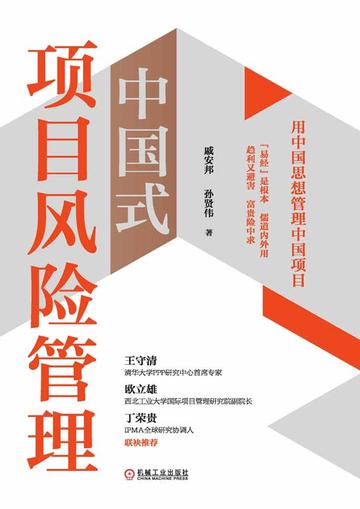
This book is divided into 12 chapters. The first three chapters are the principles and concepts of Chinese-style project risk management and the comparative study of Chinese and Western project risk management. Chapters 4 and 5 are about the comprehensive integrated management and project risk assessment of Chinese-style project risks. Chapter 6 discusses the management of Chinese-style project risk events without early warning information. Chapters 7 to 11 are respectively the principles and methods of planning, identification, measurement, response and monitoring of Chinese-style project risks. Chapter 12 is the documented management of Chinese-style project risk management. The greatest feature of this book is that it applies the management philosophy of "change" and "response" in Chinese culture for thousands of years to the field of modern project risk management. Secondly, this book also comparatively analyzes the differences in project risk management ideas and methods between China and the West. Finally, this book comprehensively discusses the comprehensive integrated management of the entire project process, all elements, and all team risks. This book can be used as a teaching material for undergraduates in various management disciplines, as well as for Master of Business Administration (MBA), Master of Public Administration (MPA), Master of Project Management (MPM) and Master of Engineering Management (MEM). It can also be used by project risk managers for self-study and training.
Reader comments
This negative review is mainly for the author's writing style (this negative review is for the author's writing style). The book contains a lot of useful knowledge, understanding, and many Chinese characteristics (the book is a good book). Since the author's style of writing contains many repeated words, seven out of ten words are considered moisture, and the remaining three words are dry information (the word count is seriously crammed), just like this comment of mine. Ha ha
This book is very practical! It applies the management philosophy in traditional Chinese culture to project risk management, and also compares Chinese and Western management ideas. The content is very comprehensive. I particularly like the part about risk response and monitoring in the book, which is explained in great detail. However, I hate those complicated theories, but fortunately this book explains it quite clearly. Overall, it is very suitable for those of us who are running around in the city and is worth reading!

This negative review is mainly for the author's writing style (this negative review is for the author's writing style). The book contains a lot of useful knowledge, understanding, and many Chinese characteristics (the book is a good book). Since the author's style of writing contains many repeated words, seven out of ten words are considered moisture, and the remaining three words are dry information (the word count is seriously crammed), just like this comment of mine. Ha ha
This book is very practical! It applies the management philosophy in traditional Chinese culture to project risk management, and also compares Chinese and Western management ideas. The content is very comprehensive. I particularly like the part about risk response and monitoring in the book, which is explained in great detail. However, I hate those complicated theories, but fortunately this book explains it quite clearly. Overall, it is very suitable for those of us who are running around in the city and is worth reading!