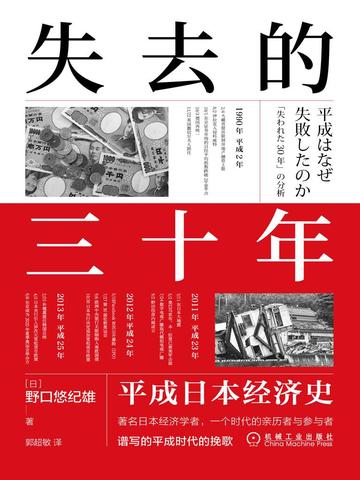
The Lost Thirty Years: A History of Japan's Heisei-Era Economy
失去的三十年:平成日本经济史
- Status
- Completed
- Length
- 97k Words
- Genre
- Historical
- Updated
- 3y ago
- Source
- Fanqie
Synopsis
28Chapters
1.8kReads
9.4Score
666Shelves
359Listens
65.9kReads · all time
More by this author
In booklists 3

Books for Studying
Something with depth that’s also engaging and easy to get into.
193Books43.6MViews1dUpdated

Looking for All Kinds of Books About Studying
No restrictions on industry, genre, or difficulty.
191Books9.7MViews7dUpdated


Books That Can Expand Your Knowledge Across Different Fields and Subjects, Ideally Starting at Elementary-School Level
First, could you recommend a few elementary-school math and English books?
124Books515.2kViews18dUpdated
Reader comments 38
Translated by Google Translate
This book describes the economic development of the Heisei era very realistically, and it feels like you are reading the story of the author's personal experience. I especially like the parts of the book about economic figures who have a direct or indirect relationship with the author, which made me understand that era better. Moreover, the author's own experience is also very rich, which I admire very much. Overall, this book not only taught me about history, but also got me interested in economics.
It is well written and has many similarities with our current situation, but it is basically a macro-level description and does not mention individual solutions to social changes. For novices, there are some financial-related professional words that are difficult to understand, so you need to look up some information.
First of all, I lament that there are such sober university professors in Japan, but I also regret that they have little ability to understand the problems and change them. 1. Japan has prospered, but due to financial, manufacturing problems and domestic corruption, it later failed to embrace the era of technological civilization first, and other factors made the country continue to fall into silence. Through this book, people learn lessons from history that they have never learned. 2. What I can see for Chinese readers is that they should study abroad more often if they have the opportunity. In the future, working in Japan may be more profitable. China will also encounter similar problems, such as the aging of the population and the rising manufacturing costs caused by the past era of demographic dividend. I also see that we should actively embrace international finance, which China lacks. Due to various financial restrictions, I believe China will gradually open up. 3. If, as the author predicts, China's GDP will become the first in the world in 2040, and since the country does not fall behind in the world, how can we ourselves actively respond and benefit from China's developing society? Keep learning, keep reading.
If you feel at a loss about the current environment, take out this book and read it for inspiration.
For me, who is about to turn 40, this book is quite useful! Viewpoint: China's housing prices will mainly fall in 2026, let's drop another 30 points! I wonder if it can be reduced to a rental return rate of 3-5 points in a provincial capital city! In the future, retirement will inevitably be extended to 65 or 70 years old! China will surely become great again, and it is only a matter of time before it surpasses the United States. One is to develop slowly and wait for him to make mistakes, and the other is to develop faster than him!
Understand history and use the past to reflect the present. Is there anything we can learn from Japan in the past 30 years?
We naively thought that Japan was our pilot version. I would say we were too naive.
As a student majoring in economics, this is a must-read, very interesting, and a living textbook.
Very good! Worth reading.
A new story has begun. ... This is the story of his passage from one world to another, the story of his becoming familiar with a new reality that he had not known until now.