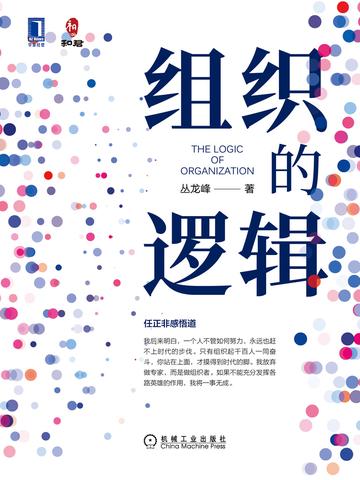
The biggest bottleneck to corporate growth and innovation is the evolution of the organization, and the biggest bottleneck to organizational evolution is the evolution of the founders themselves. <Br /> "The Logic of Organizations" hopes to use a conceptual system that is as popular as possible to explain the internal logic of organizational issues clearly at once and provide corresponding management methods. <Br /> To a large extent, the core viewpoints of "The Logic of Organizations" can be summarized in the following six sentences:<br /> ① Organizational management is a type of problem that will never go out of style; ② Organizational problems are not equal to organizational structure problems; ③ Structure alone is not enough, the key is to establish organizational mechanisms;<br /> ④Mechanism alone is not enough, the key is to form organizational capabilities;<br />⑤Whether organizational functions can be brought into play depends on the organizational form;<br />⑥Whether the organizational form can be activated depends on entrepreneurial leadership. <Br /> "The Logic of Organizations" logically progresses layer by layer. Readers can read it in chapter order, or they can read Chapter 9 of the case section first, which will give them some sense of practical problems and give them a more immersive feel when reading theory.
Reader comments
I have been looking for books on organizational management, and I was lucky enough to come across Organizational Logic. The book systematically expounds the core essence of organizational management from the theoretical and practical chapters, and explains professional theories such as organizational structure, organizational management, and performance appraisal through practical and instructive words, making you feel enlightened and enlightened. At the same time, the case interpretation in the practical chapter is very vivid, and the selection of research objects is very good. It is not the kind of giant enterprise that has no reference value. I think the underlying logic and core competitiveness of the development of the research objects are also very profound, accurate, and enlightening.
Understanding the organization is very important, because it is related to all institutions and companies, schools and departments. For organizations, we need to understand them at several levels. The first is the individual level, what impact an individual can have on the organization, the individual's experience and heart in the organization, the organization's experience and feelings about the individual, and then the macro level, what help and contribution the organization as a whole will bring to the country and society, and how to define the quality of an organization. These are the keys to considering the purpose of the organization.
After reading this book, you will have a deeper understanding of the logic, techniques and methods of organization. The evolution of the organization plays a decisive role in corporate growth and innovation, and the founder's own evolution is closely related to the evolution of the organization. The author wants to let us understand the inner logic of organizational problems through this book. In this book, the author uses a popular conceptual system to help us learn to understand organizations and give corresponding management methods. Gradually deepen the analysis, combine theory with cases, the language is easy to understand, the chapter context is clear, and the conclusion is simple and straightforward.
The content of this book is very practical, especially the analysis of organizational issues is very thorough. I especially like the part about organizational mechanisms and capabilities in the book. It makes me understand that just adjusting the structure is not enough. It is also necessary to establish good mechanisms and cultivate organizational capabilities. Moreover, the cases in the book are very rich, which makes it very immersive to read, allowing me to better understand the theory. In short, I think this is a valuable book and recommend it to everyone!





I have been looking for books on organizational management, and I was lucky enough to come across Organizational Logic. The book systematically expounds the core essence of organizational management from the theoretical and practical chapters, and explains professional theories such as organizational structure, organizational management, and performance appraisal through practical and instructive words, making you feel enlightened and enlightened. At the same time, the case interpretation in the practical chapter is very vivid, and the selection of research objects is very good. It is not the kind of giant enterprise that has no reference value. I think the underlying logic and core competitiveness of the development of the research objects are also very profound, accurate, and enlightening.
Understanding the organization is very important, because it is related to all institutions and companies, schools and departments. For organizations, we need to understand them at several levels. The first is the individual level, what impact an individual can have on the organization, the individual's experience and heart in the organization, the organization's experience and feelings about the individual, and then the macro level, what help and contribution the organization as a whole will bring to the country and society, and how to define the quality of an organization. These are the keys to considering the purpose of the organization.
After reading this book, you will have a deeper understanding of the logic, techniques and methods of organization. The evolution of the organization plays a decisive role in corporate growth and innovation, and the founder's own evolution is closely related to the evolution of the organization. The author wants to let us understand the inner logic of organizational problems through this book. In this book, the author uses a popular conceptual system to help us learn to understand organizations and give corresponding management methods. Gradually deepen the analysis, combine theory with cases, the language is easy to understand, the chapter context is clear, and the conclusion is simple and straightforward.
The content of this book is very practical, especially the analysis of organizational issues is very thorough. I especially like the part about organizational mechanisms and capabilities in the book. It makes me understand that just adjusting the structure is not enough. It is also necessary to establish good mechanisms and cultivate organizational capabilities. Moreover, the cases in the book are very rich, which makes it very immersive to read, allowing me to better understand the theory. In short, I think this is a valuable book and recommend it to everyone!
Theory combined with practice