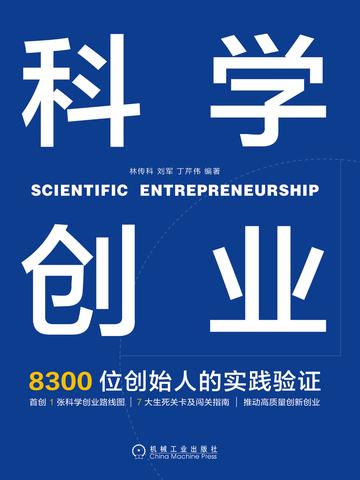
This book has seven major stages: setting direction, creating a model, building a team, building a product, building a brand, promoting growth, and leading a team. The key decisions that require the most concentration at each stage run through the book as the main thread. The first section of each level is dedicated to outlining the reasons for setting up the key tasks of this level; based on the key tasks of each level, the corresponding relatively scientific core methodology is introduced and case interpretations are performed. After learning each level, readers will have a general understanding of what they need to do and what they need to learn at that stage, and then they can conduct topic-based learning independently. It is hoped that readers can make every key decision correctly through the scientific entrepreneurship method of "Entrepreneurship Scientific Methodology + Scientific Experiment Verification" and avoid detours in entrepreneurship.
Reader comments
Entrepreneurship today is no longer as reckless as it used to be, and the ignorant are no longer fearless. Nowadays, we are a stock society. If we want to start a business, we need more preparation time, effort and energy to coordinate our entrepreneurial activities and maximize the probability of success in starting our own business. As the author introduces in the book, we need to formulate a comprehensive business plan to clarify the goals, market positioning, competitive advantages, profit model and other important aspects of the scientific entrepreneurial project.
Perhaps everyone has thought about starting a business. It is not only about completing the idea, but more importantly, it is necessary to learn how to start a business in practice and the mentality of starting a business. This book starts from this perspective and tells us that the seven major steps of entrepreneurship are setting direction, creating a model, building a team, building products, building a brand, promoting growth, and leading a team. The author said that fools build high walls and wise men build bridges. We must learn to start a business scientifically and understand the road map for scientific entrepreneurship.
In today's era, entrepreneurial companies are growing into "unicorns" at an increasingly faster rate, which shows that these "unicorn" companies must have made many key decisions right. In addition, the entrepreneurial failure rate has remained high, and the scale of losses caused by entrepreneurial failure has also continued to increase. These phenomena mean that every bit of cognitive progress in entrepreneurship can produce huge social and economic benefits. In his 17-year equity investment career, the author has examined countless entrepreneurs and start-up companies, and also made investments ranging from millions to hundreds of millions of yuan in some of them. In this process, the author deeply realized the necessity of scientific entrepreneurship.
This book is very practical! It clearly explains the key decisions and methods of starting a business, and also provides case explanations. It feels like an experienced teacher is guiding you. I especially liked the parts about team building and product development in the book, which reminded me of my own experience of starting a business with my friends. And seeing the teachers and founders thanked by the author, I felt that this book was very reliable and worth recommending!
Scientific entrepreneurship refers to entrepreneurial activities that transform scientific research results into commercial value. It combines scientific research with business innovation and aims to solve real-world problems and create economic and social value for society through the creation and application of science and technology. The goal of scientific entrepreneurship is to transform scientific innovation into commercial success and bring practical economic and social benefits to society. It is of great significance for promoting scientific and technological innovation, promoting economic development and solving social problems.
In today's era, entrepreneurship has become an important part of people's source of wealth. Some companies have become leaders in a sudden leap; there are also companies that fell into trouble before they started their business. Entrepreneurship not only relies on passion, but also requires accumulation of experience, summary of failures, continuous self-reflection and other factors to achieve success. This book "Scientific Entrepreneurship" summarizes 7 practical theories for readers: setting direction, creating a model, building a team, making products, building a brand, promoting growth, and leading a team. It clearly lists the methods and steps of scientific entrepreneurship for readers, reminding readers that scientific entrepreneurship can avoid detours and jump straight up the ladder of success.





Entrepreneurship today is no longer as reckless as it used to be, and the ignorant are no longer fearless. Nowadays, we are a stock society. If we want to start a business, we need more preparation time, effort and energy to coordinate our entrepreneurial activities and maximize the probability of success in starting our own business. As the author introduces in the book, we need to formulate a comprehensive business plan to clarify the goals, market positioning, competitive advantages, profit model and other important aspects of the scientific entrepreneurial project.
Perhaps everyone has thought about starting a business. It is not only about completing the idea, but more importantly, it is necessary to learn how to start a business in practice and the mentality of starting a business. This book starts from this perspective and tells us that the seven major steps of entrepreneurship are setting direction, creating a model, building a team, building products, building a brand, promoting growth, and leading a team. The author said that fools build high walls and wise men build bridges. We must learn to start a business scientifically and understand the road map for scientific entrepreneurship.
In today's era, entrepreneurial companies are growing into "unicorns" at an increasingly faster rate, which shows that these "unicorn" companies must have made many key decisions right. In addition, the entrepreneurial failure rate has remained high, and the scale of losses caused by entrepreneurial failure has also continued to increase. These phenomena mean that every bit of cognitive progress in entrepreneurship can produce huge social and economic benefits. In his 17-year equity investment career, the author has examined countless entrepreneurs and start-up companies, and also made investments ranging from millions to hundreds of millions of yuan in some of them. In this process, the author deeply realized the necessity of scientific entrepreneurship.
This book is very practical! It clearly explains the key decisions and methods of starting a business, and also provides case explanations. It feels like an experienced teacher is guiding you. I especially liked the parts about team building and product development in the book, which reminded me of my own experience of starting a business with my friends. And seeing the teachers and founders thanked by the author, I felt that this book was very reliable and worth recommending!
Scientific entrepreneurship refers to entrepreneurial activities that transform scientific research results into commercial value. It combines scientific research with business innovation and aims to solve real-world problems and create economic and social value for society through the creation and application of science and technology. The goal of scientific entrepreneurship is to transform scientific innovation into commercial success and bring practical economic and social benefits to society. It is of great significance for promoting scientific and technological innovation, promoting economic development and solving social problems.
In today's era, entrepreneurship has become an important part of people's source of wealth. Some companies have become leaders in a sudden leap; there are also companies that fell into trouble before they started their business. Entrepreneurship not only relies on passion, but also requires accumulation of experience, summary of failures, continuous self-reflection and other factors to achieve success. This book "Scientific Entrepreneurship" summarizes 7 practical theories for readers: setting direction, creating a model, building a team, making products, building a brand, promoting growth, and leading a team. It clearly lists the methods and steps of scientific entrepreneurship for readers, reminding readers that scientific entrepreneurship can avoid detours and jump straight up the ladder of success.