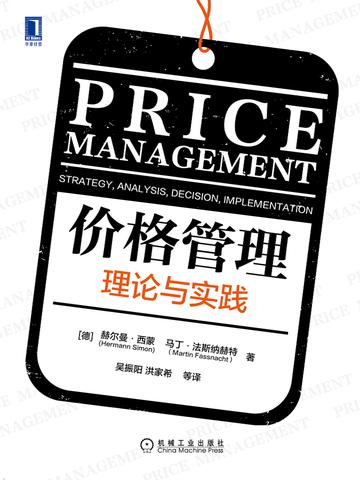
This book is the latest masterpiece co-written by Hermann Simon, the world's most famous pricing authority, and Martin Fasnacht, one of Germany's most influential economists. It comprehensively and in-depth explains all aspects of price management. It not only systematically introduces various methods of price optimization, but also analyzes in detail the entire process of price management strategy, decision-making, and implementation. This book shows the latest academic development level of price management, and also looks forward to its future development trend. It introduces a large number of price management innovations, such as flat rates, pay-as-you-go, negative prices, sharing economy, big data, innovative payment systems, etc. This book uses a large number of practical cases to ensure the perfect combination of theoretical rigor and practical relevance. Since the methods for identifying and solving price problems usually vary from industry to industry, this book adheres to an industry orientation and uses large separate chapters to specifically explore price management issues in the fields of consumer goods, industrial products, services, and retail. It can solve specific price management problems in different industries very effectively and highly targeted. This book also selects representative case studies and practical examples from around the world, striving to solve various price management challenges faced by enterprises around the world.
Reader comments
There are many examples in the book, one of which concludes that "an increase in price is more conducive to an increase in profits than an increase in sales volume. On the contrary, in order to have better profits, one should accept lower sales volume rather than lower prices." A decrease in price will have the opposite effect. Revenue and profit will decrease by the same amount, and changing price will have a much greater impact on profits, whether positive or negative, than changing sales volume. The author explains the correlation between profit and its driving factors in the simplest way, using examples to make it easier for readers to understand.
This book shows the latest academic development level of price management, also looks forward to its future development trend, and introduces a large number of price management innovations. At the same time, the author also selects representative case studies and examples from around the world to try to solve the price management challenges faced by enterprises in various places. This book is a very professional monograph on price management. It also contains a lot of advanced mathematics and econometrics, and it involves professional knowledge in different subject areas. It is very worthy of everyone's study.
Price management refers to a management method in the market economy that affects market supply and demand and optimizes resource allocation by setting and adjusting prices. The theory of price management mainly includes price strategy, price decision-making, price policy, price mechanism, etc. Price strategy refers to the method by which enterprises guide business decisions by setting long-term and short-term price targets. Price decision-making refers to the method by which an enterprise sets prices based on market conditions and competitive environment. Price policy refers to the method by which the government regulates market prices by formulating price policies and regulations. The price mechanism refers to the method by which the market forms prices through price competition and price negotiation.
This book is really good! For a new mom like me, this book provides a lot of practical knowledge about price management. I especially like the book's content on price optimization methods and innovative payment systems, which are very helpful for family finance management. Moreover, the case studies in the book are also very interesting, allowing me to understand the pricing strategies of different industries. I think this book is not only suitable for professionals but also for ordinary readers like me. Highly recommended!





There are many examples in the book, one of which concludes that "an increase in price is more conducive to an increase in profits than an increase in sales volume. On the contrary, in order to have better profits, one should accept lower sales volume rather than lower prices." A decrease in price will have the opposite effect. Revenue and profit will decrease by the same amount, and changing price will have a much greater impact on profits, whether positive or negative, than changing sales volume. The author explains the correlation between profit and its driving factors in the simplest way, using examples to make it easier for readers to understand.
This book shows the latest academic development level of price management, also looks forward to its future development trend, and introduces a large number of price management innovations. At the same time, the author also selects representative case studies and examples from around the world to try to solve the price management challenges faced by enterprises in various places. This book is a very professional monograph on price management. It also contains a lot of advanced mathematics and econometrics, and it involves professional knowledge in different subject areas. It is very worthy of everyone's study.
Price management refers to a management method in the market economy that affects market supply and demand and optimizes resource allocation by setting and adjusting prices. The theory of price management mainly includes price strategy, price decision-making, price policy, price mechanism, etc. Price strategy refers to the method by which enterprises guide business decisions by setting long-term and short-term price targets. Price decision-making refers to the method by which an enterprise sets prices based on market conditions and competitive environment. Price policy refers to the method by which the government regulates market prices by formulating price policies and regulations. The price mechanism refers to the method by which the market forms prices through price competition and price negotiation.
This book is really good! For a new mom like me, this book provides a lot of practical knowledge about price management. I especially like the book's content on price optimization methods and innovative payment systems, which are very helpful for family finance management. Moreover, the case studies in the book are also very interesting, allowing me to understand the pricing strategies of different industries. I think this book is not only suitable for professionals but also for ordinary readers like me. Highly recommended!