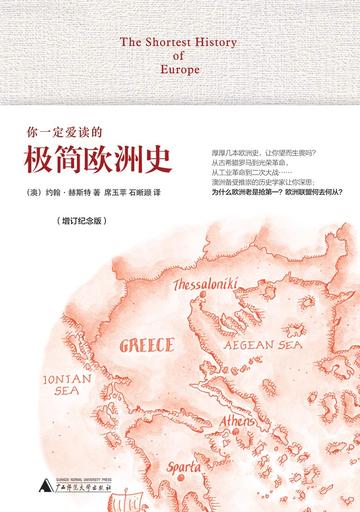
This book is a history of Europe interpreted by the well-known Australian historian John Hurst for ordinary readers. It is completed in a very concise length, sorting out the various characteristics of European civilization that can change the world for readers. Since the publication of the simplified Chinese version, it has been widely praised by the media and welcomed by readers, and has sold hundreds of thousands of copies. This time it is a hardcover commemorative edition based on the latest edition (two chapters added in length).
Reader comments
This book made me know: European civilization is unique because it has always been the only civilization that can make the rest of the world follow suit. It was able to do this by relying on continuous conquest and settlement, strong economic strength and ideological concepts, and having things that others aspired to. Today, scientific discoveries and technologies commonly used in all countries around the world originated from it, and science itself is one of the European inventions. At the beginning of European civilization, it consisted of three elements: 1. Ancient Greek and Roman culture; 2. Christianity, a peculiar branch of Judaism (the religion of the Jewish nation); 3. The warrior culture of the Germanic barbarians who invaded the Roman Empire.
Europe is a region with the most developed countries, and it is currently the most civilized place. Understanding the major historical changes in Europe is very helpful for China's development. The more we know about the world, we will broaden our horizons and see a broader world. Our cognitive level can also be improved, our way of thinking will change, and our understanding of the evolution of the world will be deeper. Therefore, in today's era of globalization, we need to understand the history of other countries so that we can better understand the laws of this world.
"I compiled these textbooks for Australian students. They know too much about Australian history and too little about European civilization, and they are also a part of Europe." It is very easy to understand, without professional terms, and it does not seem to be difficult even for people who know nothing. If you want to know various historical events, timetables, etc., This book is obviously not enough, but this book is enough for me to have a general grasp of European civilization after reading it, and to give clear answers to some basic questions.
This is a book that presents European history in a concise and clear way. This book organizes important periods and events in European history in a concise style. It presents the complex evolution of European history to readers in concise language and a clear timeline. Whether it is the ancient Greek and Roman civilization, the feudal system in the Middle Ages, or the modern religious reform and industrial revolution, they have all been summarized briefly and accurately. This way of sorting out European history enables readers to quickly grasp the main development trajectories of European history, and is especially suitable for beginners.
This book explains the major historical changes in Europe in layman's language. The more we know about the world, we will broaden our horizons and see a broader world. Our cognitive level can also be improved, our way of thinking will change, and our understanding of the evolution of the world will be deeper. Therefore, in today's era of globalization, we need to understand the history of other countries so that we can better understand the laws of this world.
The book is quite good, and I would like to ask if there is any problem with the labeling of the Kingdom of the Two Sicilies on Sicily in "Figure 6-4: Italian States during the Renaissance (approximately 1494)" (after all, where did the Kingdom of the Two Sicilies come from in 1494? Shouldn't it be the Kingdom of Sicily?)
This book combs European history in concise language, allowing me to easily grasp the characteristics of European civilization. The ideas in the book resonated with me, especially the part about the contrast between Chinese and Western civilizations. The questions raised by the author are also thought-provoking and made me think about the reasons for the rise of Europe in recent centuries. I look forward to more such good books in the future to help us better understand the diversity of world civilizations.
It's a bit interesting. I have never read European history before. It is suddenly refreshing. I learned a lot of knowledge and many fragmentary things became coherent. Europe is also civilized, and Chinese people today cannot keep talking about five thousand years of Chinese culture.
Europe has always played an important role in the development of human civilization. In particular, the democratic politics of Athens in ancient Greece, the philosophical thought of Socrates, Roman civilization, etc., The fruits of these civilizations are still having a significant impact today. This book abandons the traditional detailed explanation method and introduces the history of Europe in an extremely concise way. It only sorts out the most important events in European history to help readers quickly establish a basic understanding of European history.
I just want to know why Europe has stood on top of the world in the past few hundred years. Human rights? Limit imperial power?
Simple and easy to understand, suitable for students
Very pretty, very nice!
Further deepen the understanding of European history.
I'm not good at history, so I didn't learn much from this book, but this book is really good. The translator teacher is very authoritative. When I read it, I even thought it was a book written by a Chinese.
As an introductory reading, it is quite detailed.
A concise, clear summary of the history of Europe.



This book made me know: European civilization is unique because it has always been the only civilization that can make the rest of the world follow suit. It was able to do this by relying on continuous conquest and settlement, strong economic strength and ideological concepts, and having things that others aspired to. Today, scientific discoveries and technologies commonly used in all countries around the world originated from it, and science itself is one of the European inventions. At the beginning of European civilization, it consisted of three elements: 1. Ancient Greek and Roman culture; 2. Christianity, a peculiar branch of Judaism (the religion of the Jewish nation); 3. The warrior culture of the Germanic barbarians who invaded the Roman Empire.
Europe is a region with the most developed countries, and it is currently the most civilized place. Understanding the major historical changes in Europe is very helpful for China's development. The more we know about the world, we will broaden our horizons and see a broader world. Our cognitive level can also be improved, our way of thinking will change, and our understanding of the evolution of the world will be deeper. Therefore, in today's era of globalization, we need to understand the history of other countries so that we can better understand the laws of this world.
"I compiled these textbooks for Australian students. They know too much about Australian history and too little about European civilization, and they are also a part of Europe." It is very easy to understand, without professional terms, and it does not seem to be difficult even for people who know nothing. If you want to know various historical events, timetables, etc., This book is obviously not enough, but this book is enough for me to have a general grasp of European civilization after reading it, and to give clear answers to some basic questions.
This is a book that presents European history in a concise and clear way. This book organizes important periods and events in European history in a concise style. It presents the complex evolution of European history to readers in concise language and a clear timeline. Whether it is the ancient Greek and Roman civilization, the feudal system in the Middle Ages, or the modern religious reform and industrial revolution, they have all been summarized briefly and accurately. This way of sorting out European history enables readers to quickly grasp the main development trajectories of European history, and is especially suitable for beginners.
This book explains the major historical changes in Europe in layman's language. The more we know about the world, we will broaden our horizons and see a broader world. Our cognitive level can also be improved, our way of thinking will change, and our understanding of the evolution of the world will be deeper. Therefore, in today's era of globalization, we need to understand the history of other countries so that we can better understand the laws of this world.
The book is quite good, and I would like to ask if there is any problem with the labeling of the Kingdom of the Two Sicilies on Sicily in "Figure 6-4: Italian States during the Renaissance (approximately 1494)" (after all, where did the Kingdom of the Two Sicilies come from in 1494? Shouldn't it be the Kingdom of Sicily?)
This book combs European history in concise language, allowing me to easily grasp the characteristics of European civilization. The ideas in the book resonated with me, especially the part about the contrast between Chinese and Western civilizations. The questions raised by the author are also thought-provoking and made me think about the reasons for the rise of Europe in recent centuries. I look forward to more such good books in the future to help us better understand the diversity of world civilizations.
It's a bit interesting. I have never read European history before. It is suddenly refreshing. I learned a lot of knowledge and many fragmentary things became coherent. Europe is also civilized, and Chinese people today cannot keep talking about five thousand years of Chinese culture.
Europe has always played an important role in the development of human civilization. In particular, the democratic politics of Athens in ancient Greece, the philosophical thought of Socrates, Roman civilization, etc., The fruits of these civilizations are still having a significant impact today. This book abandons the traditional detailed explanation method and introduces the history of Europe in an extremely concise way. It only sorts out the most important events in European history to help readers quickly establish a basic understanding of European history.
I just want to know why Europe has stood on top of the world in the past few hundred years. Human rights? Limit imperial power?
Simple and easy to understand, suitable for students
Very pretty, very nice!
Further deepen the understanding of European history.
I'm not good at history, so I didn't learn much from this book, but this book is really good. The translator teacher is very authoritative. When I read it, I even thought it was a book written by a Chinese.
As an introductory reading, it is quite detailed.
A concise, clear summary of the history of Europe.