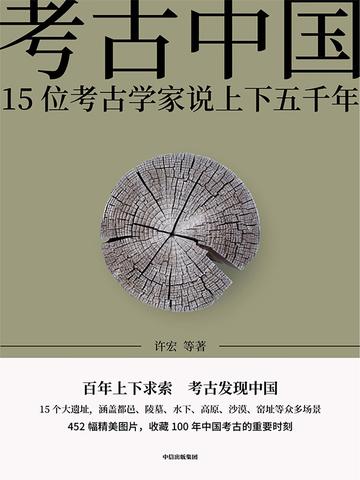
"Archaeology of China - 15 Archaeologists Talk About Five Thousand Years" is a general reading that presents 5,000 years of Chinese civilization from an archaeological perspective. 15 Major sites representing Chinese civilization are selected, including Yinxu, Sanxingdui, Liangzhu, Qin Shihuang's Mausoleum, Nanhai No. 1, The Great Wall, etc., Covering cities, mausoleums, underwater, plateaus, deserts, kiln sites and many other scenes, involving rich historical and cultural information on politics, religion, military, science and technology, industry, agriculture, architecture, transportation, water conservancy, etc., Presented in full color. Archaeologists wonderfully told their personal archaeological stories and vividly explained the great construction, great exchanges and great dreams of Chinese civilization behind the archaeological discoveries. Each article is accompanied by some archaeological knowledge, which can be understood even with no basic knowledge. The whole book is organized according to the time of archaeological discoveries, from 1921 to 2020, paying tribute to the centenary of Chinese archeology and Chinese archaeologists.
Reader comments
China's culture is so profound that it can span up to five thousand years. Let's listen to the voices and insights of 15 outstanding archaeologists from different fields about archaeological China. Each archaeologist in the book uses their unique perspective and research direction to conduct an in-depth analysis of ancient Chinese civilization. For example, through archaeological excavation, cultural relic research, and historical comparison, they restore the appearance of ancient society and reveal the lives, thoughts, and culture of ancient people. I believe that listening to their thoughts can not only help us gain new historical understanding, but also provide an important reference for our in-depth understanding of Chinese traditional culture and values.
Since the Classic of Mountains and Seas, I have been fascinated by ancient Chinese history. Looking at the turquoise dragon in the Erlitou ruins, I am even more convinced that I am a descendant of Yan and Huang, a descendant of the dragon from Xia. Chinese civilization was not created by God, nor was it given by God, nor was it helped by aliens. It relied entirely on the summarization of experience, the inheritance of knowledge, and the observation of all things in nature by generations of Chinese people to form a unique civilization that is unique to us. This civilization is so unique and shining among world civilizations.
Before the excavation of the Yin Ruins, and before the first oracle bones appeared, we had almost no idea what the Shang Dynasty was like. Our understanding of this basically only came from the historical records of Sima Qian. Only with the emergence of reinforcements did we confirm that the Shang Dynasty did exist, and showed us the succession sequence of the throne of the Shang Dynasty. The contents of the Yin Ruins in this book , shows us how archaeological work gradually built up a complete Shang Dynasty. This process is undoubtedly very fascinating. Through archeology, we can get a glimpse of the auspicious light of history, and improve its original appearance bit by bit, as large as the restoration of a dynasty. If it were not for archeology, we would never be able to discover these.
Archeology is a subject that connects the past and the present, and it is also a great subject. Just looking at a vessel or an ancient relic from ancient times, we have no idea who left it or what kind of story happened behind it. We are very curious about it. It is our instinct to trace the past and the present, and archeology can give us the answer. This book captures 15 large-scale sites and explains these sites through 14 archaeologists who personally participated in archaeological work. It is both realistic and interesting. The book contains a huge amount of information and reflects all aspects of information involved in each stage of the development of ancient Chinese history. It is of great reading value.
This book resonated with me very much. It reminded me of my regrets about wasting my studies. The archaeological discoveries presented in the book amazed me and gave me a deeper understanding of the long history of Chinese civilization. The stories of archaeologists taught me that there is no end to learning and exploration, and it is never too late to start. I want to pay tribute to Chinese archaeologists, and I hope that like them, I can continue to pursue knowledge and explore the unknown.
China's culture is so profound that it can span up to five thousand years. Let's listen to the voices and insights of 15 outstanding archaeologists from different fields about archaeological China. Each archaeologist in the book uses their unique perspective and research direction to conduct an in-depth analysis of ancient Chinese civilization. For example, through archaeological excavation, cultural relic research, and historical comparison, they restore the appearance of ancient society and reveal the lives, thoughts, and culture of ancient people. I believe that listening to their thoughts can not only help us gain new historical understanding, but also provide an important reference for our in-depth understanding of Chinese traditional culture and values.
Since the Classic of Mountains and Seas, I have been fascinated by ancient Chinese history. Looking at the turquoise dragon in the Erlitou ruins, I am even more convinced that I am a descendant of Yan and Huang, a descendant of the dragon from Xia. Chinese civilization was not created by God, nor was it given by God, nor was it helped by aliens. It relied entirely on the summarization of experience, the inheritance of knowledge, and the observation of all things in nature by generations of Chinese people to form a unique civilization that is unique to us. This civilization is so unique and shining among world civilizations.
Before the excavation of the Yin Ruins, and before the first oracle bones appeared, we had almost no idea what the Shang Dynasty was like. Our understanding of this basically only came from the historical records of Sima Qian. Only with the emergence of reinforcements did we confirm that the Shang Dynasty did exist, and showed us the succession sequence of the throne of the Shang Dynasty. The contents of the Yin Ruins in this book , shows us how archaeological work gradually built up a complete Shang Dynasty. This process is undoubtedly very fascinating. Through archeology, we can get a glimpse of the auspicious light of history, and improve its original appearance bit by bit, as large as the restoration of a dynasty. If it were not for archeology, we would never be able to discover these.
Archeology is a subject that connects the past and the present, and it is also a great subject. Just looking at a vessel or an ancient relic from ancient times, we have no idea who left it or what kind of story happened behind it. We are very curious about it. It is our instinct to trace the past and the present, and archeology can give us the answer. This book captures 15 large-scale sites and explains these sites through 14 archaeologists who personally participated in archaeological work. It is both realistic and interesting. The book contains a huge amount of information and reflects all aspects of information involved in each stage of the development of ancient Chinese history. It is of great reading value.
This book resonated with me very much. It reminded me of my regrets about wasting my studies. The archaeological discoveries presented in the book amazed me and gave me a deeper understanding of the long history of Chinese civilization. The stories of archaeologists taught me that there is no end to learning and exploration, and it is never too late to start. I want to pay tribute to Chinese archaeologists, and I hope that like them, I can continue to pursue knowledge and explore the unknown.
It is very readable and easy to read.