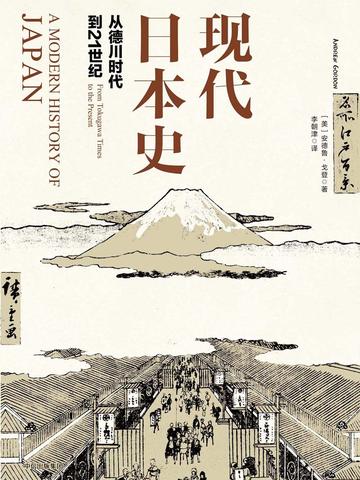
"Modern Japanese History: From the Tokugawa Period to the 21st Century" is a general reading that panoramically displays Japan's nearly 200 years of modernization and understands Japan's modern history. The author sorts out the ins and outs of Japan's modernization process in the context of global history. While making a grand narrative, it also reflects the practical activities and emotional experiences of different classes in Japan in detail. It is an excellent popular history work that provides a new interpretation of modern Japanese history. **In the past 200 years, the histories of China and Japan have been intertwined and closely related. Japan is known as China's "stranger at the gate." Except for events such as the Meiji Restoration, the Sino-Japanese War of 1888-1895, and the subsequent Anti-Japanese War, the Chinese-speaking world has little understanding of Japanese history, especially the context of Japan's internal political, economic, diplomatic, social, and cultural development. Japan is an important neighbor of China and will continue to play an important role politically and economically in the years to come. The modernization experience of the Japanese people over the past 200 years is an amazing story. "Modern Japan History" spans the time period from the Tokugawa Shogunate to the "3.11" Earthquake in 2011. It is a general history work that comprehensively describes the modernization process of Japan to the east in the past 200 years. As an expert on Japanese history at Harvard University, Andrew Gordon puts forward his own unique interpretation of the development of Japanese history based on absorbing new research results in the academic world. Different from other general history books, the author examines Japan's modern history in the context of world modernization, pointing out that the various uniquenesses of Japan today are mostly "traditional inventions" made to highlight national character in the process of establishing a modern nation-state, and strongly denies the widely popular "Japanese uniqueness theory." The content of this book covers a wide range of levels and is similar to an encyclopedia. However, it does not rigidly describe the political and social structural changes in Japanese history. Instead, it adopts a life-like and panoramic approach to describe the pain and joy experienced by the Japanese in the process of modernization. The emperor, the samurai, the soldiers, the priests, the scholars, the peasants... All the forces were entangled, either uniting or confronting each other, working together to push the wheel of history towards modernization, and walking through these 200 years of turbulent and magnificent history together. How do they understand the social and political environment in which they live? By reading this book, readers can have a personal experience of the practices and emotions of the Japanese people, and grasp the warmth of history immersively.
Reader comments
This can be said to be a general reading that provides a panoramic view of Japan's nearly 200 years of modernization and an understanding of Japan's modern history. The author sorts out the ins and outs of Japan's modernization process in the context of global history. While making a grand narrative, it also reflects in detail the practical activities and emotional experiences of different classes in Japan. It is an excellent popular history work that provides a new interpretation of modern Japanese history. The History of Nakasho is a fascinating book. The book discusses Japan's modern evolution process in a special topic. It closely follows this theme and describes the origins and changes, rather than a chronological flow. It first describes the ancient history of Japan and goes back to the past, so it is comprehensive and can be used as a popular reading book on the general history of Japan.
This book is a very neat history textbook. The author uses global history as the background to sort out the ins and outs of Japan's modernization process. In terms of narrative perspective, the author has a unique narrative perspective. While narrating history in a grand way, he also meticulously reflects the practical activities and emotional experiences of different classes in Japan. In terms of the layout of the full text, the author has reasonable tailoring and appropriate details. From the writing to the historical materials to the stance, the writing is plain and concise, allowing readers to savor it carefully. After reading it, readers will have a new understanding of Japanese history.
This book is very rich in content, like an encyclopedia, allowing me to understand the process of Japan's modernization. It turns out that many of Japan's unique features were invented during the establishment of the modern nation-state. I think this book is a bit similar to "General History of Japan", they both talk about the history of Japan. However, I prefer the narrative style of this book, which feels more vivid and easier to understand. The characters in the book are so vivid that I felt like I was actually there. It's the Tokugawa shogunate, which I don't like very much. I feel that they are very conservative and hinder Japan's development. But this also illustrates the complexity of history, and each role has its own role.
This book narrates the context and changes of Japanese history. The book meticulously explores key periods such as the Tokugawa Era, the Meiji Restoration, World War II, and postwar reconstruction, revealing the profound impact these periods had on Japanese society and culture. In order to allow readers to better understand the content of the book and to make the narrative more vivid and interesting, the author has added a large number of detailed cases to the book. Gordon describes in detail the various changes that took place in Japan during the Meiji Restoration, such as the abolition of feudal lords and the establishment of prefectures, the reform of the school system, etc. Through these specific cases, readers can gain an in-depth understanding of the huge changes in society at that time and the role it played in promoting Japan's modernization.




This can be said to be a general reading that provides a panoramic view of Japan's nearly 200 years of modernization and an understanding of Japan's modern history. The author sorts out the ins and outs of Japan's modernization process in the context of global history. While making a grand narrative, it also reflects in detail the practical activities and emotional experiences of different classes in Japan. It is an excellent popular history work that provides a new interpretation of modern Japanese history. The History of Nakasho is a fascinating book. The book discusses Japan's modern evolution process in a special topic. It closely follows this theme and describes the origins and changes, rather than a chronological flow. It first describes the ancient history of Japan and goes back to the past, so it is comprehensive and can be used as a popular reading book on the general history of Japan.
This book is a very neat history textbook. The author uses global history as the background to sort out the ins and outs of Japan's modernization process. In terms of narrative perspective, the author has a unique narrative perspective. While narrating history in a grand way, he also meticulously reflects the practical activities and emotional experiences of different classes in Japan. In terms of the layout of the full text, the author has reasonable tailoring and appropriate details. From the writing to the historical materials to the stance, the writing is plain and concise, allowing readers to savor it carefully. After reading it, readers will have a new understanding of Japanese history.
This book is very rich in content, like an encyclopedia, allowing me to understand the process of Japan's modernization. It turns out that many of Japan's unique features were invented during the establishment of the modern nation-state. I think this book is a bit similar to "General History of Japan", they both talk about the history of Japan. However, I prefer the narrative style of this book, which feels more vivid and easier to understand. The characters in the book are so vivid that I felt like I was actually there. It's the Tokugawa shogunate, which I don't like very much. I feel that they are very conservative and hinder Japan's development. But this also illustrates the complexity of history, and each role has its own role.
This book narrates the context and changes of Japanese history. The book meticulously explores key periods such as the Tokugawa Era, the Meiji Restoration, World War II, and postwar reconstruction, revealing the profound impact these periods had on Japanese society and culture. In order to allow readers to better understand the content of the book and to make the narrative more vivid and interesting, the author has added a large number of detailed cases to the book. Gordon describes in detail the various changes that took place in Japan during the Meiji Restoration, such as the abolition of feudal lords and the establishment of prefectures, the reform of the school system, etc. Through these specific cases, readers can gain an in-depth understanding of the huge changes in society at that time and the role it played in promoting Japan's modernization.
This book is not bad.