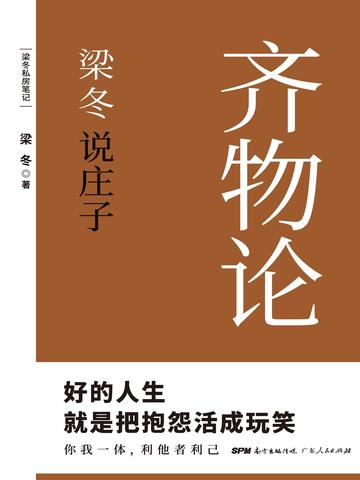
After interpreting the two major themes of "Liang Dong Speaks of Zhuangzi·Human World" and "Liang Dong Speaks of Zhuangzi·Health Preservation Master", "It is dangerous to just be a good person" and "How to solve the big problems in life at a small price", "Liang Dong Speaks of Zhuangzi·Equality of Things" reveals to you the life wisdom of "a good life is to turn complaints into a joke" and teaches you to use an optimistic and holistic approach. Look at your past, present and future from a perspective of interest, allowing you to gain insight into the truth of life - in fact, we are all "second-rate" because most of the time we live in the binary opposition of good and bad, right and wrong. Therefore, all our unhappiness in the world is because we do not realize that we are blinded by our own "prejudices".
Reader comments
I lose myself: Letting go of the paranoid ego does not mean annihilating the self.
Why do most people often fall into unhappy moods?
Because most of the time we live in the binary opposition of good and bad, right and wrong, and are blinded by our own prejudices. We are obsessed with a single standard of judgment, and will have negative emotions if things do not meet expectations.
For example, if someone fails the postgraduate entrance examination, they feel that their entire life is useless and fall into a long period of self-denial. However, they ignore the learning ability and the settled character that they have developed during the preparation process.
That is also right and wrong, and this is also right and wrong.
The author Liang Dong puts forward a very personal analogy: the world is like a holographic projection, we are slices of the whole, and everything projects each other and is related to each other.
Break away from binary judgments of black and white, look at people and things from a more global and long-term perspective, and accept the diversity and multifacetedness of everything.
There is no absolute right or wrong in the world. All judgments of right and wrong are based on the judge's own position, experience, and cognitive limitations. They are all personal prejudices. If the position is changed and the time dimension is changed, the standards of right and wrong may completely change.
Take the most common form of overtime as an example. The boss requires employees to work overtime on weekends to catch up on projects. Employees feel that it is wrong for the boss to exploit people, and the boss feels that if the project fails, the entire company will lose their jobs.
It makes sense from each side's standpoint. There is no need to argue over who is right and who is wrong. Negotiating overtime compensation can lead to a win-win situation for both parties.
This book interprets Zhuangzi's thoughts in humorous language, giving people a new understanding of life. By describing Zhuangzi's philosophy, the author inspires us to transcend binary opposition and look at things from a more comprehensive perspective. The unique viewpoints and vivid writing style in the book allow readers to comprehend the wisdom of life through relaxed reading.
Very interesting and useful!
Very good, a new perspective, improved cognitive ability after reading it







I lose myself: Letting go of the paranoid ego does not mean annihilating the self. Why do most people often fall into unhappy moods? Because most of the time we live in the binary opposition of good and bad, right and wrong, and are blinded by our own prejudices. We are obsessed with a single standard of judgment, and will have negative emotions if things do not meet expectations. For example, if someone fails the postgraduate entrance examination, they feel that their entire life is useless and fall into a long period of self-denial. However, they ignore the learning ability and the settled character that they have developed during the preparation process. That is also right and wrong, and this is also right and wrong. The author Liang Dong puts forward a very personal analogy: the world is like a holographic projection, we are slices of the whole, and everything projects each other and is related to each other. Break away from binary judgments of black and white, look at people and things from a more global and long-term perspective, and accept the diversity and multifacetedness of everything. There is no absolute right or wrong in the world. All judgments of right and wrong are based on the judge's own position, experience, and cognitive limitations. They are all personal prejudices. If the position is changed and the time dimension is changed, the standards of right and wrong may completely change. Take the most common form of overtime as an example. The boss requires employees to work overtime on weekends to catch up on projects. Employees feel that it is wrong for the boss to exploit people, and the boss feels that if the project fails, the entire company will lose their jobs. It makes sense from each side's standpoint. There is no need to argue over who is right and who is wrong. Negotiating overtime compensation can lead to a win-win situation for both parties.
This book interprets Zhuangzi's thoughts in humorous language, giving people a new understanding of life. By describing Zhuangzi's philosophy, the author inspires us to transcend binary opposition and look at things from a more comprehensive perspective. The unique viewpoints and vivid writing style in the book allow readers to comprehend the wisdom of life through relaxed reading.
Very interesting and useful!
Very good, a new perspective, improved cognitive ability after reading it