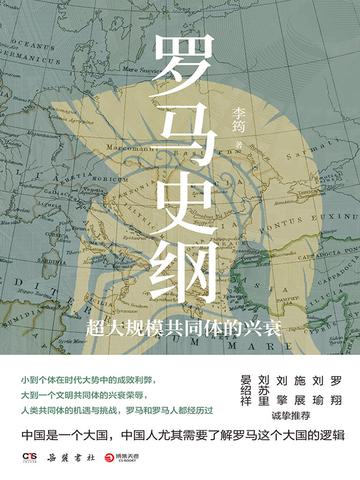
This book is written in the form of a "historical outline" and outlines the development process of Roman history around the core concept of "super large-scale community", and uses this model to shed light on a key development stage of Western history and civilization. The book consists of one main line and three thematic units. It analyzes the royal era, republican era and imperial era of Rome in chronological order, and deciphers the underlying logic of Rome, a very large community. While analyzing the history of Rome, this book also provides a reference for us to rethink the development path of China as a "big country".
Reader comments
After reading this book, I know: the age of empire is the middle and old age of Rome. Of course she has an arrogant middle age, but she will also enter an old age of decline and aging, and will eventually inevitably die. The Roman Empire did not receive as much praise as the Roman Republic. On the one hand, the achievements of the Empire were not as impressive as those of the Republic. On the other hand, because the Republic had long been "politically correct" on the surface, the Empire was always subject to moral criticism. The tradition of favoring the republic and rejecting the empire began with Livy, the greatest historian of the imperial era.
The author, Mr. Li Jun, told us that in fact, the important purpose of history is to extract general principles from history, especially political general principles. Because the success of building Rome is worth pondering, but it can never be achieved through imitation. If you want to learn from the success of others, you must analyze them, abstract historical stories into general principles that transcend history, and then use the general principles to face today's situation and guide today's actions.
"History" is the material, "outline" is the logic, history is the introduction to medicine, and great logic is the true insight. The characteristic of this book is that it uses a clear framework and logic to grasp important nodes in historical evolution, and teaches people to analyze the general principles hidden behind it through historical stories.
The reasons why I like "Outline of Roman History" are as follows: starting from the beginning of Rome, there is a source. This may be common to all historical works, but this book gave me a very solid feeling. The knowledge points have corresponding annotations. Perhaps it is like a paper. The references are clearly listed at the end of each chapter. This has led to the addition of many books that I am interested in on my bookshelf, which provides great convenience for further reading.
You have to read the book. No matter how long the video podcast is, it will never go into such detail. Reading a book can greatly improve your knowledge. If you can't read, you can listen to the book. I use 1.1X clear Qingshuyin, which is very good and I can keep up with my thinking.
This book is a compendium of Roman history. Rome is a mysterious civilization with a long history in human history. We don't know much about it, and there are too many secrets waiting for us to uncover it. This book is like a sapper's shovel, revealing a small part of this mysterious giant's secret chamber for us. But even this is enough for us ordinary people to feast our eyes on. While reading, I had to marvel at the greatness and magic of Rome. Recommended for everyone to read.
Li Jun holds a PhD in political science from China University of Political Science and Law. His main research directions include Western political tradition and political modernization, the history of Western political thought, and Western state theory. This book uses one main line and three thematic units to deeply analyze the history of Rome's monarchy era, republican era and imperial era in chronological order. This systematic and professional explanation of the Roman civilization, one of the origins of European civilization and a profound influence in politics, art and other fields, is systematically and professionally explained from religion, economy, politics, culture, etc., Laying the foundation for our understanding of today's world and art.
Not bad, pretty good
The writing is objective, true and rigorous. The writing is great. The logical thinking is clear and perfect.
After reading this book, I know: the age of empire is the middle and old age of Rome. Of course she has an arrogant middle age, but she will also enter an old age of decline and aging, and will eventually inevitably die. The Roman Empire did not receive as much praise as the Roman Republic. On the one hand, the achievements of the Empire were not as impressive as those of the Republic. On the other hand, because the Republic had long been "politically correct" on the surface, the Empire was always subject to moral criticism. The tradition of favoring the republic and rejecting the empire began with Livy, the greatest historian of the imperial era.
The author, Mr. Li Jun, told us that in fact, the important purpose of history is to extract general principles from history, especially political general principles. Because the success of building Rome is worth pondering, but it can never be achieved through imitation. If you want to learn from the success of others, you must analyze them, abstract historical stories into general principles that transcend history, and then use the general principles to face today's situation and guide today's actions. "History" is the material, "outline" is the logic, history is the introduction to medicine, and great logic is the true insight. The characteristic of this book is that it uses a clear framework and logic to grasp important nodes in historical evolution, and teaches people to analyze the general principles hidden behind it through historical stories.
The reasons why I like "Outline of Roman History" are as follows: starting from the beginning of Rome, there is a source. This may be common to all historical works, but this book gave me a very solid feeling. The knowledge points have corresponding annotations. Perhaps it is like a paper. The references are clearly listed at the end of each chapter. This has led to the addition of many books that I am interested in on my bookshelf, which provides great convenience for further reading.
You have to read the book. No matter how long the video podcast is, it will never go into such detail. Reading a book can greatly improve your knowledge. If you can't read, you can listen to the book. I use 1.1X clear Qingshuyin, which is very good and I can keep up with my thinking.
This book is a compendium of Roman history. Rome is a mysterious civilization with a long history in human history. We don't know much about it, and there are too many secrets waiting for us to uncover it. This book is like a sapper's shovel, revealing a small part of this mysterious giant's secret chamber for us. But even this is enough for us ordinary people to feast our eyes on. While reading, I had to marvel at the greatness and magic of Rome. Recommended for everyone to read.
Li Jun holds a PhD in political science from China University of Political Science and Law. His main research directions include Western political tradition and political modernization, the history of Western political thought, and Western state theory. This book uses one main line and three thematic units to deeply analyze the history of Rome's monarchy era, republican era and imperial era in chronological order. This systematic and professional explanation of the Roman civilization, one of the origins of European civilization and a profound influence in politics, art and other fields, is systematically and professionally explained from religion, economy, politics, culture, etc., Laying the foundation for our understanding of today's world and art.
Not bad, pretty good
The writing is objective, true and rigorous. The writing is great. The logical thinking is clear and perfect.