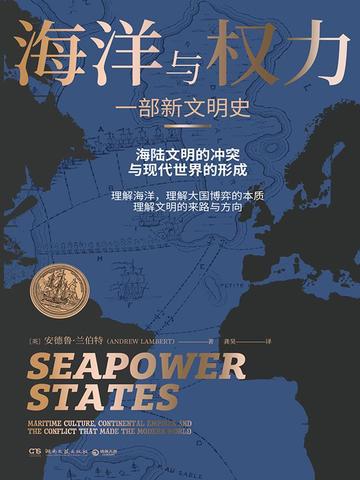
This is a classic work that won the 2018 Gilder Lerman Military History Award. It is also the core work of British historian Andrew Lambert, a well-known scholar in the field of global maritime history.
This book with the meaning of "big thinking" tells the story of the past glorious era and future direction of sea-power countries, explores how medium-sized countries in the past and present have consciously created characteristics with the sea as the core, and deeply analyzes the fundamental conflicts between sea and land civilizations and the formation process of the modern world pattern.
In this book, the author focuses on five maritime powers that are curious about the outside world: Athens, Carthage, Venice, the Netherlands, and the United Kingdom, and explores how their innate and unique maritime power culture enabled them to achieve success beyond the scale of their own territories and become "ocean overlords" that flourished for a time. But when the conflict between land power and sea power becomes increasingly clear, and the global pattern undergoes drastic changes, the status of the "ocean" begins to be rethought and redefined. This is also an issue that we need to pay attention to and solve today.
Reader comments
This is a classic work that won a history award. It is also the core work of the author, a well-known scholar in the field of ocean and a British historian. This work has great significance for thinking. It tells the past glory of ocean countries and the current development direction of ocean countries and how to develop the ocean. It also analyzes how the country consciously creates characteristics with the ocean as its core and analyzes the impact of ocean civilization on land civilization. In this book, we can clearly understand the formation of the ocean and the symbol between the ocean and power.
Mahan's theory of sea power made the world aware of the importance of good sea power. Sea power remains important today because the great fault lines in global politics always end up with the distinct nature of land and sea states. The contemporary tensions between "the West" and its adversaries reflect the deep cultural differences between a continental system characterized by authoritarian rule, ideological conformity, command economies, closed borders, and deep-seated anxieties dating back to ancient philosophers about the sea as a vehicle for destabilizing ideas, and the legacy of sea-power states characterized by inclusive politics, open and outward-looking societies, the rule of law, individual freedoms, and economic opportunity.
In ancient times, humans had a history of economic exchanges through maritime trade, including maritime trade activities and commercial networks in the Red Sea, Indian Ocean and other regions. In modern times, the struggle for maritime power is the theme of modern war doctrine, because the ocean area is very large, and strong national power is needed to dominate the sea area. Among them, the United States became the world's largest maritime hegemon in the early 20th century and used naval power to protect its interests and expand its territory. This book deeply explores the relationship between the ocean and human civilization, economy, politics and other aspects, and has high reference value and historical significance.
The history of the development of maritime culture in European countries is a history of economic development and civilization expansion. The economic development and colonial hegemony of European countries are inseparable from the maritime economy. From the ancient Maritime Silk Road to the modern ocean trade network, the ocean has promoted exchanges and prosperity among different civilizations at different levels. The explorers of the Age of Sail, the development of navigation technology, and the discovery and colonization of the New World. The ocean has helped humans explore unknown areas and expand their cognitive boundaries.
Gained a new perspective on ocean country.
If the world warms in the future and the land becomes an ocean, we may build the world structure that existed thousands of years ago.





This is a classic work that won a history award. It is also the core work of the author, a well-known scholar in the field of ocean and a British historian. This work has great significance for thinking. It tells the past glory of ocean countries and the current development direction of ocean countries and how to develop the ocean. It also analyzes how the country consciously creates characteristics with the ocean as its core and analyzes the impact of ocean civilization on land civilization. In this book, we can clearly understand the formation of the ocean and the symbol between the ocean and power.
Mahan's theory of sea power made the world aware of the importance of good sea power. Sea power remains important today because the great fault lines in global politics always end up with the distinct nature of land and sea states. The contemporary tensions between "the West" and its adversaries reflect the deep cultural differences between a continental system characterized by authoritarian rule, ideological conformity, command economies, closed borders, and deep-seated anxieties dating back to ancient philosophers about the sea as a vehicle for destabilizing ideas, and the legacy of sea-power states characterized by inclusive politics, open and outward-looking societies, the rule of law, individual freedoms, and economic opportunity.
In ancient times, humans had a history of economic exchanges through maritime trade, including maritime trade activities and commercial networks in the Red Sea, Indian Ocean and other regions. In modern times, the struggle for maritime power is the theme of modern war doctrine, because the ocean area is very large, and strong national power is needed to dominate the sea area. Among them, the United States became the world's largest maritime hegemon in the early 20th century and used naval power to protect its interests and expand its territory. This book deeply explores the relationship between the ocean and human civilization, economy, politics and other aspects, and has high reference value and historical significance.
The history of the development of maritime culture in European countries is a history of economic development and civilization expansion. The economic development and colonial hegemony of European countries are inseparable from the maritime economy. From the ancient Maritime Silk Road to the modern ocean trade network, the ocean has promoted exchanges and prosperity among different civilizations at different levels. The explorers of the Age of Sail, the development of navigation technology, and the discovery and colonization of the New World. The ocean has helped humans explore unknown areas and expand their cognitive boundaries.
Gained a new perspective on ocean country. If the world warms in the future and the land becomes an ocean, we may build the world structure that existed thousands of years ago.