Face the darkness and speak the truth of history. Hundreds of Japanese eyewitnesses reveal their bloody, brutal wartime experiences for the first time.
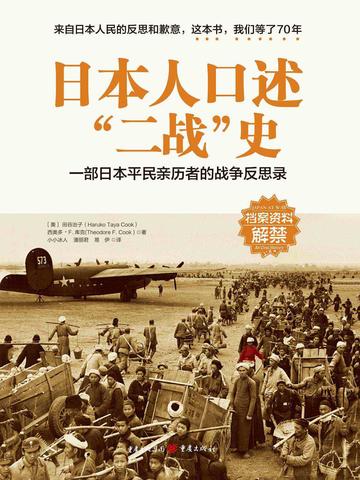
During World War II, Japan inflicted immense suffering on the Asia-Pacific region, and the wounds remain to this day. Yet the Japanese authorities have always avoided discussing the war's origins, course, cost, and consequences, and have never offered an apology. Why? By contrast, when Japanese civilians who were dragged into the depths of war looked back on it decades later, why did they so often describe it as too shameful to speak of, too painful to face?
This book is a groundbreaking work of oral history. The renowned Western historians Theodore F. Cook and Haruko Taya Cook traveled throughout Japan and interviewed hundreds of people who had experienced the war firsthand. Drawing on many previously unpublished letters, wills, diaries, military notebooks, government records, and other materials, they seek to reconstruct the full picture of the war and reveal for the first time the conflicting feelings of people in Japan today as they remember World War II. Their interviewees come from every walk of life: diplomats, kamikaze pilots, doctors in Unit 731, prisoner-of-war camp guards, and war criminals who served as soldiers in China; atomic bomb survivors, journalists, students, comfort women, Chinese merchants in Japan, painters, and many others. From their own perspectives, they recount a hidden and despairing nightmare: the truth about Unit 731's live human experiments in China; the specifics of Japan's chemical warfare there; the details of mass atrocities aimed at destroying humanity, epitomized by the Nanjing Massacre; the humiliation suffered by Korean and Japanese comfort women; the thoughts of kamikaze pilots as they prepared to die striking at Allied forces; and the details of civilians turning on one another under official propaganda as the Allies closed in...
These vivid personal accounts offer a direct view of how the conflict that began with the invasion of China cruelly destroyed the lives of people across Southeast Asia, including Japanese civilians. They reveal the vast gulf between the Japanese authorities' view of the war and the stories told by ordinary people.
A nightmare of mindless slaughter, a descent into depravity and fear too painful to recall.

This book allows us to understand World War II from a Japanese perspective through oral history. The characters' experiences in the book shocked me and gave me a deeper understanding of the cruelty of war. I think everyone should try to understand history and avoid repeating the same mistakes.
This book tells a good story about the mentality of Japanese grassroots soldiers, civilians and even people from all walks of life during and after the war. However, the author does not know much about the establishment of the Japanese army, which is indeed an insignificant issue.