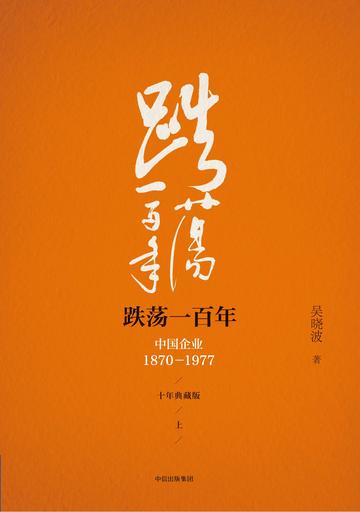
"A Hundred Years of Ups and Downs" is a follow-up to "Thirty Years of Ups and Downs" in which Wu Xiaobo goes upstream and writes about another 100 years of Chinese enterprises. To understand China's century-old rise, this is an epic work not to be missed. The first volume describes the transformation of Chinese enterprises from 1870 to 1937. The author hopes to find the answer from history: How are the growth genes and spiritual qualities of today's Chinese entrepreneurs formed? Is it a product of thirty years, or should it be examined in a longer historical context? In the history of China's progress over the past thirty years or even a century, what role have entrepreneurs played? From Zeng Guofan, Li Hongzhang, Sheng Xuanhuai, Zheng Guanying, to Zhang Jian, the Rong brothers, and the Kong and Song families, we are looking for the blood genes of China's commercial progress. The author records the development history of Chinese enterprises from a special perspective. It has both documentary value and vivid stories, and is filled with the light of idealism, the charm of heroism and romantic feelings! The second volume reorganizes the history of Chinese enterprises and business changes from 1938 to 1977. The author chronicles the Chinese business history during the period of the Anti-Japanese War, after the victory of the Anti-Japanese War, during the War of Liberation, after the founding of New China, and until the 40 years before China's reform and opening up period. The author attempts to explore the growth genes, spiritual qualities and development pulse of Chinese business figures and enterprises under these specific historical backgrounds. How to examine China's commercial development in the long historical breadth? In the century-old history of China's progress, what role have entrepreneurs played?
Reader comments
From "The Great Defeat" to "Thirty Years of Stirring" and then to "One Hundred Years of Stuttering", the author can use very fascinating language to quickly draw people into the historical atmosphere and lead them to sexual thinking. During that period of history, how did those people deal with the predicament at that time? How much better could we be if we were you and me?
It has strong reference significance for the development of today's social economy. It is more beneficial to observe from another perspective than to only hold the original perspective. The professionalism combines with the feelings of family and country to increase readability, and the structure is also very reasonable. You can finish reading a chapter without realizing it.
It was pretty good, I learned some history.
Concise and vivid, the author himself has read a lot of books
From "The Great Defeat" to "Thirty Years of Stirring" and then to "One Hundred Years of Stuttering", the author can use very fascinating language to quickly draw people into the historical atmosphere and lead them to sexual thinking. During that period of history, how did those people deal with the predicament at that time? How much better could we be if we were you and me?
It has strong reference significance for the development of today's social economy. It is more beneficial to observe from another perspective than to only hold the original perspective. The professionalism combines with the feelings of family and country to increase readability, and the structure is also very reasonable. You can finish reading a chapter without realizing it.
It was pretty good, I learned some history.
Concise and vivid, the author himself has read a lot of books