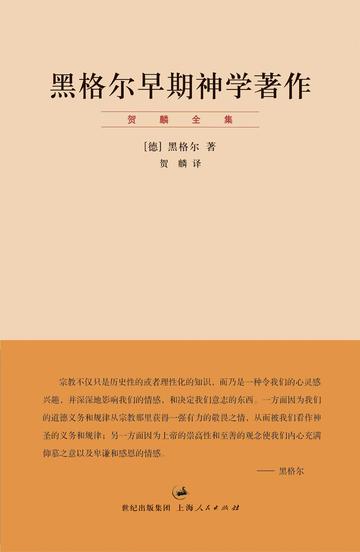
The Complete Works of He Lin: Hegel's Early Theological Works
贺麟全集:黑格尔早期神学著作
- Status
- Completed
- Length
- 333k Words
- Updated
- 4y ago
- Source
- Fanqie
Stats
6Reads
8.7Score
10Chapters
572Reads · all time
Tags
Synopsis
Reader comments
In booklists 2




Philosophy, the Kind of Masterpiece That Is Enough to Burn Your Brain and Make You Forget About Food and Drink (Regardless of Sects)
Confucianism, Taoism and Buddhism
3.6MViews567Books9dUpdated

Books to Improve Thinking
I want to read a book similar to "A Guide to Cheating in Life". Ordinary people can read this book and improve their thinking
761.9kViews492Books2dUpdated
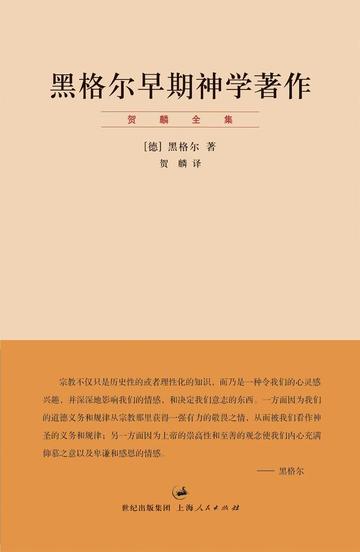
Hegel is a famous German philosopher. His early work "Phenomenology of Spirit" explores the evolution of human consciousness, starting from perceptual perception, then gradually developing through rational thinking, and finally reaching a state of self-knowledge and spiritual freedom. Hegel used the method of "dialectics" to study consciousness and culture at different stages, including ancient Greece, Christianity, and the Enlightenment. Hegel viewed Christianity as a critical moment in the course of historical development because it represented a reassessment of individual and social values. He believes that the core concepts of Christianity - love and selflessness - reveal the true meaning of human existence, and this true meaning is achieved through contradictions and struggles in the historical process.
"Man is subject to God, but God is only the good and evil in people's hearts. Religious sensibility applies to human feelings and emotions, but it does not belong to reason, because there is no light at all on the other side." Hegel borrowed the concept of "revealed religion" from Enlightenment theology to refer to rigid religions that rely on authority and tradition. The opposite of revealed religion is people's religion. Although the people's religion is based on reason, it first appeals to emotions, and all life requirements and national public affairs are closely related to the people's religion. Through these theological terms, he clearly raises the question of reasonable social institutions. The young Hegel believed that the typical example of this system was ancient democracy.
Hegel's early theological works were mainly concentrated during his teaching period at the University of Tübingen. These works involved religious philosophy, Christian theology and doctrinal issues, laying the foundation for his later philosophical system. One of the most important works is the Theological Drafts, a collection of essays including "Reflections on Critical Theology" and "Reflections on the Nature and History of Christianity." He Qi annotated these papers, discussed the relationship between religion and philosophy, and elaborated on Hegel's views on theology and faith issues.
In this book, Hegel attempts to explore the development of religious spirit in history - which is also a certain stage of spiritual development - in a way that is different from the trivial examination of historical facts and grand narratives of church history that are popular among historians and religious scientists, reflecting Hegel's ideological lineage starting from Kant and moving towards his own philosophy. He Lin is a well-known Western philosophy expert and translator at home and abroad. He is proficient in Hegel's philosophy and has discussed all aspects of Hegel's philosophy.