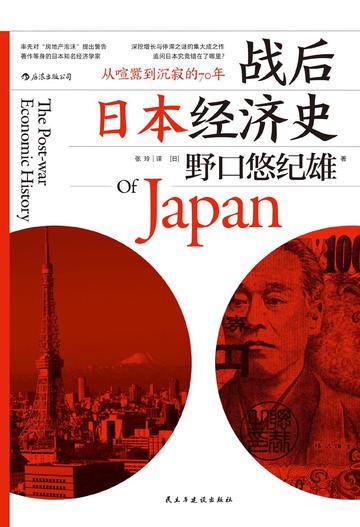
How did Japan achieve rapid economic recovery amidst the devastation after World War II? What force has pushed Japan's economy onto the path of rapid development? How did the once noisy "bubble economy" come into being and how did it eventually burst? After nearly 30 years of silence, where does Japan's future lie?
When the whole country of Japan was immersed in the fanatical atmosphere of its glorious past, Noguchi Yukio took the lead in issuing a public warning about the "real estate bubble". Today, when Japan is gradually being left behind by the tide of the world economy, and "Abenomics" has achieved little success, Yukio Noguchi has made public the answers to his years of thinking and questioning through this book.
Yukio Noguchi recalled in the book that the first images of his life began with the horrific experience during the Tokyo Air Raid in 1945. His generation personally experienced and participated in the entire process of postwar Japan's economic development. They were once filled with pride for the boundless scenery of rapid development, but they were also filled with mixed emotions due to the decline and depression that followed the economic stall. Many of them have been tricked by fate due to the changes of the times, or have been ruthlessly lost in the torrent of the times.
While discussing the process of economic development and its underlying mechanisms, this book also introduces a large number of real-life experiences of Yukio Noguchi himself and his friends and colleagues, restoring vivid and three-dimensional social and economic pictures of post-war Japan to readers. I believe that both Yukio Noguchi's cold and sharp analysis of economic issues and his affectionate look back on past experiences will bring readers an extraordinary reading experience.
Reader comments
The postwar economy is a continuation of the prewar economy, and postwar Japanese companies took shape during the war. At the end of the war, Japan was razed to the ground. After the war, it needed a lot of industrial and infrastructure construction, and the latest technologies and equipment in the world were introduced. At the same time, most postwar Japanese companies were formed during the war. , With the collapse of the Bretton Woods system, countries changed from fixed exchange rates to floating exchange rates, and the yen further appreciated significantly, making the yen more and more powerful. Japan then overcame the impact of two oil crises, mainly due to the continuation of the pre-war economic system, which allowed the government to indirectly control the direction of the national economy.
This book can provide a good understanding of the post-war Japanese economic history. Whether it is at the micro personal experience level or the macro overall level, it can provide a summary of this part of history. As the first economist in Japan to discover Japan's economic bubble, Yukio Noguchi has keen insight and a transcendent pattern. This book allows me to see the Japanese authorities that have maintained the characteristics of "little cleverness but lack of great wisdom" for 80 years. Putting aside historical factors, I feel sorry for Japan's current weakness, because it must mean that countless ordinary people bear the burden of this era's weakness. However, we should see what is behind Japan's decline and what path led to it, and learn from history.
Japan's economic development in the 70 years after the war has always been a subject of research for many economists. The author starts from that war and unfolds it based on time. The book shows readers a coherent process, which not only interprets and positions what happened in the past, but also speculates on the future based on the current situation and responds to development issues. Events such as the real estate bubble, which are of great significance in the history of world economics, are also explained in the book. It is a very detailed and comprehensive economics reading.
During the period after Japan's defeat and surrender in World War II, Japan experienced a transformation from defeat, poverty and bankruptcy in the war to economic prosperity and rising international status. The period of "Postwar Japanese Economic History" has important historical significance and reference value for the economic development and cultural shaping of Japan as a whole. Researchers usually discuss Japan's postwar economic development, policy formulation, industrial structure adjustment, technological innovation, labor market, and international competition. They analyze the exact causes of Japan's economic miracle and explain why Japan was able to achieve such rapid economic growth and development in a short period of time. At the same time, they will assess the social, environmental and cultural impacts of this rapid growth.
The purpose of studying the history of Japan's economic development is to speculate on the path of China's future economic development. It can be found that China's development situation is almost a replica of Japan 30-40 years ago. China should learn from the lessons of Japan's economic development and cannot simply let historical tragedies be repeated. From the post-war period to Japan's prosperous 1990s, China ended the war at about the same time, but its development lagged behind for decades. It was not until reform and opening up that China began to improve. Although it has the advantage of being a latecomer, it has not escaped the real estate bubble and slow industrial upgrading. The use of innovation is harmful, and the rigorous and meticulous style has been lost. We can only place our hope on scientific and technological innovation to build a strong country in the future.
The writing style of this book is easy to understand, the writing is smooth, and the story is rich and vivid. The author uses his own personal experience as a clue to describe the development process of Japan's economy after the war, allowing readers to have a deeper understanding of Japan's economy. At the same time, the book's analysis of economic issues is also very profound, with unique viewpoints that benefit people a lot. All in all, this is a good book worth reading.
A preliminary understanding of Japan's economic situation in the past 70 years.
The postwar economy is a continuation of the prewar economy, and postwar Japanese companies took shape during the war. At the end of the war, Japan was razed to the ground. After the war, it needed a lot of industrial and infrastructure construction, and the latest technologies and equipment in the world were introduced. At the same time, most postwar Japanese companies were formed during the war. , With the collapse of the Bretton Woods system, countries changed from fixed exchange rates to floating exchange rates, and the yen further appreciated significantly, making the yen more and more powerful. Japan then overcame the impact of two oil crises, mainly due to the continuation of the pre-war economic system, which allowed the government to indirectly control the direction of the national economy.
This book can provide a good understanding of the post-war Japanese economic history. Whether it is at the micro personal experience level or the macro overall level, it can provide a summary of this part of history. As the first economist in Japan to discover Japan's economic bubble, Yukio Noguchi has keen insight and a transcendent pattern. This book allows me to see the Japanese authorities that have maintained the characteristics of "little cleverness but lack of great wisdom" for 80 years. Putting aside historical factors, I feel sorry for Japan's current weakness, because it must mean that countless ordinary people bear the burden of this era's weakness. However, we should see what is behind Japan's decline and what path led to it, and learn from history.
Japan's economic development in the 70 years after the war has always been a subject of research for many economists. The author starts from that war and unfolds it based on time. The book shows readers a coherent process, which not only interprets and positions what happened in the past, but also speculates on the future based on the current situation and responds to development issues. Events such as the real estate bubble, which are of great significance in the history of world economics, are also explained in the book. It is a very detailed and comprehensive economics reading.
During the period after Japan's defeat and surrender in World War II, Japan experienced a transformation from defeat, poverty and bankruptcy in the war to economic prosperity and rising international status. The period of "Postwar Japanese Economic History" has important historical significance and reference value for the economic development and cultural shaping of Japan as a whole. Researchers usually discuss Japan's postwar economic development, policy formulation, industrial structure adjustment, technological innovation, labor market, and international competition. They analyze the exact causes of Japan's economic miracle and explain why Japan was able to achieve such rapid economic growth and development in a short period of time. At the same time, they will assess the social, environmental and cultural impacts of this rapid growth.
The purpose of studying the history of Japan's economic development is to speculate on the path of China's future economic development. It can be found that China's development situation is almost a replica of Japan 30-40 years ago. China should learn from the lessons of Japan's economic development and cannot simply let historical tragedies be repeated. From the post-war period to Japan's prosperous 1990s, China ended the war at about the same time, but its development lagged behind for decades. It was not until reform and opening up that China began to improve. Although it has the advantage of being a latecomer, it has not escaped the real estate bubble and slow industrial upgrading. The use of innovation is harmful, and the rigorous and meticulous style has been lost. We can only place our hope on scientific and technological innovation to build a strong country in the future.
The writing style of this book is easy to understand, the writing is smooth, and the story is rich and vivid. The author uses his own personal experience as a clue to describe the development process of Japan's economy after the war, allowing readers to have a deeper understanding of Japan's economy. At the same time, the book's analysis of economic issues is also very profound, with unique viewpoints that benefit people a lot. All in all, this is a good book worth reading.
A preliminary understanding of Japan's economic situation in the past 70 years.
Good-looking, really good-looking ahhhhhhhhhhhhhhhhhhhhhhhhhhhh