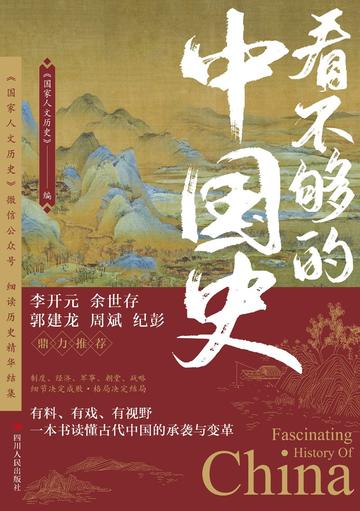
Chinese History You Can’t Get Enough Of
看不够的中国史
- Status
- Completed
- Length
- 280k Words
- Genre
- Historical
- Subgenre
- Unknown
- Updated
- 4y ago
- Source
- Fanqie
Stats
59Chapters
67Reads
9.2Score
11Listens
20.1kReads · all time
Tags
Synopsis
More by this author
In booklists 4




A Few Peak Masterpieces
768Books12.3MViews2hUpdated
Great Historical Fiction
Make it realistic, not too over-the-top.
488Books74.2MViews5dUpdated

Must-Reads for Junior High School Overachievers
Geography, biology, Chinese, English, politics... I don't care, I don't care! I'll take any book that can boost my grades! This is exactly what a study maniac should be reading!
965Books3.6MViews8dUpdated

The Books That Came Up on the High School Entrance Exam. Time to Hit the Books!
86Books57.8kViews7moUpdated
Reader comments 6
Google Translate
China is a country with a long history and rich culture. Its history spans thousands of years and contains many famous dynasties, events and figures. From these dynasty changes and the development of important events, we can learn a lot of valuable experience and principles. As the saying goes, studying history makes people wise. Read more history and think about why the Ming Dynasty was eventually replaced by the Qing Dynasty and why Qin Shihuang was able to unify the six countries. Thinking more about these questions can make us smarter.
Those who are interested in Chinese history are in luck. This book takes us through some important events in history and analyzes the reasons behind them. For example, Emperor Yang Guang of the Sui Dynasty dug the Grand Canal during his southern tour. It started from Huai'an of the Beijing-Hangzhou Grand Canal in the north and extended to the original mouth of the Yangtze River (today's Yangzhou City, Jiangsu Province), with a total length of about 1,794 kilometers. During his western tour, he adopted a series of policies and measures to strengthen the rule and protection of the border. He built a series of military facilities and fortresses in the western region, such as Beidicheng and Jiaocheng, to consolidate the defense of the northwest border. At the same time, he also vigorously recruited ethnic minorities as officials to consolidate his rule and stabilize the situation in the border areas, thereby laying the foundation for homeland security and defense.
Why are the Sixteen States of Yanyun so important? Since the "half-immortal" Liu Bowen was so amazing, why did he end so tragically? In the five thousand years of Chinese history, there are many questions we want to understand, and this book will answer them one by one. It will be explained from five aspects: system, economy, court, strategy, and military. In the past, I always had an inherent impression of historical books as boring, which led to some rejection of such books. However, this book is composed of articles, with detailed content and clear logic. It is explained to us in simple and easy-to-understand language, making the originally boring text more interesting. However, when I opened this book, I did not have the urge to give up halfway, but had the desire to continue reading and read back again and again.
This book is really interesting! It is like a time machine, taking me back to various dynasties in ancient China and watching the wonderful performances of those historical figures on the stage. The book also revealed many interesting historical details, such as "Why most of the Qin Guoxingyao Think Tank are foreigners", which opened my eyes. Moreover, its language is humorous, just like chatting with friends, not boring at all. I think it is very similar to "Those Things in the Ming Dynasty", which allows us to understand history in easy reading. Recommended to friends who like history!
China has a history of five thousand years and has a profound cultural heritage. The success of Qin Shihuang lies not only in his own courage and foresight, which allowed him to sweep through the six kingdoms and unify the world. More importantly, Qin's ancestors worked hard for generations and gradually grew from a small country. Through policies such as Shang Yang's Reform, Qin's management in all aspects was improved, the rule of law was improved, military discipline was rectified, and farmland was reclaimed, which laid a rich material foundation for Qin Shihuang's great cause of unifying the world.
A book worth reading again and again