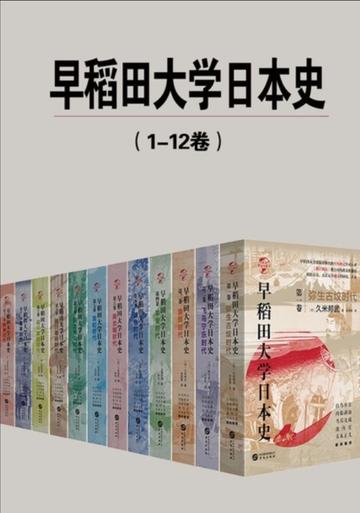
"History of Japan at Waseda University (Volume 1): The Yayoi Tomb Period" writes from Japan's prehistoric society to the reign of Emperor Tenmu. The author, Professor Kuni Takeshi, quoted extensively from Kojiki, Nihonshoki, Chinese historical books, relevant materials collected by Shosoin, and research results of Japanese and European historians during the Meiji period. He placed Japanese history in the history of ancient Asia centered on Chinese history, and elaborated on the ancient territory of Japan, the origins of Japanese religion and politics, Izanozun and Izanagi. Zang Ranzun follows the contents of the Eight Continents, the ancient times of Korea and Fujian, the Hotaru Rebellion, the unification of Japan, the Takachiho Palace era, the Great Japanese Empire, the era of the missing history of the Great Japanese Empire, the Second Founding of the Great Japanese Empire, the establishment of national counties, the expansion of the Japanese Kingdom, the strife of the nobles in the capital, the changes of Nona Tsukushi, the reform of the state religion and government, the restoration of Emperor Tenji, Emperor Tenmu's rectification of the imperial court, etc. Professor Kuni Takeshi investigated the origin and development of the Japanese from the perspective of ethnography and anthropology, and interpreted the "Kojiki" and "Nihon Shoki" from an empirical perspective, and unearthed many historical facts that are thought-provoking.
"History of Japan at Waseda University (Volume 2): The Asuka Niraku Era" Content introduction update: From the operation and driving force of the era, the infiltration of Buddhist culture, the origin and spread of Buddhism, changes in the political system, transformation of social organizations, cultural phenomena in the Asuka Era, and society in the early Neiraku Era The story tells the history of Japan from the Asuka Period (592 AD to 710 AD) and the Neiraku Period (710 AD to 782 AD) from the perspectives of the current situation, Japan's efforts to build a Buddhist country, the connotation and extension of art in the Neiraku Period, and the decadence at the end of the Neiraku Period.
"History of Japan at Waseda University (Volume 3): The Nara Period" is based on first-hand materials collected by Shosoin, Chinese historical books and the latest research results of the Meiji period, etc., Starting from the aristocratic monks before Nara moved the capital, the economic situation of the court nobles, the construction of Hei Castle, the beginning of the Nara period The history of the Nara period (710 AD to 794 AD) is narrated from the perspective of the politics of Nara, the prosperous age of Nara, the relocation of the capital and the founding of Kokubunji Temple, the casting of the Great Buddha of Todaiji Temple, Emperor Shomu becoming a monk, Emi Otsuki's power and execution, Dao Jing's power, Emperor Konin's rectification of government affairs, etc.
"History of Japan at Waseda University (Volume 4): The Heian Period" is the representative work of Professor Kobuchi Ikeda. Professor Kobuchi Ikeda carefully researched the official history and connected the key nodes of historical turning points from the vast sea of classics. He analyzed in depth the construction of Heiankyo, the conquest of Ezo, the Yakoko Rebellion, the Otenmon Rebellion, the Shomon Juntomo Rebellion, the Homoto Heiji Rebellion and other major historical events, and comprehensively presented Emperor Kanmu, Sugawara Michizane, Fujiwara Michinaga, Goshirakawain, Taira Kiyomori and other figures who were in the whirlpool of power...
Reader comments
This book is amazing! It tells the history of Japan in detail, from ancient times to the Tokugawa Shogunate period, giving me a deeper understanding of Japan's development. I especially like the plot about the Warring States Period in the book. The stories of those heroes are really exciting! Moreover, the author's descriptions are very vivid, and the characters' behaviors and decisions are very interesting, making me feel like I am immersed in the scene. All in all, this is a book well worth reading!



This book is amazing! It tells the history of Japan in detail, from ancient times to the Tokugawa Shogunate period, giving me a deeper understanding of Japan's development. I especially like the plot about the Warring States Period in the book. The stories of those heroes are really exciting! Moreover, the author's descriptions are very vivid, and the characters' behaviors and decisions are very interesting, making me feel like I am immersed in the scene. All in all, this is a book well worth reading!
Okay, I finally found a more comprehensive one.
Oh oh oh oh oh oh oh