Stats
9.3Score
11Chapters
Tags
Synopsis
Reader comments
In booklists 3
Buddhism, Taoism, Confucianism
Are there any novels about Buddhism, Taoism, and Confucianism that are so short of books!!?!?!?
60.8MViews102Books2dUpdated




I Accidentally Traveled to a Bear-Infested Place and Led Bald Qiang to Make a Fortune
I want to read a book like "I Got Rich Live Broadcasting with a Bald Man in Gou Xiong Ling".
15.8MViews245Books1dUpdated


On the Good Comics on Tomato (Hand over Your Favorite Comics)
1.6MViews519Books1dUpdated
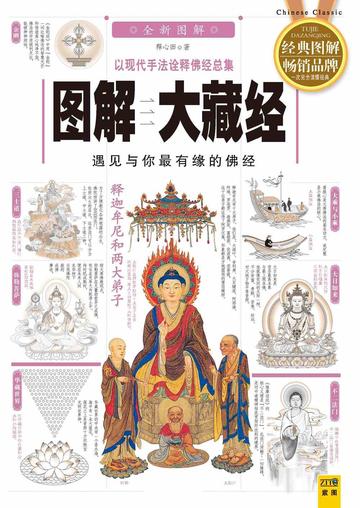
I like to read about Buddhism when I have nothing to do, but I really can't understand the scriptures. The real book is very good and has pictures! It is obviously easier to understand by looking at pictures than just reading text. The pictures in the book are great, not only beautiful, but also well explained. For example, the explanation diagrams of the three styles of Buddhist scriptures are very logical and the explanations are in place; the explanation diagrams of the Bayeux Sutra combine the birth of the Buddha, the first sermon in Sarnath, the youth of Maitreya Buddha, and the portrait of Chandni Bodhisattva, illustrating the relationship between the Sutra Collection, the Vinaya Collection, the Sastra Collection, and the external Tibetan scriptures; the Nagarjuna diagram depicts the image of the famous commentator and the founder of the Mahayana Madhyamaka School in India, and explains the theoretical system of the Madhyamaka School. This book is suitable for collection.
If you are also interested in Buddhism and Buddhist teachings, then I recommend this book and read it thoroughly. The text of the article is easy to understand, and the pictures and texts are rich at the same time. It is worth reading. It is said that when the Buddha was alive, his teachings were transmitted orally from his disciples. Therefore, there was no written Buddhist scriptures in the early days of Buddhism. After the Buddha's nirvana, in order to prevent the Buddha's teachings from being lost, his disciples held four gatherings to collect the Buddha's teachings and pass them on orally from generation to generation. These classics became the original source of the Tripitaka.
The Tripitaka is a compilation of Buddhist classics and is known as one of the oldest Buddhist documents in the world. It includes a large number of Tripitaka documents on sutras, vinaya and commentaries, totaling more than 28,000 volumes, covering Buddhist doctrines, practice methods, philosophical speculations, historical inheritance and other aspects. The Mahaparinirvana Sutra of the Indian Tripitaka This is a classic translated by the Indian Buddhist monk Xuanzang and is also the most important of the Tripitaka. It consists of 165 volumes, telling the story of Buddha's Mahaparinirvana and Buddhist teachings.
The first book that comes into contact with religious information can be passed down in the country. It contains positive energy, making people feel at ease and getting rid of distracting thoughts. Buddhism has Sutras, Vinayas, and Commentaries. The biggest insight for me is that everyone should do it all, discuss one thing, analyze it from multiple perspectives, break prejudices, and give a concept that is more in line with the official. People have seven emotions and six desires, and people have five senses, all of which are transformed into one sense of the human body to experience the beauty of the world. The decoration, appearance, layout, and height of the Buddha all have their own meanings. Overall, the word Jing can be used as a practice to stabilize your emotions, empty your mind, and calm down.
Good book, recommend one
Good book, worth reading. The Buddhist scriptures are profound and difficult to understand. For thousands of years, many people have read and understood Buddhism, but most people only read it and cannot understand it deeply. Buddhist scriptures mention three elements: people, dharma, and metaphors. What is the relationship between these three levels of source elements? "Illustrated Tripitaka" provides illustrated explanations. The Buddha was good at telling stories, and the techniques he often used were metaphors, causes and conditions, and life. These methods, combined with illustrations, make it more vivid and easier to understand. There are many pictures in "Illustrated Tripitaka" and even a mind-mapping mode, which is amazing. For those who like Buddhist scriptures, this book is a must-read.
Very good, but can't buy it anymore
Detailed enough and easy to understand, it is worth having.
It is basically an introduction to the history of Buddhist scriptures, as well as methods of reading scriptures, which is helpful for beginners and a must-read for practitioners.
Prajnaparamita, Buddhist wisdom, benefit from learning.