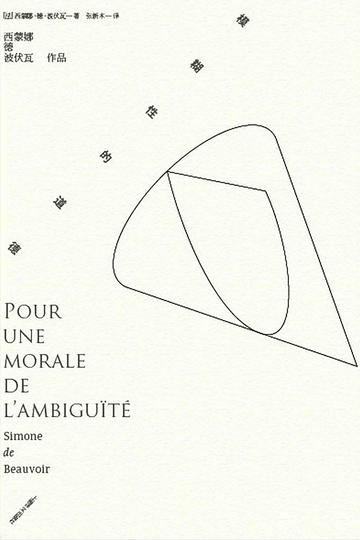
This book contains two essays, which are an introduction to Beauvoir's existential theory. "The Morality of Ambiguity" elaborates on the duality of existence and offers profound reflections on the human condition. Under the influence of Sartre's existentialism, Beauvoir began to study the works of philosophical pioneers such as Hegel, Kierkegaard, and Kant, and gradually formed his own unique existential philosophy and put forward the concept of "ambiguity of existence." She advocates taking on one's own existence, striving for freedom, and letting our existence be in finitude that is open to infinity. As the old proverb says: "No matter what the consequences, do what you have to do." The article "Pyrrhus and Zenas" discusses the scale of human action, the purpose and value of action.
Simone de Beauvoir (1908-1986), French philosopher, writer, and feminist. Passed the French Philosophy Teacher Qualification Examination in 1929 and taught in many schools. In 1945, he co-founded "Modern" magazine with Jean-Paul Sartre, dedicated to promoting existentialist perspectives. The Second Sex was published in 1949, which caused great repercussions and became a feminist classic. In 1954, he won the Prix Goncourt for his novel "The Romance". She, Hannah Arendt and Susan Sontag are known as the three centers of Western women's scholarship.
Reader comments
Ambiguous morality means that when people face certain ethical and moral issues, they are unable to make clear judgments and decisions due to lack of sufficient information, experience or knowledge. In this case, various views and positions may have certain rationality and feasibility, but they may also conflict with each other and be difficult to reconcile. In this book, the author conducts in-depth discussions and reflections on some ethical and moral areas, establishes consensus and balance, and formulates rules and decisions that are as accurate and fair as possible to protect and promote the well-being of humans and other living things.
While reading this book, I clearly felt that many of the author's ideas were very similar to mine. Sometimes I would think the same way, but I was too lazy to write them down. Of course, in a large social environment, the development of philosophy must be based on complete knowledge, scientific development, and the summary of predecessors. The author has his own unique existential philosophy, advocating taking responsibility for one's own existence, striving for freedom, and letting our existence be in a finite state that is open to infinity. This book is very inspiring for readers to think. After reading it, I also reflected on how people should live with themselves and get along with others when they live in the present.
It explains some moral issues in society, and at the same time shows us some problems that may exist in society, so that we can better understand morality and understand ourselves. In this ambiguous era, everyone has different judgment methods for their own moral standards. At the same time, they have various differences in their daily life, including study and life, as well as interpersonal relationships, etc. This book explains some methods in an easy-to-understand manner so that we can maintain the morality in our hearts.




Ambiguous morality means that when people face certain ethical and moral issues, they are unable to make clear judgments and decisions due to lack of sufficient information, experience or knowledge. In this case, various views and positions may have certain rationality and feasibility, but they may also conflict with each other and be difficult to reconcile. In this book, the author conducts in-depth discussions and reflections on some ethical and moral areas, establishes consensus and balance, and formulates rules and decisions that are as accurate and fair as possible to protect and promote the well-being of humans and other living things.
While reading this book, I clearly felt that many of the author's ideas were very similar to mine. Sometimes I would think the same way, but I was too lazy to write them down. Of course, in a large social environment, the development of philosophy must be based on complete knowledge, scientific development, and the summary of predecessors. The author has his own unique existential philosophy, advocating taking responsibility for one's own existence, striving for freedom, and letting our existence be in a finite state that is open to infinity. This book is very inspiring for readers to think. After reading it, I also reflected on how people should live with themselves and get along with others when they live in the present.
It explains some moral issues in society, and at the same time shows us some problems that may exist in society, so that we can better understand morality and understand ourselves. In this ambiguous era, everyone has different judgment methods for their own moral standards. At the same time, they have various differences in their daily life, including study and life, as well as interpersonal relationships, etc. This book explains some methods in an easy-to-understand manner so that we can maintain the morality in our hearts.
Better to read than I expected