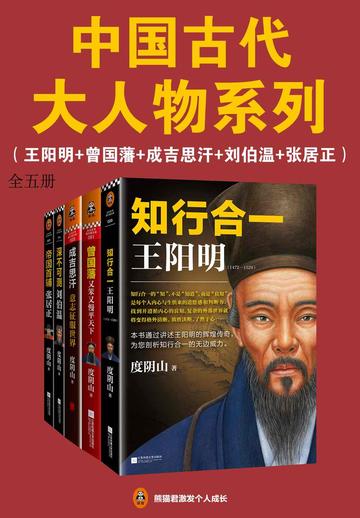
Five classic biographies of the famous historical writer Du Yinshan! Wang Yangming + Zeng Guofan + Liu Bowen + Genghis Khan + Zhang Juzheng! Uncover the legendary lives of great figures and appreciate the thousand-year wisdom of the Chinese people.
"Emperor Master Liu Bowen": Zhuge Liang divides the world into three parts, and Liu Bowen rules the country. In terms of achievements, Liu Bowen was far superior to Zhuge Liang; in terms of military ability, Liu Bowen far surpassed Xiao He, helping Zhu Yuanzhang conquer the Yuan Dynasty in only eight years; in terms of governance ability, Liu Bowen was stronger than Zhang Liang, setting the pattern of the Ming Empire's prosperity for the next two hundred years. A "Shaobing Song" has been handed down from generation to generation, which adds to its legendary color.
"The Unity of Knowledge and Action by Wang Yangming (1472-1529)": In the wild Longchang, Wang Yangming realized that "the way of the sage, my nature is self-sufficient", that is, everyone has a conscience. In the bloody battlefield and dangerous court, what makes Longchang Enlightenment actually work is the "unity of knowledge and action", that is, following the inner conscience, one can achieve a state of tranquility within and invincibility from the outside. If the study of mind is the skill of sages, then the unity of knowledge and action is worldly wisdom. The unity of knowledge and action does not come from sudden enlightenment, but is a realm of life that is finally forged through continuous reflection and practice in hardships.
"Genghis Khan: Will Conquers the World": He lost his father at the age of nine, was abandoned by his tribe and tribes, fell into the abyss of pain from his noble family, and almost starved to death in the wilderness; six or seven years later, he was captured by his mortal enemy Taichiwu, and escaped from death, returning to the road of exile, and all his savings of several years were destroyed; at the age of 41, Genghis Khan, who had already unified the Mongolian tribes, was defeated again, only to The remaining 19 people followed him... However, Genghis Khan relied on his amazing will to withstand the blows of failure again and again. Each time he was able to quickly squeeze the enemy's experience and strength in a short period of time and come back with a stronger self; through continuous bloody battles, he swept across the Eurasian continent with very few troops and created the world's largest empire - the Mongol Empire. At its peak, the Mongol Empire covered half of the world at that time, including more than 40 countries and 720 ethnic groups.
"Zhang Juzheng, the Chief Assistant of the Ming Dynasty": Zhang Juzheng, who first entered officialdom at the age of 23, was an upright idealist. However, after experiencing the bloody cabinet struggle, he deeply understood what politics was and embarked on a pragmatic path to achieve his goals by any means. Regardless of the contempt of his colleagues, he colluded with the eunuch Feng Bao, ascended to the position of chief assistant, won the trust of the emperor and the queen mother, and paved the way for the great cause of reform. He appeased the border garrison generals by collecting large amounts of bribes, appointed the corrupt official Yin Zhengmao to quell the rebellion in the southwest, and completely solved the long-standing border war troubles. Taking advantage of the emperor's young age, he used the name of the emperor's master to authorize and exercise power. He changed the decadent habits of the officialdom and made the government orders "even though they were thousands of miles away, they were implemented day and night." Using the excuse of resigning, he coerced the young emperor into issuing an edict to eradicate his opponents one by one, thus successfully implementing the New Deal and reversing the empire's financial crisis in one fell swoop.
"Zeng Guofan: Clumsy and Slow": Zeng Guofan looks slow in doing things, but he is actually the fastest. Because this is a solid death kung fu that leaves no hidden dangers. Over time, no one can surpass it. Zeng Guofan did not do anything opportunistically, and he took this "clumsy" philosophy to the extreme in fighting.
Reader comments
There is no Zhang Juzheng in the world!
The principle of "unity of knowledge and action" that he realized in difficult situations is really inspiring. I think about my own life. Sometimes we think well, but it is difficult to do it. If you can combine thoughts and actions and follow your inner conscience like Wang Yangming did, it may be easier to achieve your goals. I think this book can not only help us understand history, but also learn a lot of life wisdom.




There is no Zhang Juzheng in the world!
The principle of "unity of knowledge and action" that he realized in difficult situations is really inspiring. I think about my own life. Sometimes we think well, but it is difficult to do it. If you can combine thoughts and actions and follow your inner conscience like Wang Yangming did, it may be easier to achieve your goals. I think this book can not only help us understand history, but also learn a lot of life wisdom.