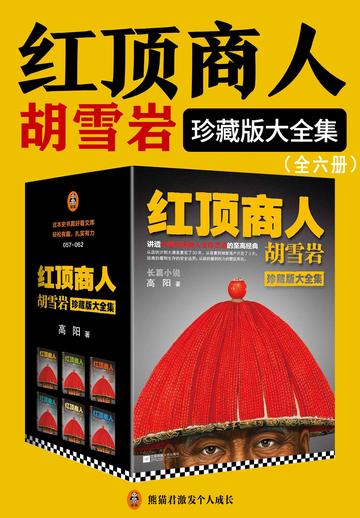
The ultimate classic that explains the survival methods of traditional Chinese businessmen! It took 30 years to go from a store clerk to the richest man in the Qing Dynasty, and only 3 days to go bankrupt! Those in business see the safe boundaries of survival, and those in politics see the minefields of power! Open this book to understand the bureaucracy and the genius and destiny of a generation of business sages!
Born in poverty, he met his patrons: Hu Xueyan, the richest man in the Qing Dynasty, came from a poor family when he was young, and made a living by herding cattle for others; at the age of 14, Hu Xueyan entered a bank to do odd jobs, sweeping the floor and emptying urinals. He was appreciated by his boss and promoted to a streetwalker; at the age of 26, he met the noble man in his life - Wang Youling.
Starting a business with public funds and wearing a red hat: At the age of 27, Hu Xueyan opened a bank with the support of Wang Youling, and interacted with people in the officialdom, and soon became a wealthy man in Hangzhou; at the age of 38, Wang Youling committed suicide after defeat, and Hu Xueyan changed his name to At the age of 49, Hu Xueyan started a shipyard, raised military expenses, and opened a pharmacy, and he became rich all over the world. At the age of 58, because of his meritorious service in the Western Expedition, Cixi was given a yellow mandarin jacket and was awarded a two-pink red top.
He went bankrupt and died in depression: at the age of 60, the price of silk plummeted, Hu Xueyan's bank failed to close, and Cixi ordered his dismissal and property raids. Within three days, Hu Xueyan was penniless and became a victim of political struggle. At the age of 62, Hu Xueyan died in depression, and his bones were buried in a pile of rocks in the western suburbs of Hangzhou.
Reader comments
The result is actually more tragic than in the book, but Mr. Gao Yang interspersed it with some stories to make it easier for everyone to accept, and it also better shows his character. He remains calm in the face of defeat and finds joy in suffering. The whole book is also interspersed with many thoughts of college students, about business, friends, current situation, and society. It is full of wisdom in life. It is like drinking sweet wine, with endless aftertaste~
Hu Xueyan (1823-1885), formerly known as Hu Huai, with the courtesy name Xueyan and the nickname Manyan, was a businessman and industrialist during the Qing Dynasty in China and one of the important figures in the history of Chinese business. He was born in a poor family in Quanzhou City, Fujian Province, and made a living by farming since he was a child. His business empire was based in Fujian and gradually expanded to all parts of the country and even across borders. His business interests involved tea trade, textile industry, finance, real estate, shipbuilding and other fields, making him one of the richest and most influential businessmen in China at that time.
The whole set of books takes Hu Xueyan, a famous businessman in history, as the theme. Through detailed descriptions and carefully constructed stories, it presents readers with a wonderful and legendary business world.
Hu Xueyan was a business tycoon in Qing Dynasty China who started out as a hawker and gradually accumulated wealth and became a business emperor. This set of books is based on his life and provides an in-depth exploration of his business strategies, family legacy, and impact on society and history.
The value of Hu Xueyan's biography lies not only in the restoration of historical figures and business history, but also in the enlightenment of business wisdom and ways of thinking. Through Hu Xueyan's story, readers can learn a lot of business success experiences and lessons, and think about how to develop their own careers in modern society.
"Red-top businessman" is Hu Xueyan's most well-known label, and was later widely used for businessmen who obtained resources through government connections. Hu Xueyan is well versed in politics. China's political system determines that the most scarce resources and the ultimate control of resources are in the hands of the supreme ruler. Only by dealing with high-ranking government officials can one make big money. But what he overlooked was that the final property rights of the fixed assets and money he obtained were still in the hands of the government. Hu Xueyan's story allows us to see from the side why China failed to achieve capitalist prosperity at that time.
Hu Xueyan started as a bank boy and gradually distinguished himself in the business field with his intelligence, keen business sense and adventurous spirit. He has a deep understanding of human nature and is good at making friends with all kinds of people. Whether they are official dignitaries or political heroes, he can establish a deep relationship with him. These network resources provide many conveniences for his business development, allowing him to make the best of both worlds in a complex business environment and continuously expand his business. From Qianzhuang, grain business, to silk industry, to arms, and other fields, his business grew bigger and bigger, and he became a famous wealthy businessman at that time. It can be said that "business is prosperous all over the world, and wealth reaches Sanjiang." His business achievements and personality charm are amazing.
However, he was not only satisfied with business success, but also actively participated in officialdom. He wore a red hat and became a special figure who was both a businessman and an official. On the one hand, this brought him more privileges and opportunities for business, but on the other hand, it also plunged him into official disputes and political whirlpools. In that turbulent era, the unstable political situation and official corruption eventually became the triggers of his decline. When the backer fell, political opponents ostracized him and business competitors suppressed him one after another. The business empire that Hu Xueyan had worked so hard to build collapsed in a short period of time, which was very disappointing.
He was the richest man in the Qing Dynasty; in that era when everything was low-grade and only high-achieving students were educated, how did he manage to maneuver between the court and the shopping malls, gain power and make money? Not only that, Hu Xueyan's life was full of ups and downs; he went from being the richest man to becoming bankrupt in just a few days. His turbulent personal destiny also implicated the national fate of the Qing Empire. The author summarizes the turbulent life of this business prodigy as a passing cloud. Indeed, anyone who has experienced an experience like his will not only have a huge sense of emptiness about fame and fortune.
This book made me realize: At that time, the transportation between Sichuan and other provinces was the most inconvenient. Carrying large amounts of cash in and out of Sichuan was not only troublesome, but also risky. So Lei Lutai initiated the exchange method, where Rishengchang's cashier issued the check, and the check was redeemed at the designated location with the bank number. Of course, there is a fee for remittance, which is called "Huishui". There is no fixed quota for water collection, which is calculated based on three factors. First, the distance of the journey. Far away is expensive, close is cheap. Second, the tightness of the money. Generally speaking, it is cheaper to transfer money from a small place to a big place, and it is more expensive to transfer money from a big place to a small place. Because money is loose in a big place, and money is tight in a small place. If there is a shortage of cash somewhere and there are bills of exchange to be redeemed, then there will be customers making remittances at this time, which is just a relief, but some will in turn supplement the customers' remittance fees.
This book is so wonderful! Mr. Gao Yang's writing style is really amazing. He told Hu Xueyan's story so vividly that I felt like I was actually there. I especially like the plot in the book about Hu Xueyan from being born in poverty to wearing a red hat. His struggle is admirable. This book not only shows the vicissitudes of the shopping mall, but also reveals the cruelty of the power struggle. Worth reading!
The overall effect is very good, especially the first and sixth parts, which are ups and downs and exciting, but the middle parts are a bit complicated, and many stories and characters have no continuity. For example, several characters in Fukang, as well as Yu Si, You Wu, Liu Bucai, etc. Are not explained clearly, and they disappear without being mentioned, so that readers cannot know the final ending, which is also a pity. Another thing is that some of the stories are a bit lengthy and some are told over and over again, which is also a slight shortcoming. If there is anything wrong, please forgive me.
Hu Xueyan is a traditional businessman who relies on power to survive. He worked as an apprentice in a bank, and was later entrusted by the shopkeeper to become the first pot of gold. Later, he spent money to help Wang Youling fill his official position. From then on, they got to know each other. With the support of the government, Hu Xueyan's business grew bigger and bigger, acquiring pharmacies, banks and other stores. As the relationship developed, the relationship between the two became closer. With Wang Youling's rise, Hu Xueyan also became more prosperous. In terms of traditional enterprises, Sheng Xuanhuai may not be as good as Hu Xueyan, but he surpasses Hu Xueyan in the new economy, as mentioned in the article Telegraph. Zuo Zongtang initially refused when Sheng Xuanhuai applied to start the telegraph industry. He did not give up his persuasion. Later, Zuo Zongtang changed his attitude and urged the completion of the project. It was precisely because of his mastery of the telegraph industry that Sheng Xuanhuai became a powerful official and businessman. The two are mortal enemies of each other in business. What they have in common is their reliance on power, and neither of them can escape decline in the end. Once the rights are lost, all the foundations will collapse quickly without external force. Hu Xueyan became a red top purely relying on rights. The most obvious thing is that he seeks benevolence and gains.
This book is very suitable for businessmen to read. It contains many overall views on doing business and perspectives on understanding and employing people. It is worth reading.
I am not a businessman, so I am more interested in the conduct and words of people;
In the book, "You should only speak a few words to people, but don't throw everything away." I really understand it. I used to trust my colleagues too much at work, and in the end I was stabbed in the back so hard that I almost lost my job. Colleagues are colleagues, and there is competition among everyone. Never show all your cards, and keep a low profile. When getting along with others, be careful not to talk lightly. If you trust others too much, you will give them the opportunity to hurt you. It is better to know some things yourself.
Long experience, Hu Xueyan's wealth empire is somewhat legendary. After meeting Wang Youling, and then working for Zuo Zongtang, from struggling to start a business to becoming extremely wealthy, at first glance, I felt that he had been gambling. Only later did I realize that his gambling has a down-to-earth meaning. A very realistic book can bring wisdom to people.
It's wonderful and I've learned a lot, thank you author!
The writing style is simple, the content is true, and it is highly readable.
Hu Xueyan (1823-1885), formerly known as Hu Huai, with the courtesy name Xueyan and the nickname Manyan, was a businessman and industrialist during the Qing Dynasty in China and one of the important figures in the history of Chinese business. He was born in a poor family in Quanzhou City, Fujian Province, and made a living by farming since he was a child. His business empire was based in Fujian and gradually expanded to all parts of the country and even across borders. His business interests involved tea trade, textile industry, finance, real estate, shipbuilding and other fields, making him one of the richest and most influential businessmen in China at that time.
You should learn from Du Yuesheng as a person, and Hu Xueyan as a businessman. It took Hu Xueyan 30 years to grow from a shop assistant to a wealthy man in the Qing Dynasty, and it only took him 9 days to lose everything! "Where there is well water, there is Jin Yong, and where there is village and town, there is Gao Yang. Gao Yang is indeed a good writer of historical novels. This book reproduces the glory and fate of a generation of business saint Hu Xueyan Destiny. His moral character and good manners are the basic conditions for him to become the richest man. However, on the other hand, politics and business are not separated, and the influence of politics on the economy is the main reason for Hu Xueyan's ultimate failure, which is sad but reasonable...
It took 30 years to go from a store clerk to the richest man in the Qing Dynasty, and only 3 days to go bankrupt! Who is he? He is Hu Xueyan. The author of this book uses real stories, detailed language, and rigorous information to explain the survival methods of traditional Chinese businessmen. Under the bureaucracy, Hu Xueyan was born in poverty, his family was poor when he was young, and he made a living by herding cattle for others; at the age of 14, Hu Xueyan entered a bank to do odd jobs, sweeping floors and emptying urinals. He was appreciated by his boss and promoted to street running; at the age of 26, he met the noble man in his life - Wang Youling, started a business with public funds, and wore a red hat... His life was a legendary life with Chinese feudal colors. This book is not only beneficial to business people, but also to politicians.
Hu Xueyan, from unknown to wealthy, what is the reason for his success? Bole's appreciation is just the icing on the cake. The most important thing is that he is good at dancing and has a unique vision. He is especially good at dealing with people. He was able to open banks and pharmacies and raise military expenses in the late Qing Dynasty when the economy was depressed... Open this book and follow the protagonist to grow up. The author's writing is profound and he can vividly portray the characters on the page in just a few words. The language is vivid, the dialect is appropriate, and has local characteristics. It uses events to make sense, is clear and concise, and fascinating.
The dialect is very friendly, and the language and culture of Jiangsu and Zhejiang have been seriously invaded.
A very favorite book! The characters are vivid and revealing, and the author has profound expressive skills. I benefited from reading it twice.
In the past, a certain book was called a literary novel. I feel that this title is very appropriate for Mr. Gao Yang's "Hu Xueyan".
Why are many characters who appeared in the back part missing, such as Chen Shilong, Liu Bucai, Ji Heling, Furong, etc. It stands to reason that Hu Xueyan should have performed something when he was down and out.
This book is definitely a classic and not suitable for children. Young people will not read Water Margin, middle school students will not read Red Top, and old people will not read Three Kingdoms.
Gao Yang's writing is delicate and accurate, in the style of an ancient literati
Very nice. I have also read multiple versions of the red-top businessman Hu Xueyan. The plots are varied and the rewards are great!





The result is actually more tragic than in the book, but Mr. Gao Yang interspersed it with some stories to make it easier for everyone to accept, and it also better shows his character. He remains calm in the face of defeat and finds joy in suffering. The whole book is also interspersed with many thoughts of college students, about business, friends, current situation, and society. It is full of wisdom in life. It is like drinking sweet wine, with endless aftertaste~
Hu Xueyan (1823-1885), formerly known as Hu Huai, with the courtesy name Xueyan and the nickname Manyan, was a businessman and industrialist during the Qing Dynasty in China and one of the important figures in the history of Chinese business. He was born in a poor family in Quanzhou City, Fujian Province, and made a living by farming since he was a child. His business empire was based in Fujian and gradually expanded to all parts of the country and even across borders. His business interests involved tea trade, textile industry, finance, real estate, shipbuilding and other fields, making him one of the richest and most influential businessmen in China at that time.
The whole set of books takes Hu Xueyan, a famous businessman in history, as the theme. Through detailed descriptions and carefully constructed stories, it presents readers with a wonderful and legendary business world. Hu Xueyan was a business tycoon in Qing Dynasty China who started out as a hawker and gradually accumulated wealth and became a business emperor. This set of books is based on his life and provides an in-depth exploration of his business strategies, family legacy, and impact on society and history. The value of Hu Xueyan's biography lies not only in the restoration of historical figures and business history, but also in the enlightenment of business wisdom and ways of thinking. Through Hu Xueyan's story, readers can learn a lot of business success experiences and lessons, and think about how to develop their own careers in modern society.
"Red-top businessman" is Hu Xueyan's most well-known label, and was later widely used for businessmen who obtained resources through government connections. Hu Xueyan is well versed in politics. China's political system determines that the most scarce resources and the ultimate control of resources are in the hands of the supreme ruler. Only by dealing with high-ranking government officials can one make big money. But what he overlooked was that the final property rights of the fixed assets and money he obtained were still in the hands of the government. Hu Xueyan's story allows us to see from the side why China failed to achieve capitalist prosperity at that time.
Hu Xueyan started as a bank boy and gradually distinguished himself in the business field with his intelligence, keen business sense and adventurous spirit. He has a deep understanding of human nature and is good at making friends with all kinds of people. Whether they are official dignitaries or political heroes, he can establish a deep relationship with him. These network resources provide many conveniences for his business development, allowing him to make the best of both worlds in a complex business environment and continuously expand his business. From Qianzhuang, grain business, to silk industry, to arms, and other fields, his business grew bigger and bigger, and he became a famous wealthy businessman at that time. It can be said that "business is prosperous all over the world, and wealth reaches Sanjiang." His business achievements and personality charm are amazing. However, he was not only satisfied with business success, but also actively participated in officialdom. He wore a red hat and became a special figure who was both a businessman and an official. On the one hand, this brought him more privileges and opportunities for business, but on the other hand, it also plunged him into official disputes and political whirlpools. In that turbulent era, the unstable political situation and official corruption eventually became the triggers of his decline. When the backer fell, political opponents ostracized him and business competitors suppressed him one after another. The business empire that Hu Xueyan had worked so hard to build collapsed in a short period of time, which was very disappointing.
He was the richest man in the Qing Dynasty; in that era when everything was low-grade and only high-achieving students were educated, how did he manage to maneuver between the court and the shopping malls, gain power and make money? Not only that, Hu Xueyan's life was full of ups and downs; he went from being the richest man to becoming bankrupt in just a few days. His turbulent personal destiny also implicated the national fate of the Qing Empire. The author summarizes the turbulent life of this business prodigy as a passing cloud. Indeed, anyone who has experienced an experience like his will not only have a huge sense of emptiness about fame and fortune.
This book made me realize: At that time, the transportation between Sichuan and other provinces was the most inconvenient. Carrying large amounts of cash in and out of Sichuan was not only troublesome, but also risky. So Lei Lutai initiated the exchange method, where Rishengchang's cashier issued the check, and the check was redeemed at the designated location with the bank number. Of course, there is a fee for remittance, which is called "Huishui". There is no fixed quota for water collection, which is calculated based on three factors. First, the distance of the journey. Far away is expensive, close is cheap. Second, the tightness of the money. Generally speaking, it is cheaper to transfer money from a small place to a big place, and it is more expensive to transfer money from a big place to a small place. Because money is loose in a big place, and money is tight in a small place. If there is a shortage of cash somewhere and there are bills of exchange to be redeemed, then there will be customers making remittances at this time, which is just a relief, but some will in turn supplement the customers' remittance fees.
This book is so wonderful! Mr. Gao Yang's writing style is really amazing. He told Hu Xueyan's story so vividly that I felt like I was actually there. I especially like the plot in the book about Hu Xueyan from being born in poverty to wearing a red hat. His struggle is admirable. This book not only shows the vicissitudes of the shopping mall, but also reveals the cruelty of the power struggle. Worth reading!
The overall effect is very good, especially the first and sixth parts, which are ups and downs and exciting, but the middle parts are a bit complicated, and many stories and characters have no continuity. For example, several characters in Fukang, as well as Yu Si, You Wu, Liu Bucai, etc. Are not explained clearly, and they disappear without being mentioned, so that readers cannot know the final ending, which is also a pity. Another thing is that some of the stories are a bit lengthy and some are told over and over again, which is also a slight shortcoming. If there is anything wrong, please forgive me.
Hu Xueyan is a traditional businessman who relies on power to survive. He worked as an apprentice in a bank, and was later entrusted by the shopkeeper to become the first pot of gold. Later, he spent money to help Wang Youling fill his official position. From then on, they got to know each other. With the support of the government, Hu Xueyan's business grew bigger and bigger, acquiring pharmacies, banks and other stores. As the relationship developed, the relationship between the two became closer. With Wang Youling's rise, Hu Xueyan also became more prosperous. In terms of traditional enterprises, Sheng Xuanhuai may not be as good as Hu Xueyan, but he surpasses Hu Xueyan in the new economy, as mentioned in the article Telegraph. Zuo Zongtang initially refused when Sheng Xuanhuai applied to start the telegraph industry. He did not give up his persuasion. Later, Zuo Zongtang changed his attitude and urged the completion of the project. It was precisely because of his mastery of the telegraph industry that Sheng Xuanhuai became a powerful official and businessman. The two are mortal enemies of each other in business. What they have in common is their reliance on power, and neither of them can escape decline in the end. Once the rights are lost, all the foundations will collapse quickly without external force. Hu Xueyan became a red top purely relying on rights. The most obvious thing is that he seeks benevolence and gains.
This book is very suitable for businessmen to read. It contains many overall views on doing business and perspectives on understanding and employing people. It is worth reading. I am not a businessman, so I am more interested in the conduct and words of people; In the book, "You should only speak a few words to people, but don't throw everything away." I really understand it. I used to trust my colleagues too much at work, and in the end I was stabbed in the back so hard that I almost lost my job. Colleagues are colleagues, and there is competition among everyone. Never show all your cards, and keep a low profile. When getting along with others, be careful not to talk lightly. If you trust others too much, you will give them the opportunity to hurt you. It is better to know some things yourself.
Long experience, Hu Xueyan's wealth empire is somewhat legendary. After meeting Wang Youling, and then working for Zuo Zongtang, from struggling to start a business to becoming extremely wealthy, at first glance, I felt that he had been gambling. Only later did I realize that his gambling has a down-to-earth meaning. A very realistic book can bring wisdom to people.
It's wonderful and I've learned a lot, thank you author!
The writing style is simple, the content is true, and it is highly readable.
Hu Xueyan (1823-1885), formerly known as Hu Huai, with the courtesy name Xueyan and the nickname Manyan, was a businessman and industrialist during the Qing Dynasty in China and one of the important figures in the history of Chinese business. He was born in a poor family in Quanzhou City, Fujian Province, and made a living by farming since he was a child. His business empire was based in Fujian and gradually expanded to all parts of the country and even across borders. His business interests involved tea trade, textile industry, finance, real estate, shipbuilding and other fields, making him one of the richest and most influential businessmen in China at that time.
You should learn from Du Yuesheng as a person, and Hu Xueyan as a businessman. It took Hu Xueyan 30 years to grow from a shop assistant to a wealthy man in the Qing Dynasty, and it only took him 9 days to lose everything! "Where there is well water, there is Jin Yong, and where there is village and town, there is Gao Yang. Gao Yang is indeed a good writer of historical novels. This book reproduces the glory and fate of a generation of business saint Hu Xueyan Destiny. His moral character and good manners are the basic conditions for him to become the richest man. However, on the other hand, politics and business are not separated, and the influence of politics on the economy is the main reason for Hu Xueyan's ultimate failure, which is sad but reasonable...
It took 30 years to go from a store clerk to the richest man in the Qing Dynasty, and only 3 days to go bankrupt! Who is he? He is Hu Xueyan. The author of this book uses real stories, detailed language, and rigorous information to explain the survival methods of traditional Chinese businessmen. Under the bureaucracy, Hu Xueyan was born in poverty, his family was poor when he was young, and he made a living by herding cattle for others; at the age of 14, Hu Xueyan entered a bank to do odd jobs, sweeping floors and emptying urinals. He was appreciated by his boss and promoted to street running; at the age of 26, he met the noble man in his life - Wang Youling, started a business with public funds, and wore a red hat... His life was a legendary life with Chinese feudal colors. This book is not only beneficial to business people, but also to politicians.
Hu Xueyan, from unknown to wealthy, what is the reason for his success? Bole's appreciation is just the icing on the cake. The most important thing is that he is good at dancing and has a unique vision. He is especially good at dealing with people. He was able to open banks and pharmacies and raise military expenses in the late Qing Dynasty when the economy was depressed... Open this book and follow the protagonist to grow up. The author's writing is profound and he can vividly portray the characters on the page in just a few words. The language is vivid, the dialect is appropriate, and has local characteristics. It uses events to make sense, is clear and concise, and fascinating.
The dialect is very friendly, and the language and culture of Jiangsu and Zhejiang have been seriously invaded.
A very favorite book! The characters are vivid and revealing, and the author has profound expressive skills. I benefited from reading it twice.
In the past, a certain book was called a literary novel. I feel that this title is very appropriate for Mr. Gao Yang's "Hu Xueyan". Why are many characters who appeared in the back part missing, such as Chen Shilong, Liu Bucai, Ji Heling, Furong, etc. It stands to reason that Hu Xueyan should have performed something when he was down and out.
This book is definitely a classic and not suitable for children. Young people will not read Water Margin, middle school students will not read Red Top, and old people will not read Three Kingdoms.
Gao Yang's writing is delicate and accurate, in the style of an ancient literati
Very nice. I have also read multiple versions of the red-top businessman Hu Xueyan. The plots are varied and the rewards are great!
This is the way to do great business
Very exciting, can't bear to put it down
Very good! Wonderful content
Good book, flesh and blood
Gao Yang's masterpiece is well-deserved
The last businessman of the Qing Dynasty