Stats
9.5Score
20Chapters
Tags
Synopsis
Reader comments
In booklists 3

Literary Masterpiece, (ㆁωㆁ)
84.9MViews748Books2dUpdated


World Famous Books
🍅All the world famous books I can find are thrown at me, I can bear it
9.3MViews764Books4dUpdated


Do You Have Any Books to Improve Yourself?
It's just that you can improve yourself or gain knowledge after reading it, and it's not the kind of book that ends after reading and has no benefit.
345.2kViews101Books19dUpdated
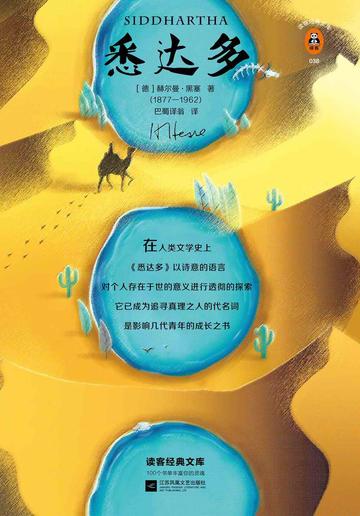
We know very little about Hinduism, and it seems rather obscure and dry, but it seems that we will become Siddhartha at a certain moment while reading this book, but we also know that we cannot be him. My favorite sentence in the book is "Love, Govinda, I think is the most important of all things." Seeing through the world, explaining it, and despising it may be the work of thinkers. But what I care about is to be able to love the world, not despise the world, not hate the world and myself, and be able to observe the world, myself and everything with love, appreciation and awe."
I like it very much, as if my heart is at peace because of it. An aria about life, a lyric about river water. It seems that recently I am more fond of this type of novels, such as "Song of the Humble" and "Siddhartha". The ultimate in love and understanding, and the pursuit of life, are narrated from afar in poetic words. Look at the mountains as mountains, look at the water as water. Looking at mountains is not mountains, looking at water is not water. Look at mountains as mountains, water as water. After many setbacks and tribulations, I realized that the meaning of life is to explore oneself, and only then can I become a Buddha. After thousands of sails, he is still a young man.
This book allowed me to see the changes of Siddhartha in the process of searching for himself. At first, he went to find Atman and followed the Samanas to practice in the forest. Later, he met Gautama. At this time, his friend Govinda converted to Buddhism and broke up with him. Then he entered the world again, and finally chose to escape and find his original thoughts again. He lived with Vasudeva by the river and worked as a ferryman. He met Kamala again and knew that he had a son. He was humble to his son in every possible way. Finally, he understood that he would leave him sooner or later and chose to let go. He also saw the melancholy and reluctance on his father's face when he left home without hesitation. This may be reincarnation. Siddhartha's thought-provoking conversation with Gautama before parting. Sakyamuni's name is Siddhartha Gautama. Their dialogue can be regarded as the dialogue between Sakyamuni before his practice and Sakyamuni after his practice. This is indeed the finishing touch of Hesse's arrangement of the characters' names. Throughout the text, Siddhartha goes from youth to old age, from a Brahmin at the beginning to a ferryman at the end. He finally finds his own "Om". He values things rather than words. Things bring him existence, but his words are often inconsistent. In fact, we are all looking for ourselves and understanding the true meaning of the world. After all, we are jumping from one realm to another. Whether ordinary people in the world or wise people, they are just existences in the world. They can understand everything or choose to accept everything. They can adapt to the world or be suspicious of the world. It was through this repetition and constant exploration that I finally discovered that everything was just a reincarnation. The most impressive sentence: Knowledge can be conveyed, but wisdom cannot. Greatness lies only in life.
May all ruins regain their strength and all deserts bloom again. Life is about experience, good and bad, good and bad, success and failure. It's just an opinion, an experience. So well written. Improve your life and take your time. Tranquility reaches far, mid-stream hits the water, and benefits all things without contending.
Knowledge can be conveyed, but wisdom cannot
After all, people can only find their ideal "residence" in life by themselves. What everyone has experienced must be that person's most precious wealth. Everyone has his own ideas and needs to think, wait, endure, experience, love, and break through like a few people.
This book gave me great ideological shock and inspiration. It is simpler and easier to understand than the Tao Te Ching, but it also contains some Taoist thoughts. Perhaps this is the way that all laws are connected. But I couldn't abandon my parents like him and let them endure this pain. Just because I am me, everyone's path is different. I never picked it up and couldn't let it go. I just know it but I can't do it. Just like the book says that knowledge can convey wisdom but not, I can't achieve the unity of knowledge and action if I have attachments in my heart. But I also learned from it that thinking, waiting, and then entering into the world first!
A great book. We have to experience many things ourselves. Others can only tell you other people's experiences, and you need to go your own way, live in the moment, experience, love, and feel the world. From the dislike at the beginning to the final reincarnation, it's the same. You can't avoid it just because you missed it, and your children are not bad. They are all reincarnations, and they all have their own way to go. No one can accompany someone for a lifetime.
A coming-of-age novel that introduces Siddhartha's journey into the world many times. In line with my understanding. First, there is a noble and transcendent spirit, and then when you enter the world, you can overlook it outside the eternal cycle. Understand the unified understanding of the pain and joy of all living beings. Tens of thousands of words in length poetic language
In the past, I almost read it all, but this book is the only one that I can read carefully word for word. After reading it, I feel extremely calm, as if my soul has been sublimated, and I have found my own pure spiritual land in the materialistic modern society!
The human body itself is a body. This body has experienced tens of thousands of years of continuous reincarnation and evolution. Eventually, it can remember various scenes and receive various information. It sees more and more things, and the information it receives becomes more and more complex. In order to process these unknown information, it has to constantly think, recognize, and react. Because there are so many things and information that are unknown and uncertain, people often feel overwhelmed and uneasy. And all of this comes from the outside world. People are too influenced by the outside world. They are often busy processing the information and things sent to them by the outside world, and forget the form of their own existence. "Most people are like fallen leaves, Kamala, fluttering and rolling in the air, and finally swinging to the ground. But there are others, some few people, who are like stars moving along a fixed orbit. No wind can blow them; they have their own laws and orbits."
I was deeply attracted. When I read it, I didn't feel like I was reading a book. I didn't expect the ingenious ideas and writing methods used by the author. Instead, I resonated deeply with Siddhartha and connected Siddhartha's story with some of my own thoughts and experiences. Siddhartha's thinking and insights seemed to point me to some doubts and directions.
"Siddhartha" The pursuit of the spiritual world is far more valuable than material addiction, but life in the world can never be separated from material support. Once material satisfaction is not achieved, there will always be an unbalanced unwillingness in the heart. Now, wait, think ~ understand the wisdom of life, not willing to sink in material life, just want to stick to your love, and strive to pursue the life you want
Love yourself, explore yourself; explore the world, discover the world Knowledge can be taught, but wisdom cannot! Sometimes, waiting is also a very powerful ability! Where there's a will, there's a way!
"Knowledge can be conveyed, but wisdom cannot. People can discover wisdom, experience wisdom, enjoy wisdom, and create miracles with wisdom, but they cannot tell or teach wisdom."
It's okay, maybe my experience is too shallow, and I don't have a deep understanding of some parts, which makes me feel a little obscure. But you can also roughly taste Siddhartha's thinking about reality and his exploration of the meaning of life.
Looking at it with the eyes of a child, simple and hopeless, the world is so beautiful. I no longer compare this world with the world I want to shape, but accept the world, love it, and belong to it. Most people are like fallen leaves, rolling and swaying in the air, and finally staggering back to dust. Some people, a very small number, are like stars in the sky, moving along a fixed orbit. No wind can shake them. They have their own laws and orbits within them. Listen to the rush of drinking water, immerse yourself in the past, and be touched and surrounded by a lifetime of time. The world is not imperfect. The world does not move slowly toward perfection: no, every moment in the world is perfection. All sins carry forgiveness, all children carry the old, all newborns carry the dead, and all dying carry eternal life. Good books are helpful
Read "Siddhartha" and follow the protagonist's life. The book does not promote asceticism or indulgence; it explains Wisdom cannot be taught, it can only be experienced by oneself Siddhartha left the Brahmin family, became an ascetic, and indulged in the world of mortals. Finally, he had an epiphany by the river. The river made him understand that time is not real and that every moment of life exists simultaneously. The enthusiasm in youth, the loss in middle age, and the peace in old age are all part of "me". In the end, he did not become a perfect saint, but a man who truly understood human nature. Perhaps, the way to find yourself is not in the distance, but in every real experience.
It is a novel about the growth of Siddhartha based on religion. It has 5 turning points and is more about the description of the characters. Overall, it is very good. I recommend everyone to watch it. But there are some words that I don't understand. I hope to have a deeper understanding in the future. This is the first novel I have read this year. Goodbye!
"Never mind that these things are illusions or not, I am actually an illusion myself, so they are always the same as me. This is why I like them and respect them: they are all like me. So I can love them. And this is also a doctrine that you may laugh at: Love, Govinda, I Feeling is the most important of all things. It may be a thinker's business to see through the world, explain it, and despise it. But what I care about is to be able to love the world, not to despise the world, not to hate the world and myself, to be able to observe the world, myself and everything with love, appreciation and awe."
To be honest, I forgot about three to four times out of ten after reading the book, and I will probably forget about it tomorrow, but I still want to post a book review. The deepest impression on my mind after reading the book is like going from seeing a mountain as a mountain to seeing a mountain as not a mountain, returning to seeing a mountain as a mountain, retrieving one's own thinking, waiting, and fasting. What everyone throws away will never be found again, and what is found must be a new thing.
Love everything and seek unity. If the true self exists, it is eternal without distracting thoughts. Wisdom comes from experience, not from rivers. Enjoy real emotions, but don't let emotions dominate your consciousness. Time is useless, Nirvana is finally achieved.
This book made me understand that the meaning of life needs to be explored and found by myself. Just like Siddhartha, we can't just enjoy a comfortable life, we must bravely face difficulties and challenges in order to find our true self. I think of a friend of mine who has been studying very hard. Although the process was very hard, he never gave up. This book also made me cherish everything around me more, because the world is beautiful and we must look at it with simplicity and innocence. I think this is a book worth reading, it will bring you a lot of inspiration and thinking.
A book full of wisdom. Because it involves some religion and philosophy, maybe not everyone can see it so thoroughly, but it is still worth reading. The breath of wisdom will seep out from between the lines and reach your heart, making us calm and happy. Siddhartha spent his whole life willingly searching for meaning and salvation and himself on the vast road of life. He went deep into people, experienced the lives of various people, became a layman, and did what a Brahmin son and a Samana must not do, but in this way he understood everything and became a Buddha. If you want to truly understand and realize something, you can't just stay outside of it and learn a lot of thoughts. You have to enter it, and wait until you become one with it, and everything will be perfect.
When I was at my lowest point, I read Siddhartha immersively. It felt a little strange but also a little familiar, and pain and freedom coexisted.
I really understand the meaning of the word calm. Unfortunately, I used to like to live in a way that looks good. I always set up many rules and strive for the beauty of the past. But after I read this book carefully, I seemed to understand a lot. Many waterfalls that once surged in my mind turned into warm hot springs in an instant. I no longer force many people or things.
Knowledge can be conveyed, but wisdom cannot
Siddhartha is you and me, going through every journey of life: youth, old age, passion, faith, confusion, enlightenment, greed, desire, love, family affection, friendship, love and hatred, troubles and joys. After experiencing all of these, you will find that this is a real and thorough life. No one can control it. You can only accept it and be grateful for all the gifts in life, regardless of pain and joy, and live every moment seriously.
A very good book. Some places are obscure and difficult to understand, but sometimes you don't need to delve too deeply into reading. It is rich in philosophy. What does it mean to life? How to be detached? The answer was given. The benevolent sees benevolence and the wise see wisdom. Reading is not in vain if you absorb knowledge.
Cleared up a lot of understanding Om