In the era of Kant, there were two main important theories in European philosophical thought: empiricism developed by Locke, Hume and others, and rationalism by Descartes and others. Empiricists believe that human understanding and knowledge of the world come from human experience, while rationalists believe that human knowledge comes from human reason.
Kant combined the two views to a certain extent. Kant believed that knowledge is obtained by human beings through both senses and reason. Experience is necessary for the generation of knowledge, but it is not the only element. Converting experience into knowledge requires rationality (Kant, like Aristotle, calls this rationality "categories"), and rationality is innate. Human beings obtain external experience through the framework of categories. Without categories, it is impossible to perceive the world. Categories, like experience, are therefore necessary for the acquisition of knowledge. But there are also some factors in the human category that can change human beings' concepts of the world. He realized that things themselves are different from what people see, and people can never know for sure the true appearance of things.
In the Critique of Pure Reason, Kant pointed out that no one can imagine an object existing in a world without time and space, so he emphasized that experience is impossible without time and space, which precede everything else. In addition, Kant also believed that experience must come from outside the mind. In other words, a person can perceive and understand the world around him, but he can never perceive and understand himself, because the generation of knowledge requires three elements: time, space and category.
Reader comments
Kant was an 18th-century German philosopher who is considered one of the most important thinkers in the history of Western philosophy. His philosophical thoughts cover ethics, epistemology, metaphysics and other fields, and have a profound impact on the discussion of morality and human understanding. Kant believed that human beings can only obtain knowledge about the phenomenal world, but cannot obtain direct knowledge about the nature of things. He emphasized that human knowledge is limited by the subject and object of knowledge, and we can only establish objective knowledge through the cooperation of experience and rationality.
This book is very interesting. It introduces Kant's philosophical views and allows me to understand how knowledge comes from. Moreover, the author of this book explains Kant's theory very clearly and is easy to understand. I think Kant is really great. His ideas are unique and he can combine empiricism and rationalism. I want to learn from him, think hard, and use my own wisdom to understand the world.
This is a great man with the starry sky above his head and moral principles shining brightly in his heart forever. This thinker presented all his thinking about knowledge and understanding of reason to the poet in a philosophical and even slightly obscure writing style. He is the Copernicus of human philosophy. They say that if you worship Nietzsche when you are young, it is inevitable, then when you mature, Kant will be an eternal hero. From philosophy, aesthetics to ethics, his insights in Königsberg will last forever.
When it comes to Kant, everyone must be familiar with it. He is a very famous philosopher and thinker. This book tells us the wisdom and thoughts of these great Kant very well, giving us the opportunity to further understand the great men, further communicate with the great men, communicate spiritually, and let us learn the wisdom of the great men. I recommend everyone to read this book. Don't waste this opportunity no matter what. Everyone will benefit a lot.
This book is an illuminating read for readers interested in philosophy and Kant's ideas. This is an in-depth exploration of Kant's philosophical thought. The author explains in detail Kant's main concepts and theories, including pure reason, practical reason and judgment. This book explains complex philosophical concepts in clear and concise language that is easy to understand. It guides readers to think about core questions about human cognition and morality, stimulating in-depth thinking and discussion.
A good book, although there are many things you still don't understand, but you can study it again and again!
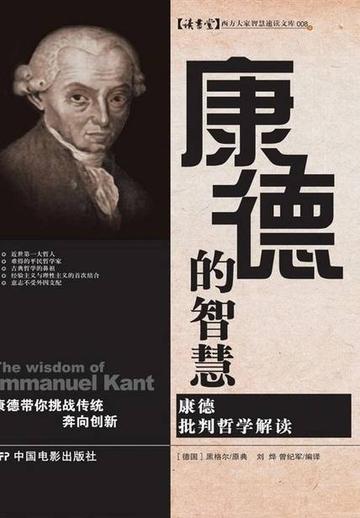



Kant was an 18th-century German philosopher who is considered one of the most important thinkers in the history of Western philosophy. His philosophical thoughts cover ethics, epistemology, metaphysics and other fields, and have a profound impact on the discussion of morality and human understanding. Kant believed that human beings can only obtain knowledge about the phenomenal world, but cannot obtain direct knowledge about the nature of things. He emphasized that human knowledge is limited by the subject and object of knowledge, and we can only establish objective knowledge through the cooperation of experience and rationality.
This book is very interesting. It introduces Kant's philosophical views and allows me to understand how knowledge comes from. Moreover, the author of this book explains Kant's theory very clearly and is easy to understand. I think Kant is really great. His ideas are unique and he can combine empiricism and rationalism. I want to learn from him, think hard, and use my own wisdom to understand the world.
This is a great man with the starry sky above his head and moral principles shining brightly in his heart forever. This thinker presented all his thinking about knowledge and understanding of reason to the poet in a philosophical and even slightly obscure writing style. He is the Copernicus of human philosophy. They say that if you worship Nietzsche when you are young, it is inevitable, then when you mature, Kant will be an eternal hero. From philosophy, aesthetics to ethics, his insights in Königsberg will last forever.
When it comes to Kant, everyone must be familiar with it. He is a very famous philosopher and thinker. This book tells us the wisdom and thoughts of these great Kant very well, giving us the opportunity to further understand the great men, further communicate with the great men, communicate spiritually, and let us learn the wisdom of the great men. I recommend everyone to read this book. Don't waste this opportunity no matter what. Everyone will benefit a lot.
This book is an illuminating read for readers interested in philosophy and Kant's ideas. This is an in-depth exploration of Kant's philosophical thought. The author explains in detail Kant's main concepts and theories, including pure reason, practical reason and judgment. This book explains complex philosophical concepts in clear and concise language that is easy to understand. It guides readers to think about core questions about human cognition and morality, stimulating in-depth thinking and discussion.
A good book, although there are many things you still don't understand, but you can study it again and again!