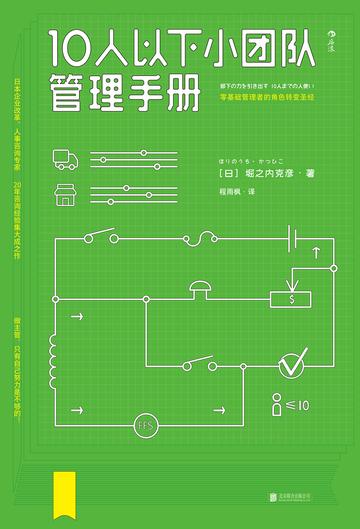
The general manager ordered to double sales, how to communicate it to achieve immediate results? Subordinates always complain about low wages. What can the supervisor do for him? How should supervisors and subordinates distribute the sales tasks of the team? Do supervisors need to deliberately please their subordinates? Is the supervisor responsible for the mistakes of his subordinates? The dissatisfaction of the subordinates is as high as the mountain, the subordinates are not motivated at work, the subordinates want to start their own business...
Mr. Horinouchi Katsuhiko has been engaged in corporate personnel consulting for more than 20 years and has accumulated rich experience in solving employment problems. In response to the confusion and troubles that new small team managers often encounter, he put forward a large number of practical and specific suggestions and methods, and also introduced a powerful theoretical weapon that can help managers make the best use of their subordinates' talents.
If you are a small team manager, if you have encountered similar problems, or if you are worried about whether to take up the position of supervisor because of the above situation, this book will dispel the myths for you and help you lead your team to deliver beautiful report cards!
Reader comments
It took me 2 nights to read it. The content of the entire book is concise, short and easy to understand; the knowledge points are loose and only have a rough framework but not a precise system. The theory in Chapters 1 and 2 is good, and the method in Chapter 5 is okay. Qianqian took notes. 1. Responsibilities of supervisors: achieving the goals of the operator through subordinates. 2. The supervisor's work is roughly divided into business management and employee management, which are subdivided into formulating policies, promoting business, controlling subordinates, assisting leaders, and promoting the PDCA cycle, which is planning → execution → inspection → correction. 3. Motivating subordinates: brainwashing and painting, the four-line diary method provided to strengthen the self-consciousness is good. 4. Tolerance, maintenance and training of subordinates.
Small team management of less than 10 people, a small number of people, can help us achieve management goals as quickly as possible. This book introduces some case studies and practical tools, including the setting and communication of team goals, the allocation of roles and responsibilities among team members, effective communication and collaboration skills, team decision-making and problem-solving methods, and the shaping and maintenance of team culture. To help readers understand and apply management theory and practice, provide guidance and inspiration for small team leaders, and help them build efficient, collaborative and successful teams.
Horinouchi Katsuhiko was born in Tokyo in 1956. After graduating from Keio University's Faculty of Law, he worked for Honda, Sony and other companies. In 1991, he founded Horinouchi Social Insurance and Labor Law Firm and MK Human Resources Consulting Company and served as president. The general manager ordered to double sales, how to communicate it to achieve immediate results? Subordinates always complain about low wages. What can the supervisor do for him? How should supervisors and subordinates distribute the sales tasks of the team? Do supervisors need to deliberately please their subordinates? Is the supervisor responsible for the mistakes of his subordinates? What should I do if my subordinates are dissatisfied and lack motivation at work? Come into this book to find out.
Small teams of less than ten people can be at work or on campus. Nowadays, the atmosphere of flat management on the Internet is small, and teams are getting smaller and smaller. How to manage small teams well is actually a big issue. How to lead the team to achieve good results is the ultimate goal, but you cannot just think about the goal and blindly urge team members to follow your own arrangements. Only by listening to them, cultivating them, and making good use of them can you help the team do better. This book provides a wealth of methods to help small leaders.
Like The Effective Manager, it teaches us how to leverage everyone's strengths in small teams. Moreover, this book reminds me of Tang Seng in "Journey to the West". He led his disciples with different personalities to obtain the true scriptures. Isn't it just like the various challenges we have to face in a small team? However, with this book, I believe we can all become better team managers.
The content of this book is very good. It is an underrated book.
A good book. After reading this book based on my own experience, I discovered my own shortcomings and future development directions.




It took me 2 nights to read it. The content of the entire book is concise, short and easy to understand; the knowledge points are loose and only have a rough framework but not a precise system. The theory in Chapters 1 and 2 is good, and the method in Chapter 5 is okay. Qianqian took notes. 1. Responsibilities of supervisors: achieving the goals of the operator through subordinates. 2. The supervisor's work is roughly divided into business management and employee management, which are subdivided into formulating policies, promoting business, controlling subordinates, assisting leaders, and promoting the PDCA cycle, which is planning → execution → inspection → correction. 3. Motivating subordinates: brainwashing and painting, the four-line diary method provided to strengthen the self-consciousness is good. 4. Tolerance, maintenance and training of subordinates.
Small team management of less than 10 people, a small number of people, can help us achieve management goals as quickly as possible. This book introduces some case studies and practical tools, including the setting and communication of team goals, the allocation of roles and responsibilities among team members, effective communication and collaboration skills, team decision-making and problem-solving methods, and the shaping and maintenance of team culture. To help readers understand and apply management theory and practice, provide guidance and inspiration for small team leaders, and help them build efficient, collaborative and successful teams.
Horinouchi Katsuhiko was born in Tokyo in 1956. After graduating from Keio University's Faculty of Law, he worked for Honda, Sony and other companies. In 1991, he founded Horinouchi Social Insurance and Labor Law Firm and MK Human Resources Consulting Company and served as president. The general manager ordered to double sales, how to communicate it to achieve immediate results? Subordinates always complain about low wages. What can the supervisor do for him? How should supervisors and subordinates distribute the sales tasks of the team? Do supervisors need to deliberately please their subordinates? Is the supervisor responsible for the mistakes of his subordinates? What should I do if my subordinates are dissatisfied and lack motivation at work? Come into this book to find out.
Small teams of less than ten people can be at work or on campus. Nowadays, the atmosphere of flat management on the Internet is small, and teams are getting smaller and smaller. How to manage small teams well is actually a big issue. How to lead the team to achieve good results is the ultimate goal, but you cannot just think about the goal and blindly urge team members to follow your own arrangements. Only by listening to them, cultivating them, and making good use of them can you help the team do better. This book provides a wealth of methods to help small leaders.
Like The Effective Manager, it teaches us how to leverage everyone's strengths in small teams. Moreover, this book reminds me of Tang Seng in "Journey to the West". He led his disciples with different personalities to obtain the true scriptures. Isn't it just like the various challenges we have to face in a small team? However, with this book, I believe we can all become better team managers.
The content of this book is very good. It is an underrated book.
A good book. After reading this book based on my own experience, I discovered my own shortcomings and future development directions.
The method is practical and I took notes.
Practical, affordable, practical
Gave me a lot of management inspiration