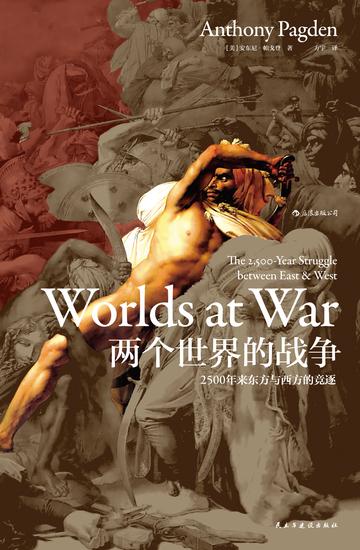
Since the September 11 attacks, Western countries have published a wealth of books examining the roots of terrorism through historical, political, religious, and cultural perspectives. This book brings all these approaches together and offers its own argument: the story must be traced back 2,500 years, to the divide in reality and thought between East and West. Its astonishing sweep across time, subtle analysis of history and ideas, and timely engagement with current affairs earned it the 2008 book award from the Washington Institute for Near East Policy.
The book begins with the Persian king Xerxes’ attempt to conquer Greece, opening a conflict that has never truly ended. Alexander the Great came first, followed by the Romans, each seeking to bring Europe and Asia under a single civilization. As the West converted to Christianity and parts of the East embraced Islam, the two religions became locked in a bitter war, each claiming dominion over the world. By the seventeenth century, as the Christian Church declined, the struggle shifted from religion to philosophy: Westerners guided by scientific reason stood in stark contrast to those seeking God’s ultimate teachings.
During the eighteenth and nineteenth centuries, the great Islamic empires, the Ottoman, Mughal, and Safavid, gradually crumbled, while the West steadily brought much of Asia under its control. This led to attempts to reconcile Islamic life with Western modernity, sparking a conflict between reformers and traditionalists in the Islamic world that continues to this day.
Throughout human history, the wars between East and West have been among the longest and costliest conflicts. They have shaped the modern world in the past, and will continue to shape it in the future.


This book has a unique perspective. It analyzes the conflict between East and West from a historical and ideological perspective. I loved the part in the book where the struggle between West and East moved from religion to philosophy, it gave me a deeper understanding of different cultures. Moreover, the story of Europa mentioned in the book is also very interesting. It made me think about the definition of "West" and "East". In short, this is a thought-provoking and good book, recommended to friends who are interested in history and culture.