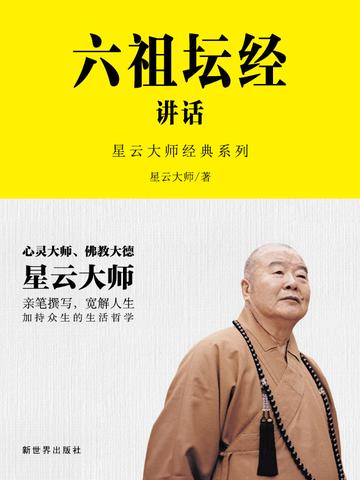
The Sixth Patriarch's Speech on the Altar Sutra
六祖坛经讲话
- Status
- Completed
- Length
- 277k Words
- Updated
- 5y ago
- Source
- Fanqie
Stats
340Reads
9.5Score
16Chapters
141Listens
51.9kReads · all time
Tags
Synopsis
Reader comments
In booklists 2
I'm Looking for Buddhist Dharma Books, the Kind That Are Serious About Delivering People in the Afterlife and the Mighty Heavenly Dragon.
I want to read a book like "I Became a Buddha, I Became a Bodhisattva in the Temple".
8.1MViews151Books3moUpdated
Recommended Books on Confucianism, Buddhism and Taoism
I would like to read books similar to "Taoist Life, Confucian Action, and Buddhist Mind Cultivation Collection (Super Value Platinum Edition)".
287.9kViews243Books2moUpdated
The ancients said: The greatest happiness in life is to stay up late at night and read the Altar Sutra. What is Zen? Zen is not based on words, Zen is the judgment of words, Zen is the original appearance of nature, Zen is our original mind and nature. Zen is not exclusive to monks, nor is it only practiced by old monks in ancient temples in the mountains. Because Zen is the nature of the Buddha, everyone can practice Zen. Zen has infinite meaning, infinite content, and infinite realm. If each of us has a little Zen literacy, it will be of great help to the broadening of one's own state of mind, the sublimation of spirit, the cultivation of personality, and the reconciliation of mind and body. "The Dharma Treasure Altar Sutra of the Sixth Patriarch" is an important classic that explains the true nature of everyone. It points out our true life. Therefore, it can also be said to be a treasure book full of life wisdom.
Philosophy has supreme mysteries, and the philosophy of the ancients has always been regarded as a secret by us. Here it is. Zen meditation and enlightenment are even more supreme skills. The meaning of Zen has always been considered unfathomable by us. Here, Master Hsing Yun will work with us to purify our thoughts and psychology, so that the Zen meaning can quietly enter our world without knowing it. Zen meditation and enlightenment can actually be like this. There is no need to cut off one's hair to become a monk, and there is no need to fast and recite the Buddha's name. Read the speeches carefully and understand life. Understand the truth in life and deeply feel the Zen meaning in life.
The Tantra Sutra of the Sixth Patriarch is an important work of Zen Buddhism. It is a record of the words and deeds of the Sixth Patriarch Huineng by his disciples. The Tantra Sutra of the Sixth Patriarch not only plays an extremely important role in the Buddhist world, but is also listed by scholars as one of the classics for exploring Chinese culture along with the Analects of Confucius and Mencius. The Master's lecture on the Tan Sutra of the Sixth Patriarch gave an in-depth and simple explanation of the origin of the Tan Sutra's thoughts, historical value, various versions, cultivation concepts, enlightenment and enlightenment, etc.
The lower the status, the closer to wisdom, because he does not live in form. The higher the status, the closer to wisdom, because it is easier to live in appearance. "The Speech of the Sixth Patriarch's Altar Sutra" says, "The inferiors have superior wisdom, and the superiors have inferior wisdom. If you underestimate others, you will commit immeasurable sins." The translation of the book is: Lower-class people with low status often have real wisdom that is superior to others; while the wisdom of people with high status and high status will also be buried, and sometimes they cannot be used. If you despise others because of this, you will commit immeasurable sins.
Everyone has a pure nature and inherently has Buddha nature, but with this mind, he can become a Buddha. Buddhist thoughts are indescribably exquisite, and the "Sixth Patriarch's Altar Sutra" is the supreme classic of Chinese Zen Buddhism. Fortunately, Master Hsing Yun has provided in-depth explanations and interpretations of the classics. Let's use the thirty-two words in the book as a summary of reading: Reflect on oneself and seek others instead; Self-renewal and constant purification; Practice yourself and don't seek outside; Self-separation, regardless of internal and external aspects. Self-contemplation, seek others instead In the practice concept advocated in the "Sixth Patriarch Altar Sutra", everyone inherently possesses Buddha nature, but it is often obscured by worldly distractions and delusions. Pay less attention to the external environment or accuse others of right and wrong, and observe your own words and deeds, your emotional ups and downs when facing various situations, and your thoughts in the process. Through such continuous self-contemplation, we can discover the areas in our own mind that need to be corrected and improved, and gradually remove the impurities that obscure our Buddha nature, thereby leading to the path to enlightenment. Self-renewal, continuous purification The Sixth Patriarch mentioned that we should adhere to the principle of non-thought. Once we notice that there are delusional thoughts in our daily life, we should eliminate them through our own awareness and practice, so that our hearts will always remain in an ethereal and pure state. In social life, people's hearts are easily contaminated by various bad habits, concepts, etc. Self-renewal is to actively abandon these negative things, just like wiping away the dusty pearls, so that one's own heart can return to its original purity and brightness. This is a continuous and gradual process, and you need to rely on your own strength to actively change and improve yourself. [Practice yourself, don't ask outsiders] But with this intention, I can become a Buddha. Relying on this inherent Buddha-nature, through self-cultivation and practice, we can gain insight into the emptiness of all things in the world without looking for external power or special help. This is similar to a certain extent with Yangming's philosophy of "My mind is self-sufficient and I don't seek anything from outside." Self-awareness needs to be explored and practiced from within oneself, rather than placing hope on external things or others, and relying more on oneself to do, feel, and understand. Self-separation, regardless of internal and external aspects Fame, fortune, and wealth in the world are "appearances" that arise from the harmony of causes and conditions and change momentarily. Neither external things nor inner feelings are eternal. If you are too persistent, you will fall into pain and troubles. My purpose of separation is to get rid of the attachment to these appearances and not to be confused by the superficial phenomena of things. "Don't be happy with things, don't be sad with yourself" is an excellent description of this state.
The famous Buddhist figure Master Hsing Yun explains the Sixth Patriarch's Altar Sutra in modern vernacular. If you are interested in Buddhist philosophy or religious thought, you can read this work carefully. The content not only demonstrates Buddhist thought, but more importantly, you can see how the ancients interpreted and developed a foreign religion in a Chinese way. The content in this work is obviously formed by integrating my country's localized Confucian and Taoist thoughts. It has a very obvious Chinese character of Buddhism.
After reading the "Sixth Patriarch's Altar Sutra", I deeply realized the non-attachment and inner peace of Zen Buddhism. The non-attachment advocated by Zen Buddhism helps us maintain inner peace and ease when facing various situations.
A treasure book that unlocks the wisdom of soul life
This book has both the original text and the translation, and more importantly, the interpretation of the original text, which can help readers better understand the essence of the "Sixth Patriarch's Altar Sutra". There are also many stories in it, which are profound and simple, suitable for more readers.
Listen and read this book! It can make people live wisely in the present! Don't worry about all the complicated things and people! Amitabha!
Can purify the heart and generate respect
Good teacher, if you have a Zen mind after hearing this book, it is useless if you don't practice it.
The best in cultivating the mind and character
Not bad, very profitable.
Good, good, good, good, good
To the end, the ultimate method Wuwu does not practice good, Tengteng does not do evil, is silent and stops seeing and hearing, and wanders with no attachment.
Read more classics and do more meritorious deeds.
Beautiful, a life lesson book.
Pay homage to the Sixth Patriarch! ! ! Believe it and follow it!
Very good at enlightening people
Benefit a lot, benefit a lot
Thanks to Master Hsing Yun
Cultivate your own heart, increase your wisdom in life, and be yourself in this life.
The realm of a saint is beyond what we mortals can comment on. The Buddha's compassion is a medicine to save all sentient beings and guide people with superior roots. Because we know that all living beings have different abilities. Medication for illness. If there is no disease, there is no medicine.
Good, good, good, good, good, good, good, good
It is easy to understand, explains the Buddhist principles of the Sixth Patriarch in detail from multiple angles, and compares ancient and modern times, which is very helpful to modern people. I am very teachable! Grateful!
Thank you. Thank you. It's worth watching.
It is helpful to open the book. Master Xingyun answers questions and doubts in a convenient method of ten questions and answers for each article. You need to listen and read it over and over again, and practice it hard! Amitabha
Explain in simple terms and reveal the essence of Zen Buddhism!
I have benefited a lot from reading the Sixth Patriarch's Altar Sutra [Like][Like][Like][Like][Like]