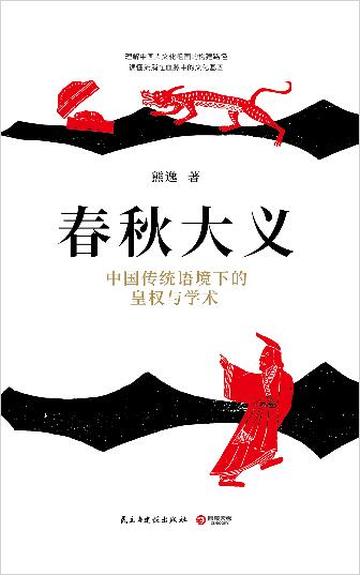
The Great Principles of Spring and Autumn: Imperial Power and Scholarship in Traditional Chinese Thought
春秋大义:中国传统语境下的皇权与学术
- Status
- Completed
- Length
- 92k Words
- Genre
- Historical
- Updated
- 5y ago
- Source
- Fanqie
Synopsis
12Chapters
73Reads
9.3Score
4Listens
4.5kReads · all time
More by this author
In booklists 3
Historical Stories (Any Dynasty, No System, and with Intelligent Characters)
Looking for books like "The Glory of the Great Wei". Historical novels with some brains behind them. Read too many mindless wish-fulfillment stories and they’ll rot your mind.
912Books10.5MViews1dUpdated
Meticulously Researched Historical Fiction
A twisting, suspenseful plot, a protagonist who's not an idiot, and something I can learn from while reading. Ideally, it should be close to real history.
519Books10.6MViews2dUpdated

Any Novels with No Romance or Flirting?
Are there any novels where the protagonist never flirts or gets involved romantically, and just focuses on their career and moving the plot forward? The protagonist should be completely self-sufficient.
206Books551.8kViews1moUpdated
Reader comments 8
Translated by Google Translate
Xiong Yi, one of the important contemporary thinkers in China, is also an ideological hermit, a person who lives in seclusion in the city and concentrates on writing books. Xiong Yi is a pen name, and only a few people know his true face in Lushan. He insisted on using this pen name to dissect traditional Chinese culture and reflect on the cultural motherland of the Chinese people from a modern perspective that combines both Chinese and Western knowledge. He regards this pen name as his precious life and property. Power must always override academics: on the one hand, the emperor's identity is not only the greatest ruler of a country, but also the greatest mentor and the highest high priest; on the other hand, only academics who meet the requirements of power can win in the arena - conversely, in order to win, academics must transform themselves to meet the needs of power, except by chance.
Reading along Xiong Yi's train of thought until the end, there will inevitably be waves of emptiness looming from the end of the pores. Because the so-called righteousness of the Spring and Autumn Period in Xiong Yi's works, through the ages, has become nothing more than a trick used by the autocratic imperial power to control its subjects and ignorant people, no matter how beautiful it is on the surface and how glorious it is on the outside. A Spring and Autumn Classic can be interpreted in countless ways, each of which can be interpreted in its own way. In the end, only Dong Zhongshu remained the academic orthodoxy. There is no other reason than that Dong's solution rationalizes the autocratic imperial power to the greatest extent.
This book is very interesting! The author Xiong Yi is like a storyteller. Starting from a murder case, he reveals the mystery of traditional Chinese culture to us. He allowed me to see the changes in history such as "Spring and Autumn" and other classics, and also talked about the unknown sides of emperors and sages. Moreover, his writing is humorous and humorous, just like chatting with friends, making it easy for people to read. However, I kind of hate those who use classics as tools of power and distort their original meaning. Overall, this is a great book worth reading!
Quotes from side-by-side, and the vast ocean is unbridled. This is the kind of book bag that I like. The main plot is very simple. How the One and Three Legends of Spring and Autumn Period exerted their functions and had radiating influence under the Chinese imperial political system. The actual argumentation process cited many research results from Western political science, anthropology, and psychology for comparison. It corrected a long-standing misunderstanding of mine: the so-called deposing hundreds of schools of thought to favor Confucianism is actually just using the "basket" of Confucianism to contain ideas that are beneficial to one's own rule. There are many differences between the Confucian classics we see now and when they were first proposed.
The author expounds the key elements of history and culture since the Spring and Autumn Period with a vast knowledge base spanning ancient and modern China and the West, and conducts an in-depth dissection of traditional culture and imperial power. So much so that I didn't watch it for the first time. The author uses various quotations and various speculations in his explanation of Confucianism, Taoism, ideology and politics, and his profound knowledge is impressive. This book helped me fill in many gaps in my study of history. This is a good book that you must read several times and take notes on. It's just that the discussion is a bit long-winded, but the shortcomings do not hide the good points. If you want to understand the evolution of Chinese history, you must read this book.
Many of the viewpoints mentioned in this book come from a very novel perspective. You may feel a little confused after a cursory reading, but after careful consideration, you find that this seems to be the case! The interpretation of the Spring and Autumn Period has been one of the classic masterpieces of Confucianism since ancient times. But the author links it with the rule of the country and the authority of the emperor, which is actually an issue that ordinary people will not think about. But in fact, after deposing hundreds of schools of thought to only respect Confucianism, Confucianism has indeed become one of the tools used by rulers to control the minds of the people. What's even more rare is that the text in the book is not serious, but full of humor. It is as comfortable as having a small talk with friends in the house in the afternoon, which is really rare.
The author is good at ancient writing and serious in research and knowledge.
Very wonderfully written