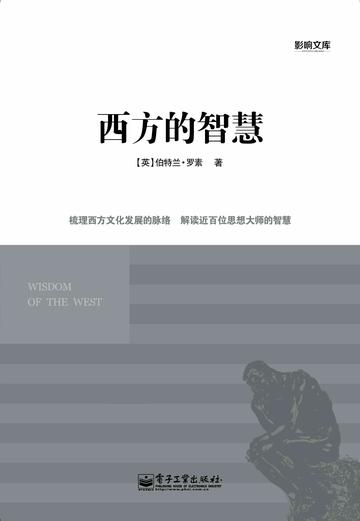
This book is a popular philosophy work, compiled with new ideas based on the mammoth "History of Western Philosophy". In the book, Russell not only elaborates on the causes and consequences of the development of Western philosophy, but also touches on history, science, economics, politics and other aspects.
Reader comments
[All the history of Western philosophy is the history of Greek philosophy. When Russell was 87 years old, he once again wrote a "History of Western Philosophy" that was both popular and well-illustrated. In this book, Russell does not hide his partiality for ancient Greek philosophy at all. More than one-third of the book is devoted to the history of ancient Greek philosophy. Russell prefers Plato among the three masters of ancient Greek philosophy, Socrates, Plato and Aristotle. Although I prefer Plato, I do not deny that Plato was partly influenced by Socrates.
The book mainly tells a complete narrative of Western philosophical concepts, involving knowledge in many fields including science, history, politics, etc., And tells the impact of philosophy on people's thoughts in society at that time. This book runs through the entire development of Western philosophy, with Russell's own thoughts running through it, allowing me to better appreciate the charm and influence of philosophy at that time. The language in the book is fluent and easy to understand, allowing me to understand the causes and consequences behind the profound philosophy and its impact on the government at that time, allowing readers to think involuntarily.
In Russell's view, Western philosophy is Greek philosophy, and the great minds of ancient times have always had an influence on realistic philosophical thinking. Or, as popular saying goes: Western philosophy is just a footnote to Socrates, Plato, and Aristotle. However, Western wisdom is not limited to this. Due to the specialization of knowledge in later generations, many disciplines such as economics, politics, and sociology have been developed based on philosophy. Russell hoped that this book would be a reversal of this trend and examine these complex knowledge in connection with Western philosophy.
History is the best teacher. Although Master Russell's "The Wisdom of the West" is about the history of philosophy, we can see that some philosophers have done many commendable deeds in the long history of history. For example, the highlights of Western philosophy from a series of great figures such as Socrates, Plato, Aristotle, Hegel, and Marx. The book also clarifies the relationship between the inheritance and inheritance of various philosophers and thinkers. The long river of history has been extended through philosophical thought. The author spends a lot of space focusing on the ideas and philosophy behind history that promote historical development. We will also see a complete picture of Western history at the ideological level.
Russell was one of the most important philosophers and mathematicians of the 20th century. He made many contributions to Western wisdom and thought. Russell emphasized the importance and value of science. He believes that through scientific methods, we can obtain objective knowledge and understand the truth of the world. He supports scientific thinking and critical thinking to promote the progress of human society and solve problems. This book is a cultural history book covering ancient Greek philosophy, Christian culture, Renaissance and scientific revolution. This book is easy to understand, comprehensively and systematically introduces the development process of Western culture and thought, and has an important enlightenment effect on understanding and understanding of Western culture.
The Western philosophical tradition is ancient Hellenism since Socrates, and what makes it different from other contemplative behaviors is that it is the origin of all modern science, and its detachment is independent of other disciplines. Russell explores the details, trying to understand their lives from the past philosophical schools, and understand whether the ethical issues about good and evil have changed in form over time. And whether this questioning itself can be called wisdom, a panacea for solving the confusion in life.





[All the history of Western philosophy is the history of Greek philosophy. When Russell was 87 years old, he once again wrote a "History of Western Philosophy" that was both popular and well-illustrated. In this book, Russell does not hide his partiality for ancient Greek philosophy at all. More than one-third of the book is devoted to the history of ancient Greek philosophy. Russell prefers Plato among the three masters of ancient Greek philosophy, Socrates, Plato and Aristotle. Although I prefer Plato, I do not deny that Plato was partly influenced by Socrates.
The book mainly tells a complete narrative of Western philosophical concepts, involving knowledge in many fields including science, history, politics, etc., And tells the impact of philosophy on people's thoughts in society at that time. This book runs through the entire development of Western philosophy, with Russell's own thoughts running through it, allowing me to better appreciate the charm and influence of philosophy at that time. The language in the book is fluent and easy to understand, allowing me to understand the causes and consequences behind the profound philosophy and its impact on the government at that time, allowing readers to think involuntarily.
In Russell's view, Western philosophy is Greek philosophy, and the great minds of ancient times have always had an influence on realistic philosophical thinking. Or, as popular saying goes: Western philosophy is just a footnote to Socrates, Plato, and Aristotle. However, Western wisdom is not limited to this. Due to the specialization of knowledge in later generations, many disciplines such as economics, politics, and sociology have been developed based on philosophy. Russell hoped that this book would be a reversal of this trend and examine these complex knowledge in connection with Western philosophy.
History is the best teacher. Although Master Russell's "The Wisdom of the West" is about the history of philosophy, we can see that some philosophers have done many commendable deeds in the long history of history. For example, the highlights of Western philosophy from a series of great figures such as Socrates, Plato, Aristotle, Hegel, and Marx. The book also clarifies the relationship between the inheritance and inheritance of various philosophers and thinkers. The long river of history has been extended through philosophical thought. The author spends a lot of space focusing on the ideas and philosophy behind history that promote historical development. We will also see a complete picture of Western history at the ideological level.
Russell was one of the most important philosophers and mathematicians of the 20th century. He made many contributions to Western wisdom and thought. Russell emphasized the importance and value of science. He believes that through scientific methods, we can obtain objective knowledge and understand the truth of the world. He supports scientific thinking and critical thinking to promote the progress of human society and solve problems. This book is a cultural history book covering ancient Greek philosophy, Christian culture, Renaissance and scientific revolution. This book is easy to understand, comprehensively and systematically introduces the development process of Western culture and thought, and has an important enlightenment effect on understanding and understanding of Western culture.
The Western philosophical tradition is ancient Hellenism since Socrates, and what makes it different from other contemplative behaviors is that it is the origin of all modern science, and its detachment is independent of other disciplines. Russell explores the details, trying to understand their lives from the past philosophical schools, and understand whether the ethical issues about good and evil have changed in form over time. And whether this questioning itself can be called wisdom, a panacea for solving the confusion in life.