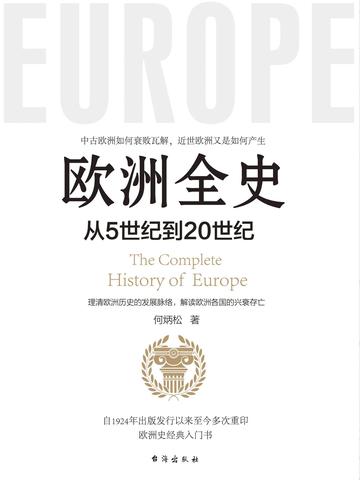
The Whole History of Europe
欧洲全史
- Status
- Completed
- Length
- 421k Words
- Genre
- Historical
- Audience
- Male
- Updated
- 5y ago
- Source
- Fanqie
Stats
188Reads
9.3Score
20Chapters
28Listens
29.9kReads · all time
Tags
Synopsis
Reader comments
In booklists 6
European Historical Fiction.
Modern times and ancient times should not be modern. Don't be too smart, but have a good historical foundation. Europe, no Chinese historical novels
5MViews312Books1dUpdated
If You Are Interested in European Politics and Wars, Don't Focus on Magic and Fantasy, but Focus on History.
I would like to read a book similar to "Welcome to 19th-century Europe where strength is paramount".
3.4MViews195Books2dUpdated
Nice Historical Novel
2.1MViews367Books1dUpdated
Books About All Kinds of Miscellaneous Knowledge, Enough to Be Confusing and Incomprehensible
1.6MViews745Books4dUpdated
Is There Anyone Writing About European Politics and War? Don't Want Magic and Fantasy, but Focus on History.
I would like to read a book similar to "Welcome to 19th-century Europe where strength is paramount".
520.2kViews139Books8dUpdated
Historical Novels
I want to watch content similar to "The Surname Langya". A masterpiece of history! ! ! ! !
369.3kViews241Books1dUpdated
It is always difficult for Chinese people to write or translate Western history. Because unless you have lived in Western society for a long time, it is impossible to be familiar with the subtleties of local history and culture. But what is surprising is that as early as a hundred years ago, Chinese scholars were committed to translating foreign Western social history works into Chinese for domestic students to study, and the quality of the translations was so high that even today's people are ashamed. Those scholars at that time were really talented. They received traditional private school education and had a profound foundation in Chinese studies. They were also the first people to open their eyes to the world. They themselves had broad vision and lofty aspirations. Therefore, the translations produced by them naturally revealed a global perspective.
His integrity can be seen in most of the history books written by modern scholars. Perhaps because of that stormy era, which held so many heavy and painful national memories, most intellectuals at that time wrote articles with an iron-shouldered moral heart. This book is intended to assist students in learning history and is a teaching handout to assist history textbooks. Therefore, it is not difficult to understand the unique organization of this book - unlike other history books, each paragraph of this book has a subtitle, so that the whole book is like a dictionary of European historical entries. It is best to place it next to your pillow or table. You can read a few articles at any time and learn a little bit about Europe.
The text is a bit obscure. The author was a scholar in the early 20th century, so the book is in classical Chinese.
Fortunately, it took me over a week to read this book! I'm in my third year of college and I don't have much time, but I've finished reading it. Overall, the book is a good book, and as a textbook from the Republic of China, compared with today's history textbooks, the text is unfamiliar and the proper nouns are different; such as currency and currency, Germany and the German Empire, Austria and Hungary and the Austro-Hungarian Empire, etc.! Reading this book, I feel like I have traveled back to the Republic of China... Advantages: It uses chronological order, proper nouns or events as subtitles, and is supplemented by small topics. It is worth reading for those who want to understand European history (history from the 5th century AD to the beginning of the 20th century). Others: It is too professional and the author is not from after the founding of New China. He is biased against workers and farmers...~~~
From the European representative system in the 17th century to the waves of European thought and culture in modern times, the earth-shaking changes that have taken place in Europe in modern times are probably beyond the imagination of Europeans in the Middle Ages. Not to mention Chinese readers, their understanding of Europe may only be limited to a few countries and a few major historical events. This book tells the story of the European Middle Ages represented by the feudal system since the founding of the Christian Church, and also includes the Great Navigation, the Reformation, the French Revolution and other major events that affected the course of Europe. Since this is a course handout from the History Department of Peking University, it is also recommended for students who are interested in academic research on European history.
The history of Europe has gradually become clear through the excavation of some new historical materials and cultural relics. Our history of Europe comes from two major types of books. One is the translation of history written by Europe itself, and the other is the history of Europe that we observe through our own eyes, compile and interpret by ourselves. Every kind of history has its advantages and disadvantages, and history books are inevitably integrated with the author's subjective thoughts.
This book is like a patient teacher, taking me through time and space to appreciate the long history of Europe. The detailed discussion of important figures in the book made me feel like I was in that era and experienced the ups and downs with them. Moreover, the language of this book is concise and easy to understand, which is very suitable for beginners like me. If I could have read this book earlier, maybe I would not have neglected my studies, but would have worked harder to pursue my dreams.
This book introduces in great detail the occurrence of major events in Europe from the Middle Ages to modern times. It is often read and updated frequently.
Not bad, I quite like it. The author's writing is very good. It's not the kind with lots of typos and unclear logic.