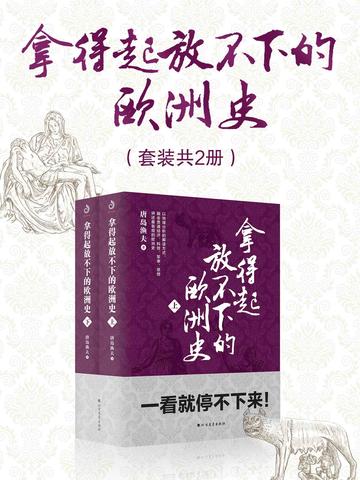
European History You Can't Put Down (2-Book Set)
拿得起放不下的欧洲史(套装共2册)
- Status
- Completed
- Length
- 620k Words
- Genre
- Historical
- Updated
- 5y ago
- Source
- Fanqie
Synopsis
48Chapters
8.6Score
In booklists 3

Historical Novels Set in Europe
Stories set in ancient or modern-era Europe, but not contemporary times. No characters getting dumber for the plot, and a solid grasp of history. European history, not Chinese historical fiction.
283Books5.3MViews4dUpdated

For Fans of Literary Classics
Looking for books similar to "La Dame aux Camélias". I thought this book was pretty well written, so I recommend it!
177Books15.1MViews8dUpdated


Any Books That Could Help a Second-Year Middle Schooler Study History?
My second-year middle-school history textbook is giving me a headache. It is so dry.
88Books262.9kViews28dUpdated
Reader comments 17
Translated by Google Translate
This book made me understand: The past glory of the Romans finally ushered in a stunning moment of glory when it came to Emperor Justinian. Justinian I's conquest of the Mediterranean world seemed quite as heroic as a tiger swallowing thousands of miles. However, for the Eastern Roman Empire, which was in the midst of four wars, its successive victories on the Western Front came at the expense of peace negotiations between the Northern and Eastern Fronts. The Yugoslav tribes in the north are not bad, but the Sasanian Persia in the east is a behemoth in the east of the empire. Compared with the gentle and kind-hearted Parthian Empire, Sasanian Persia was more aggressive, and in terms of legal principles, Sasanian Persia was also known as the superior Achaemenid dynasty. Because of this, Sasanian Persia is rightfully called the "Second Persian Empire" in the history books of modern Iranians.
After visiting various parts of Europe, Tang Dao Fisherman tells the history of Europe in a way that is more familiar to us. Europe also has a very long history in general, starting with the reappearance of ancient Greek writing in the Classical period. From the establishment of the Roman Republic in 509 BC, the dark medieval period, the Renaissance to World War I, World War II and the Cold War, etc. The author carefully and professionally interprets European culture from multiple aspects such as politics, economy, and culture, and looks at the development of European civilization.
This book has a unique perspective, breaking away from the Eurocentric theory of Western scholars and telling the history of Europe from the perspective of macro-world historical development. Based on his own personal experience of living in various European countries for many years, the author tells readers the history of Europe from a traditional Chinese perspective. It has a more "Chinese flavor" and is easy for readers to read and understand. The language is witty and humorous, so that readers will not feel bored while reading. Another highlight is the comprehensive and objective narration of historical events, which will present all historical events, historical figures, historical civilization creation, conflicts of blood and fire in history, etc. In front of readers.
This book provides a unique perspective on European history that is informative and engaging. The author jumped out of the Western-centric theory and gave me a more comprehensive understanding of the development of Europe. The geographical analysis in the book is also very exciting, reminding me of "Guns, Germs, and Steel", both of which explore history from different angles. Moreover, I especially like the interpretation of myths and legends in the book, which makes me seem to see the figures of heroes such as Minos and Rhadamandis. All in all, this is a great book worth reading!
From ancient Greece and Rome to the Middle Ages and modern Europe, too many regime changes and revolutionary events have occurred in this land. In this book, the author provides a comprehensive and in-depth introduction to the important events, cultural changes and political evolution of various periods on the European continent in an easy-to-understand manner. By reading this set of books carefully, we can gain a more detailed and in-depth understanding of European history, broaden our historical horizons, and gain a deep understanding of European cultural, political, and social development.
This book made me understand: The past glory of the Romans finally ushered in a stunning moment of glory when it came to Emperor Justinian. Justinian I's conquest of the Mediterranean world seemed quite as heroic as a tiger swallowing thousands of miles. However, for the Eastern Roman Empire, which was in the midst of four wars, its successive victories on the Western Front came at the expense of peace negotiations between the Northern and Eastern Fronts. The Yugoslav tribes in the north are not bad, but the Sasanian Persia in the east is a behemoth in the east of the empire. Compared with the gentle and kind-hearted Parthian Empire, Sasanian Persia was more aggressive, and in terms of legal principles, Sasanian Persia was also known as the superior Achaemenid dynasty. Because of this, Sasanian Persia is rightfully called the "Second Persian Empire" in the history books of modern Iranians.
This book is very worthy of its name, and it is really hard to put down. Nowadays, many books on European history are written by local Europeans from their perspective. They do not break away from the Eurocentrism of Western scholars and contain their thoughts and opinions. This book is quite different. It tells the history of Europe from China's perspective and from China's perspective, which is eye-catching. Moreover, the author of this book has lived in various European countries for many years and is very rich in both theoretical and practical knowledge. The author's cautious writing style, realistic attitude, and detailed information fascinated me. Readers who like history must not miss it.
Interpreting this period of European history from a Chinese perspective seems to bring a different perspective to readers. A thousand readers will have a thousand Hamlets. The author's perspective on European history is also unique. Because the author lived in Europe, he organized and integrated the history of the European world. It is prosperous and absurd to reflect on this history carefully. He traveled to many countries and cities, saw different styles, saw different things, and had different perceptions of each history. It is a very comprehensive and wonderful world history book.
A very interesting book. The author has traveled all over Southeast Asia, the Middle East, Europe, North America, Latin America and other countries in his career for sixteen years. In "A History of Europe You Can't Put Down," the author tells the history of Europe from a traditional Chinese perspective, combined with his many years of experience in living in European countries. Using the method of geographical analysis, it integrates the economic, technological, military, ideological and other aspects of European countries. At the same time, it uses objective and cold words to unearth the real driving force of European development and the original historical appearance. The whole book is clearly organized and the main line of European historical framework is presented in a concise context. Worth reading.
It lays out the main lines of Europe's historical framework in detail and concisely. The writing is fluent, all in vernacular, and easy to understand. The author's subjectivity is quite obvious in it. I would like to remind beginners to find some books written by academics first. After having a basic understanding of things, avoid staying on the author's point of view. In addition, I still admire Mr. Tang Dao Fisherman. He can remember the names of so many gods in Greek mythology, and he can also clarify the relationship between those gods. I really admire him.