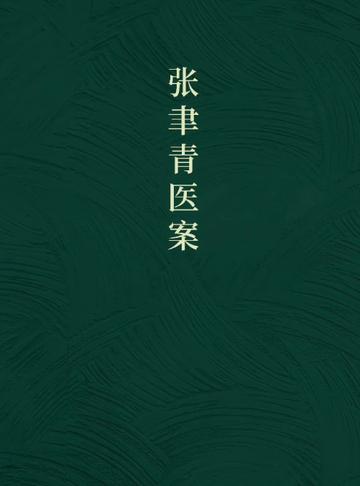
"Medical Cases of Zhang Yuqing" is written by Zhang Naixiu. "Medical Cases of Zhang Yuqing" is the original work of Zhang Naixiu in the Qing Dynasty, which was compiled and edited by his disciple Wu Yuchun (Wen Han).
The book has 20 volumes, including Zhang Yuqing's 1,100 regulations on clinical diagnosis and treatment, organized according to external infections, internal injuries, and miscellaneous diseases, with medical records attached after each disease syndrome. The case selection is rigorous, the records are detailed, the identification is precise, the argument is precise, and the prescriptions are accurate. It records Mr. Zhang Naixiu's clinical experience and medication characteristics with outstanding curative effect. Especially the comments after each case are to the point. It is a medical case monograph with high academic value. It occupies an important position in the history of the development of modern Chinese medicine. It has important guiding significance for improving clinical efficacy and is a must-read book for clinicians.
This book is compiled and published based on the Jiangyin Wu's printed version. In order to facilitate readers' learning, an introduction has been written, and an index of disease and syndrome names is attached at the back of the book for easy reference during study.
Reader comments
This book is very good! Mr. Zhang Yuqing's medical records are very detailed, with fine identification, precise arguments, and precise prescriptions, which are of great academic value. I especially hate those village doctors who pretend to understand and administer medicine randomly. Fortunately, Mr. Zhang Naixiu pointed out the difference between heat syndrome and cold syndrome and their treatment methods in the book. However, it is not easy to gain these experiences after thirty years of experience. This book is really a must-read for clinicians!

This book is very good! Mr. Zhang Yuqing's medical records are very detailed, with fine identification, precise arguments, and precise prescriptions, which are of great academic value. I especially hate those village doctors who pretend to understand and administer medicine randomly. Fortunately, Mr. Zhang Naixiu pointed out the difference between heat syndrome and cold syndrome and their treatment methods in the book. However, it is not easy to gain these experiences after thirty years of experience. This book is really a must-read for clinicians!