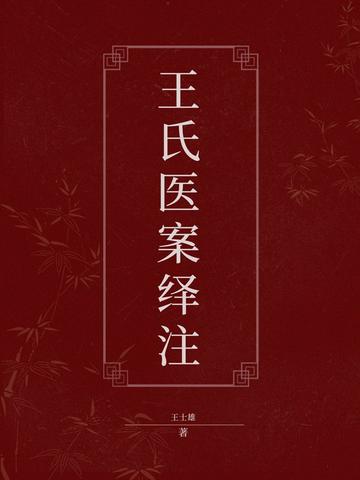
"Explanatory Notes on Wang's Medical Cases", title, ten volumes, with one appendix. It was written by Wang Shixiong in the Qing Dynasty, annotated by Shi Nianzu, and published in 1919.
This book collects Wang's medical cases with detailed annotations. Analyze the condition, identify the pathogenesis, and determine the location of the disease. It is indeed helpful for studying Wang's medical records. There were omissions in the original case such as pulse conditions, illness conditions, prescription dosages, etc. When Shi made the annotation, he would make up for it based on his personal analysis. Its purpose is to help readers understand the spirit of Wang's original case, but it is an inference or subjective opinion, so it is one-sided.
Reader comments
This book is very practical! The author Wang Shixiong is really amazing. His medical case analysis is very detailed, and the condition, pathogenesis, and location of the disease are all explained clearly. I particularly like his distinction between qi and blood, and his emphasis on the sinking pulse. Moreover, this book also emphasizes the importance of syndrome differentiation, which is very helpful for learning traditional Chinese medicine. Shi Nianzu's annotations are also very considerate and add some missing information. However, it should be noted that his inference may be one-sided. All in all, this is a good book worth reading!



This book is very practical! The author Wang Shixiong is really amazing. His medical case analysis is very detailed, and the condition, pathogenesis, and location of the disease are all explained clearly. I particularly like his distinction between qi and blood, and his emphasis on the sinking pulse. Moreover, this book also emphasizes the importance of syndrome differentiation, which is very helpful for learning traditional Chinese medicine. Shi Nianzu's annotations are also very considerate and add some missing information. However, it should be noted that his inference may be one-sided. All in all, this is a good book worth reading!